Disclosure: Some of the links on this site are affiliate links. If you make a purchase through one of them, I may earn a small commission at no extra cost to you. Read my full disclaimer here. Thank you for your support!
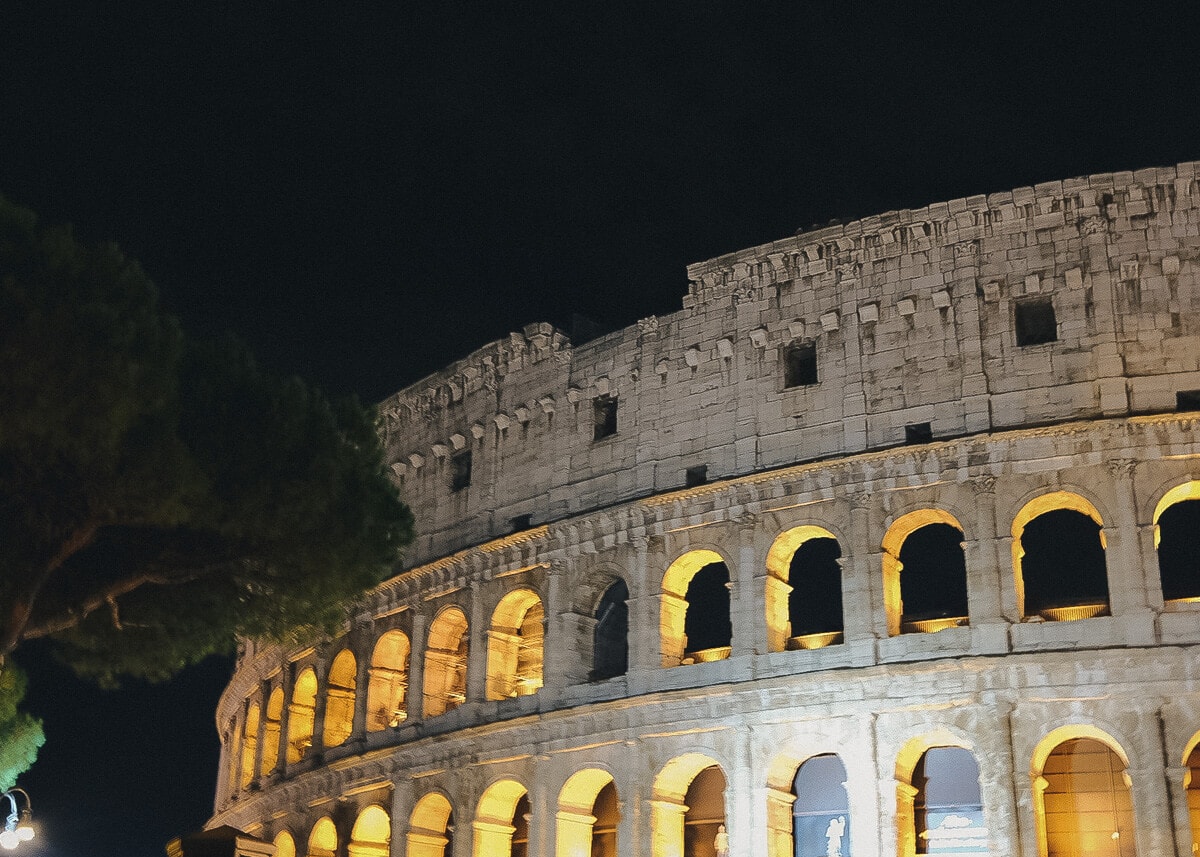
This is a review of the Colosseum night tour – what the underground looks like after dark, whether the experience justifies the cost, and what nobody else seems to be saying clearly about how these tours now work.
The short answer is yes, it’s worth it. But there’s a catch that matters depending on what you’re paying for.
When I took this tour it was run by Walks of Italy.
The opening section – through Ancient Rome, up the Capitoline Hill, down Via dei Fori Imperiali – was led by Michela, one of the best guides I’ve encountered anywhere: sharp, funny, genuinely passionate and skilled at making history come alive.
At the Colosseum entrance, she handed us over to the official Colosseum guide, as was required.
The drop was immediate.
He was knowledgeable but disengaged, kept walking and talking regardless of where the group was, and the earpiece signal dropped constantly as he rounded corners without checking. When Michela took us back at the end, the contrast was stark.
The reason this matters now is that the Colosseum runs all underground night tours directly – TakeWalks and other operators no longer have access. That official guide experience is now the whole experience.
If the quality of your guide matters as much as the access, that’s worth factoring in. If what you’re paying for is the hypogeum after dark with almost no one else there – and that is extraordinary – book it and go.
COLOSSEUM TOURS REFERENCED IN THIS POST
Colosseum underground by night tours: Now run exclusively by the official Colosseum authority. Book at ticketing.colosseo.it. For current options available through third-party booking platforms, see my Colosseum night tours guide.
Walks of Italy daytime Colosseum tours – my recommendations:
☆ Premium Colosseum Guided Tour with Roman Forum & Palatine Hill – their most popular tour, max 16 people
☆ Colosseum Arena Floor Tour: Special Access via the Gladiator’s Gate – enter through the original Gladiator’s Gate
☆ Colosseum Express Tour with Roman Forum Tickets – 1.5 hours, the right option if time is tight
Table of Contents Show
But first – a little bit about the Colosseum & why you should visit it
What is the Colosseum famous for?
First things first, it’s important to understand a little about this incredible structure’s history, and just why the Roman Colosseum is so important to Rome.
The Colosseum is one of the most famous structures ever built. Recognisable worldwide today for its worn, weathered stone and its distinct, crooked shape due to the collapse of some of its upper levels on one side, the Colosseum didn’t always appear as such.
In its heyday it was a perfect sphere, adorned in gleaming white marble, with its now empty arches filled with statues. It was capped by a gargantuan, retractable velarium (or awning), which kept its 50,000 spectators shaded from the intense heat of the summer sun.
A Cultured Voyages Guide
Seven shifts that take you from sightseeing to actually understanding a place – the same ones I use on every trip I plan.
Construction began under Vespasian in 72 AD and was completed under his son Titus, who inaugurated it in 80 AD. Originally known as the Flavian Amphitheater, and was the scene of many bloody spectacles.
Games were organised and paid for by the ‘editor’, often the emperor himself, and were used at the time to curry political favour with the people (it was free to attend) or to celebrate great events, such as victory in war.
A day at the games would kick off with the wild beast hunt, where exotic animals like elephants, leopards and lions would be pitted against one another, or against highly skilled hunters. Either way, the animals were always the real victims in this line up.
In 80 AD for the Flavian Amphitheater’s inauguration, the series of games held by the Emperor Titus resulted in the death of 9,000 animals.
Astonishingly, the statistics grew even worse – a mere 30 years later, Trajan held a series of games to celebrate his conquest of the Dacians, and sadly, some 11,000 animals were slaughtered.
At midday, it was time for public executions. Some of the condemned were set upon by wild animals; others had to fight each other with swords.
Sometimes, the deaths were even more elaborate, with scenes from Greek mythology reenacted, where the victims played the part of a character – such as the part of Hercules, who was burnt to death before becoming a god. Heart-warming stuff.
Finally, came the main event – the gladiatorial fights. Gladiators were highly skilled fighters. The best gladiators were rewarded with riches and fame, but they were also slaves, otherwise forced into servitude until their retirement age.

Descent into ruin and the importance of the Colosseum today
In the centuries following the fall of the Roman Empire, the Colosseum was used for a number of purposes. Primarily, it was used as a quarry and was stripped of its marble, statues and stone for other building projects.
In fact, much of the marble from Ancient Roman constructions was used to build many of Rome’s most famous churches and palaces, including the Vatican.
The Colosseum was also affected by earthquakes and lightning strikes and over time, it’s great hypogeum (the underground part that acted as ‘backstage’ for the games) was filled with rubble, and used as a store and dump.
The passageways above ground became home to blacksmiths, cobblers and priests and the Colosseum even found itself acting as a fortress for the 12th century Frangipane warlords.
Preservation of the Colosseum only really started in the 19th century, under efforts led by Pope Pius VIII.
In the 1930’s, in one of Mussolini’s less abhorrent moves, the hypogeum was cleared of earth as part of his drive for the glorification of Classical Rome and in the 1990’s, a large restoration project was undertaken.
Today, the Colosseum is one of Rome’s most important tourist attractions, along with being one of the most famous ones in the world to boot.
It stands as an important relic of Ancient Rome’s power and might, as well as evidencing its impressive engineering prowess. Receiving over 7 million visitors a year before the pandemic, it is also a huge source of revenue to Italian tourism.
Is it better to see the Colosseum at night or day?
The best time to visit the Colosseum is when it is at its quietest. There are two times of day that win out. The second quietest time of day to visit the Colosseum is first thing in the morning.
If you queue for security about half an hour before they begin operating, you’ll likely be amongst the first visitors to the Colosseum that day, so you’ll get a good 15 – 20 mins in relative peace and quiet before it starts to fill up.
The absolute quietest time of day is after hours, at night, when general admission has ended and when privately led Colosseum night tours are the only ones permitted inside.
You’re not side-stepping other tourists and there is really time to look at things properly, and to take it all in. It’s all quite thrilling, really, especially if you’ve visited the Colosseum before during the day and can attest to how busy it gets.
There’s an almost eerie calm and the only sounds you can hear are your group’s footsteps, your guide’s voice and the humdrum of distant traffic from beyond the Colosseum’s great walls.
Without the clamour of the Colosseum’s crowds during the day, your imagination can really fire into action and you can imagine the clang of swords, the excited roars of the crowd and all the glamour and gore that were part of a day at the games in Ancient Rome.
In my opinion, visiting the Roman Colosseum at night wins out to visiting during the day.

Colosseum by night tour review – my experience with TakeWalks
To give you a clear idea of what a night-time Colosseum tour involves, the best way is to take you through the tour I took with TakeWalks, from start to finish.
The specific tour I took was the VIP Colosseum At Night Tour With Underground & Arena Floor, which is a circa 2.5 hour group tour of a maximum of 19 people. It might sound like a slightly larger group, but in a space as large as the Colosseum, it didn’t feel like there were that many other people at all.
We met outside a café close to the Marcello Theatre, where we were handed headsets so that we could hear our guide properly. Then, the tour began!

Night tour of Colosseum part 1: Marcello Theatre
First stop on our Rome Colosseum at night tour was the Marcello Theatre, or Teatro di Marcello.
Located to the side of Piazza Venezia and close to the steps that lead to the top of the Capitoline hill and museum, if you haven’t seen the Colosseum before you may be forgiven for thinking that the Marcello Theatre is it.
Here, our guide Michela imparted some interesting facts about the theatre; including how it is still in use today as apartments and is under the ownership of a noble Italian family.
RELATED READING: Best Colosseum by Night Tours
Night tour of Colosseum part 2: Capitoline Hill & Piazza del Campidoglio
We then made our way across the road to the impressive set of steps that lead up to the Piazza del Campidoglio. Here, we learned how Michelangelo restored harmony to the square, making an awkward shape symmetrical by designing two of the palazzo that now form part of the Capitoline Museum.
We looked down upon the Roman Forum from the back of the square, learning about Rome’s origins and some of its most important buildings and streets during the time of Ancient Rome.
All these tales were regaled with great enthusiasm and humour and we then made our way down a winding road from the back of the hill towards the ground level of the Forum, and the Via dei Fori Imperiali.

Night tour of Colosseum part 3: Approach down Via dei Fori Imperiali
While we made our approach towards the Colosseum, we stopped to take in some important sights along the way. We learned why local Romans don’t like the Alter of the Fatherland on Piazza Venezia, before pausing at the former Trajan’s Market.
Here, I came to the conclusion that ancient Roman shopping and commercial centres weren’t a whole lot different to our own today!
As the dramatic, spot lit mass of the Colosseum loomed larger and larger as we made our way along the pavement, we made our penultimate stop of the night at the Basilica of Maxentius before making our way towards the entrance for the main event of our Roman Colosseum night tour – the Colosseum itself.
Night tour of Colosseum part 4: Night tour of Colosseum
We checked in through security, and Michela handed us over to the official Colosseum archaeologist for the section inside. As I mentioned in the intro, the contrast in guide quality was noticeable – and the earpiece signal issues in the underground made it more frustrating than it needed to be.
What no guide can diminish, however, is the space itself.
Moving down into the hypogeum, you descend into a warren of passageways lined with cells that held gladiators, animals and condemned prisoners as they waited to be raised to the arena floor above. The scale only becomes real when you’re standing inside it.


The horizontal channels cut into the walls were ancient elevator shafts. The semicircular recesses beside them held capstans – turned by hand to raise compartments and cages up through the floor of the arena.
At peak operation, sixty were running simultaneously: forty for animal cages, twenty for scenery. Some have been partially recreated so you can understand the mechanism in context. If the games felt in any way fantastical before you walked in here, they won’t afterwards.
After the underground, the tour moved to ground level to look down at the full maze below – which puts into perspective what you were just walking through – before finishing on the arena floor itself, quiet in a way the Colosseum simply is not during the day.
When Michela took us back for the final section outside the walls, the difference between her and the official guide was, as I said, immediately obvious.
Is a Colosseum Night Tour Worth It?
Yes – with one qualification that’s worth taking seriously.
The hypogeum after dark, with a small group and no crowds, is genuinely extraordinary.
The underground is the most interesting part of the Colosseum by some distance, and seeing it at night – in near-silence, with the arena floor above and the passageways lit just enough to read the engineering – is something a daytime visit can’t replicate.
The qualification is the quality and enthusiasm of the guide.
The Colosseum’s official authority now runs all underground night tours directly. The official guides are knowledgeable.
They are not, from my own experience, the kind of charismatic storytellers that make you feel like history is alive rather than archived – and at €50 for a one-hour tour, that gap matters more than it would at a lower price point.
The tour covers the underground, the arena floor and the first tier, and runs on selected evenings only.
If the experience itself – the silence, the underground, the empty arena – is what you’re paying for, book it. If the quality of the guide is equally important to you, read my Colosseum night tours guide first, which covers the current options available through third-party booking platforms so you can weigh up what’s on offer.
At a glance:
- No third-party operators currently run underground night tours; TakeWalks daytime options remain the best guided alternative
- Very small group, no general public – you have the space almost entirely to yourselves
- The underground is unmissable; the night version is the best context for it
- Official tours are one hour, €50, and include the underground, arena floor and first tier
- Tours run on selected evenings only.
- Guide quality varies – the Colosseum’s official guides are knowledgeable but not always engaging


How to Book a Colosseum Night Tour
All underground night tours are now operated directly by the Colosseum’s official archaeological authority. Tickets go on sale 30 days in advance at ticketing.colosseo.it and sell out quickly – this is not a last-minute booking. Tours run on selected evenings only.
For current options available through Viator and GetYourGuide, see my Colosseum night tours guide.
Visiting the Colosseum on your own (self-guided)
If, having read my review above, you’ve decided that a self-guided daytime trip wins out over a night at the Colosseum, then I’d strongly urge you to a) visit first thing in the morning and; b) to purchase your tickets in advance.
This especially goes for if you are tied to visiting later in the day, as queues can grow very large and you’ll save yourself the hassle of joining the crowds by being able to just show up and waltz through security at your allotted time.
How to purchase skip the line tickets to the Colosseum
For standalone entry tickets, book directly at ticketing.colosseo.it. If your preferred slot has sold out, both Viator and GetYourGuide carry Colosseum tickets.
Booking skip the line tickets for the Colosseum
Your first option is to book skip-the-line tickets to the Colosseum. This includes entry to the Roman Forum and Palatine Hill also.

Visiting the Colosseum as part of a guided tour
There are several different types of guided tours of the Colosseum that you can do.
Premium Colosseum Tour with Roman Forum and Palatine Hill
This is the Walks of Italy tour I’d recommend as the standard starting point – three hours, maximum 16 people, expert historian guide, pre-reserved access. It covers the Colosseum, Roman Forum and Palatine Hill in one visit. With over 8,000 reviews it’s the most trusted Colosseum tour currently available through an independent operator.
Colosseum Arena Floor Tour: Special Access via the Gladiator’s Gate
Enter the Colosseum through the original Gladiator’s Gate – the entrance used by gladiators before combat – for arena floor access, followed by the Roman Forum and Palatine Hill with an expert historian. A special-access area that remains closed to other visitors during your time there.
Colosseum Express Tour with Roman Forum Tickets
One and a half hours focused on the Colosseum itself, led by an Ancient Rome expert, with tickets to the Roman Forum included to explore at your own pace afterwards. The right option if time is genuinely tight and you can’t commit to a three-hour tour.
VIP Special Access: Colosseum with Caesar’s Palace and Roman Forum Super Sites
For those who want to go considerably further than the standard visit, this afternoon tour opens up restricted Super Sites – Caesar’s Palace, private palaces and frescoed villas – that are closed to general visitors entirely.
Three and a half hours, maximum 16 people, afternoon departure. The option I’d point to for anyone returning to Rome who has already done the Colosseum and wants to experience Ancient Rome at a level most visitors never reach.
Frequently Asked Questions
Can you visit the Colosseum at night?
Yes – but only on an officially sanctioned guided tour with limited capacity. Night access to the underground hypogeum is available on selected evenings and must be booked well in advance at ticketing.colosseo.it. Tickets go on sale 30 days before the date and sell out quickly.
Is the Colosseum night tour worth it?
Yes, with a caveat. The underground after dark with a small group is genuinely extraordinary – one of the more affecting experiences Rome has to offer. The caveat is guide quality: the Colosseum’s official guides are knowledgeable but the experience can be variable, and at €50 for one hour that matters. If this is a concern, read my full verdict above before booking.
What does the official Colosseum night tour include?
The current official night tour is one hour long, costs €50, and includes the underground hypogeum, the arena floor and the first tier. It does not include the upper levels of the Colosseum. Tours run on selected evenings only – verify the current schedule at ticketing.colosseo.it.
What’s the difference between a night visit and a daytime visit?
At night, access is restricted to a small guided group with no general public present. The focus is the underground and arena floor. During the day you can also access the upper levels, which offer views over the Roman Forum, but the crowds are significant even with a timed entry ticket.
If you’ve already visited during the day, the night tour is a worthwhile return. If it’s your only visit, a daytime tour gives you slightly more of the building overall – but considerably less atmosphere.
Does the Colosseum light up at night?
Yes. The exterior is illuminated and the approach along Via dei Fori Imperiali is one of the more dramatic arrivals in Rome. The interior is partially lit during night tours – enough to navigate and examine the structure clearly, with enough shadow to make the atmosphere genuinely different from a daylight visit.
How far in advance do I need to book?
Tickets go on sale 30 days before the date. For summer dates and weekends, booking the day tickets are released is advisable – they sell out fast. Don’t leave this to the week before your trip.
Are there alternatives if the night tour is sold out or not right for me?
Yes. For underground access with a guide quality I can personally vouch for, the Walks of Italy Premium Colosseum Tour with Roman Forum & Palatine Hill is the daytime option I’d recommend first – it’s their most popular tour for good reason.
For arena floor access specifically, the Colosseum Arena Floor Tour via the Gladiator’s Gate is the standout. Both include the Roman Forum and Palatine Hill in the same visit.
Planning Your Visit
The Colosseum after dark is worth the effort. The underground in near-silence, the empty arena floor, the approach along Via dei Fori Imperiali with the lit exterior ahead of you – these are the details that make Rome feel different on a return visit from how it felt on the first.
Book early, go in with realistic expectations about the guide experience, and you’ll come away with something genuinely memorable.
For the full picture on Rome after dark, Things to Do at Night in Rome covers the rest of the city’s evening options. And if you’re building this into a broader Rome trip, my 4-day Rome itinerary shows exactly where it fits.

You’ll find all my Rome travel guides via my Rome destination hub. For Italy more broadly, head to my Italy travel page.
Related reading for Rome


Before you go
Everything I check before a trip now lives on one page.
Seven shifts I run on every trip I plan, each one paired with the story that taught it to me and the steps for using it yourself — built to be printed, kept, and pulled back out before the next one.
It arrives when you join The Cultured Voyages Edit, a fortnightly letter on European cultural travel.
Like this post? Please share or pin for later

