
Disclosure: Some of the links on this site are affiliate links. If you make a purchase through one of them, I may earn a small commission at no extra cost to you. Read my full disclaimer here. Thank you for your support!
This guide to the best things to do in Connemara covers twelve of them: six beaches, three scenic drives, five walks, four islands and the towns worth basing yourself in. It also covers where to eat, where to stay and how long the region actually needs, which is more than the day trip from Galway most people give it.
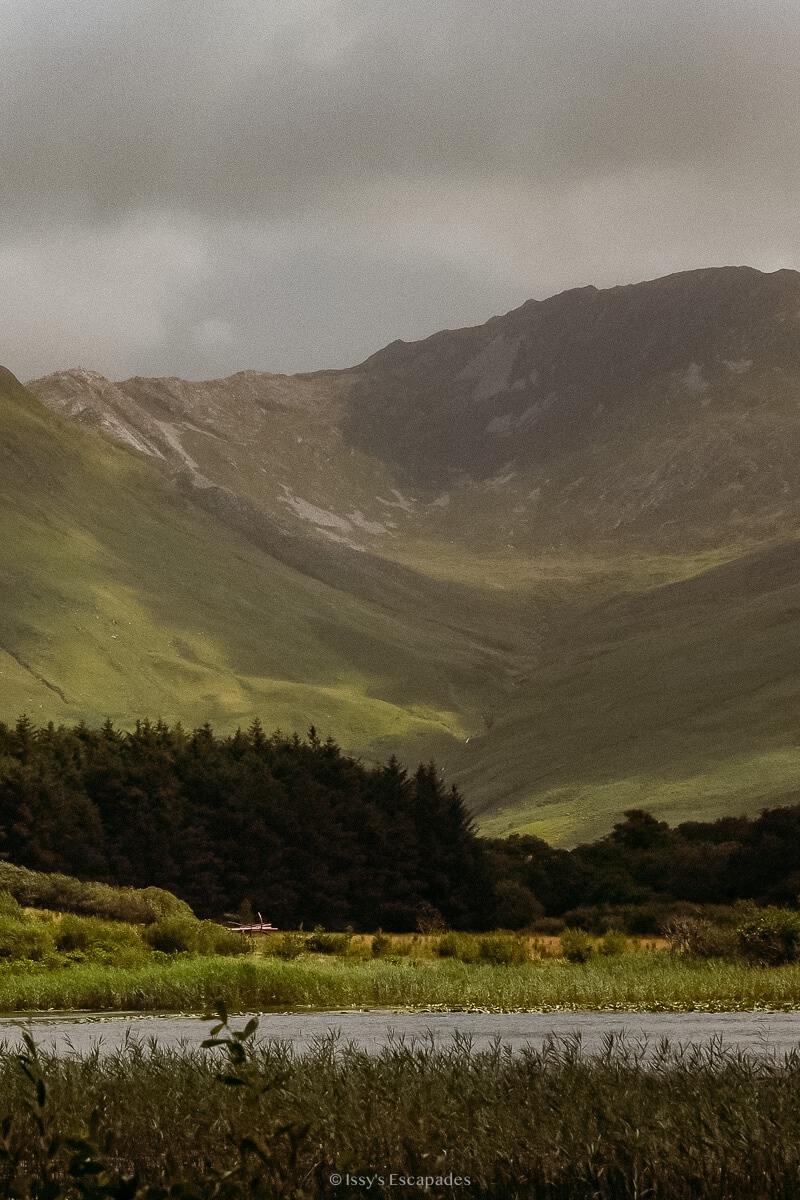
Connemara is a raw, desolate sort of beautiful.
Muted greens and russet tones, great mountains rearing up out of peat, coves the colour of the Caribbean cut into a jagged coastline. I have been coming here since childhood, and I still go back most years, and I have yet to find anywhere else in Ireland that looks anything like it.
It is one of the last Gaeltacht regions left in the country, where Irish is still the day-to-day language, and it holds Killary Harbour, Ireland’s only true fjord, where the mussel rafts sit out on water that is almost always calm.
The food is better than most visitors expect, too. Some of the best things I have eaten in Connemara came out of a food truck parked at the edge of the water, and there was too much of it to fit in here, so where to eat in Connemara has a guide of its own.
Mostly, though, this is a region for being outdoors.
Mountains to climb, lakes and beaches to swim from, and fishing, cycling, horse riding and kayaking for anyone who wants the landscape to be more than a view from the car.
I tend to alternate between the ambitious and the horizontal depending on energy levels, and Connemara accommodates both.


The best things to do in Connemara Ireland
1 Visit some of the incredible beaches in Connemara
On sunny days when the weather is warm the beaches of Connemara present an intoxicating, paradisaical proposition of silvery sands and aquamarine waters.
Instead of the accompanying palm trees and coconuts you’d expect in such a setting, the beautiful beaches of Connemara are instead fringed with green fields and a smattering of baa-ing sheep – a scene that you just wouldn’t find anywhere else.
Connemara is famous for its stunning beaches and of all Connemara things to do, one of the best ways to spend a day of good weather is to head to the seaside. If you’re wondering just what the best beaches in Connemara are, I’ve included a (non-exhaustive) summary below.
Dogs Bay Connemara | coordinates
With fine, soft sand that is made from the particles of fragmented seashells, the beach at Dog’s Bay Connemara is absolutely spectacular. A wide, horseshoe shaped stretch that houses magical turquoise waters, this popular Connemara beach is located close to the town of Roundstone.
For the ultimate treat, try to walk to the end of the beach and climb up onto the grassy headland – if you keep following the shoreline you’ll be rewarded with a hidden cove and a private beach in a couple of hundred yards.
Gurteen Beach | coordinates
Dog’s Bay is actually one side of a tombolo and the other side is occupied by the equally lovely Gurteen Beach. Larger than Dog’s Bay, Gurteen also offers crystal clear waters and is the better pick of the two if you plan on doing water sports.

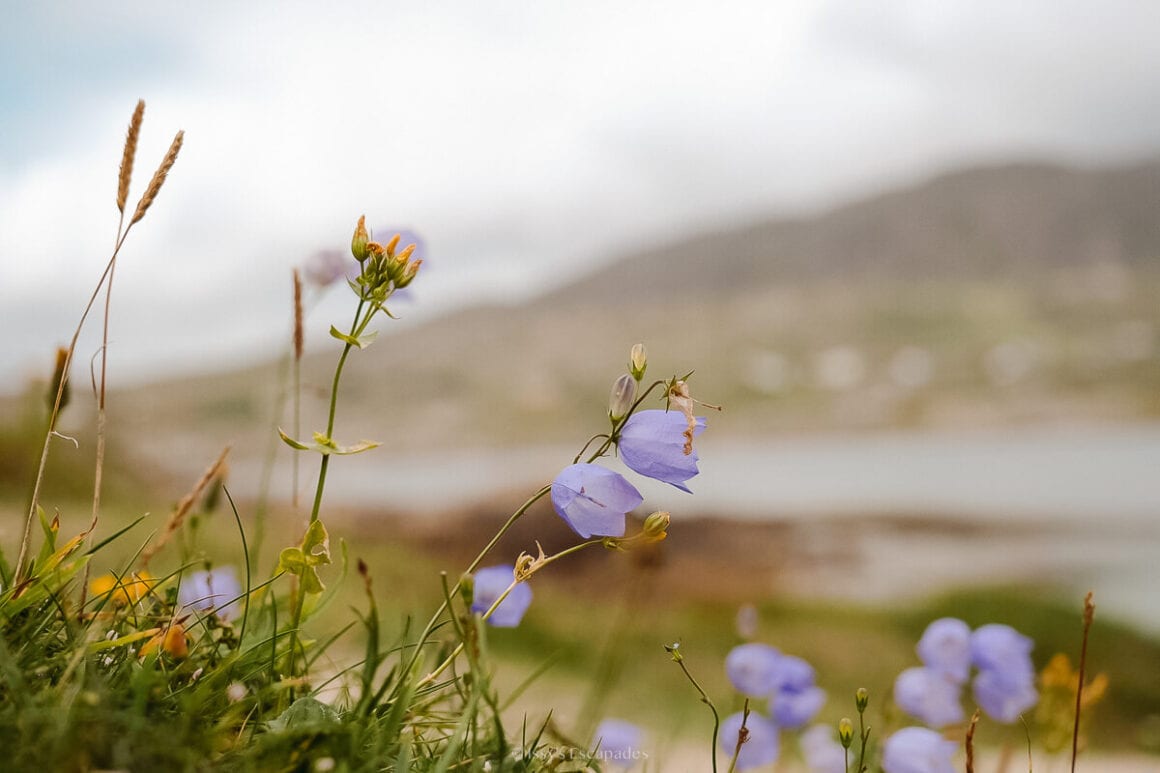
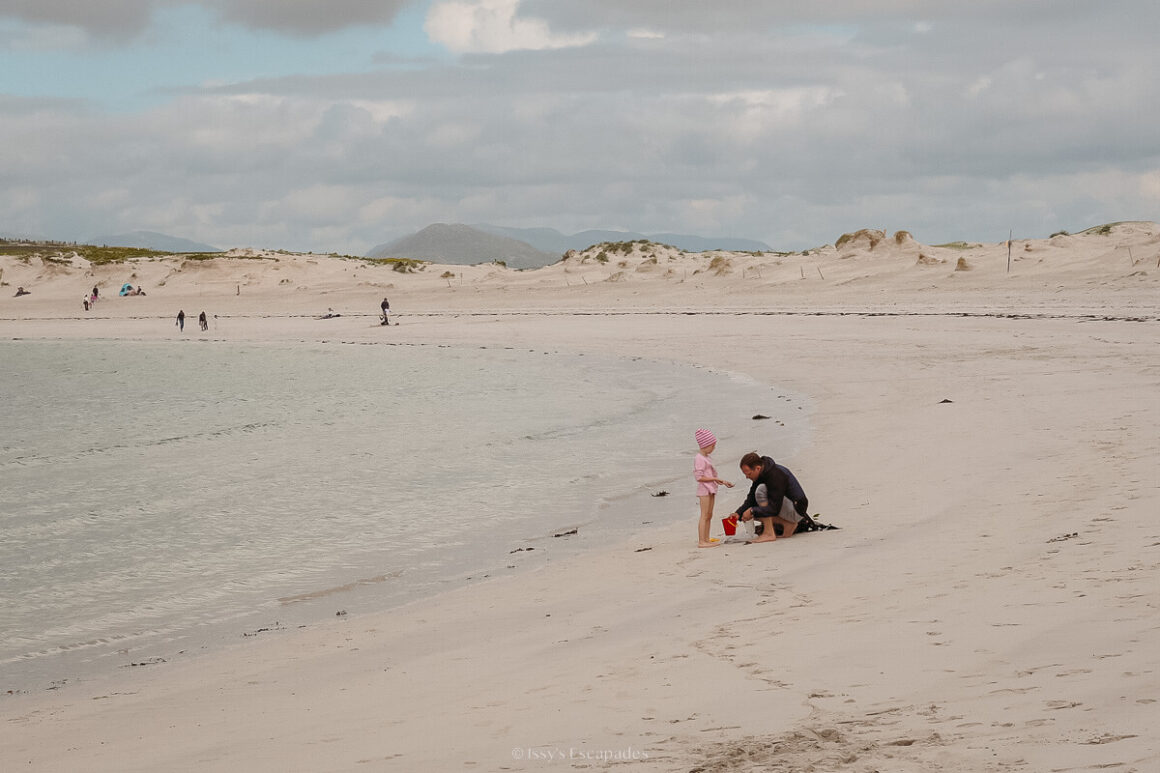

Glassilaun Beach | coordinates
One of Connemara’s most popular beaches and it’s easy to see why – boasting vivid waters and white sands, Glassilaun beach is set amongst some of the region’s finest landscape and shows it at its best.
Surrounded by rugged scenery and a dramatic mountainous backdrop, Glassilaun beach is located between Renvyle and Killary Harbour.
Mannin Bay | coordinates
The theme continues – again, this fabulous beach also boasts silky, white sands and turquoise water, along with lots of rock pools and a 4.5km rocky shoreline trail to undertake from which you can bask in the epic views of the Atlantic ocean.
Renvyle Beach | coordinates
Renvyle beach offers visitors views of the mighty Mweelrea mountains in neighbouring Mayo. This beach is a huge expanse of white sand and is also known as “White Strand Beach” because of this fact.
Nearby is Renvyle Beach Caravan and Camping Park, making this a good beach to pitch up at if you’re camping or undertaking a road trip by campervan.
Coral Strand, Ballyconneely | coordinates
The hint is in the name of this beach and unlike the others on this list, Coral Strand does not boast satin sands but instead is comprised of coral – so its uniqueness alone renders it a Connemara must do.

2 Explore the majestic Connemara National Park
Comprised of mountains, bogs, forestry, heaths and grasslands that were shaped after the last Ice Age, the Connemara National Park occupies much of the region, spanning some 2,000 hectares of Connemara.
Much of its landscape is what visitors associate with this unique, rugged region. Now fully state owned, much of the park land was formerly part of the privately owned Kylemore Abbey Estate, as well as the Letterfrack Industrial School.
Vestiges of former inhabitants of the park can be found throughout.
The earliest evidence is 4,000 year old megalithic court tombs, ranging up to more recent centuries in the form of ruined houses and sheep pens, along with old walls and other signs of farming life – all scars that remind visitors that this area was once more densely populated than it is today.

Much of the land is covered in western blanket bog and heathland and bears a distinctive purple colour due to an abundance of purple moor grass. There’s also a wide variety of bird and animal life in the park, the most well known being the Connemara Pony.
While Connemaras are very much domesticated (they make wonderful children’s ponies and are fabulously good natured and athletic), there is a herd in the national park that are descended from a herd of pure-bred Connemara ponies that were presented to the State by the late President Erskine Childers in 1974.
There is a visitor centre at Letterfrack, which offers an informative exhibition on the Connemara landscape. There is also a children’s playground, a cafe and picnic areas, meaning a visit is one of the more popular things to do in Connemara for families.
A Cultured Voyages Guide
Seven shifts that take you from sightseeing to actually understanding a place – the same ones I use on every trip I plan.
You won’t be able to drive through the National Park, so the best way to see it is on foot. There are a number of well marked National Park walks.
The easier are Ellis Wood Nature Trail (0.5km) and the Struffaunboy Trail (1.5km), or, you could undertake one of the most popular Connemara National Park things to do and climb Diamond Hill – more on that in the “Go hiking in Connemara” section below.
Planning your visit | The National Park is open 24 hours a day, with the exception of during orange and red weather warnings. The visitor’s centre is free of charge, and is open from 9am – 5.30pm March – November, and from 8.30am to 5pm December – February.
3 Enjoy some of the wonderful food in Connemara
If you are a foodie who is wondering what to do in Connemara, then there is a very straightforward answer to this one – eat!
Connemara is bursting at the seams with wonderful food producers and the concept of farm to fork really pervades here.
Due to its seaside location, seafood does, of course form a huge part of the local cuisine and you’ll be able to delight in fresh seafood that includes mussels, oysters, lobster, clams, turbot, plaice, cod and pollock, to name but a few. Look out for Cleggan crab, Dooncastle oysters and Killary mussels on menus.
There are also plenty of bounteous, fish-filled lakes in Connemara and locally caught salmon and trout will feature too on menus.



The beaches and coastal environment also offer wonderful opportunities for foraging, so you’ll also find plenty of locally foraged seaweed and sea plants in some of the more embellished dishes on menus. There is also plenty of quality lamb, beef and wild game to be eaten in Connemara.
You’ll find more on where to eat in Connemara further on in this post.
Learn about food production in Connemara – pay a visit to the Connemara Smokehouse
If you’d like to learn some more about food production in the area, then one of the places in Connemara that you’ll want to visit is the Connemara Smokehouse.
Set on the edge of the Atlantic Ocean at Bunowen Pier in Ballyconneely, three generation of the Roberts family have applied the traditional Irish fish smoking craft to wild and organic salmon, tuna, mackerel, trout and herrings straight from the wild Atlantic Ocean and are now world-renowned for their skills.
4 Go on a scenic drive in Connemara
Much of the most scenic Connemara attractions can be experienced by taking to the road – and by road, I mean country lanes in many instances.
There are several scenic routes that take you through particularly magnificent parts of the region, where you could be skirting the rippling waters of the lakes of Connemara one minute and admiring the rugged hills of Connemara the next.
Below are some of my favourites to get you started.
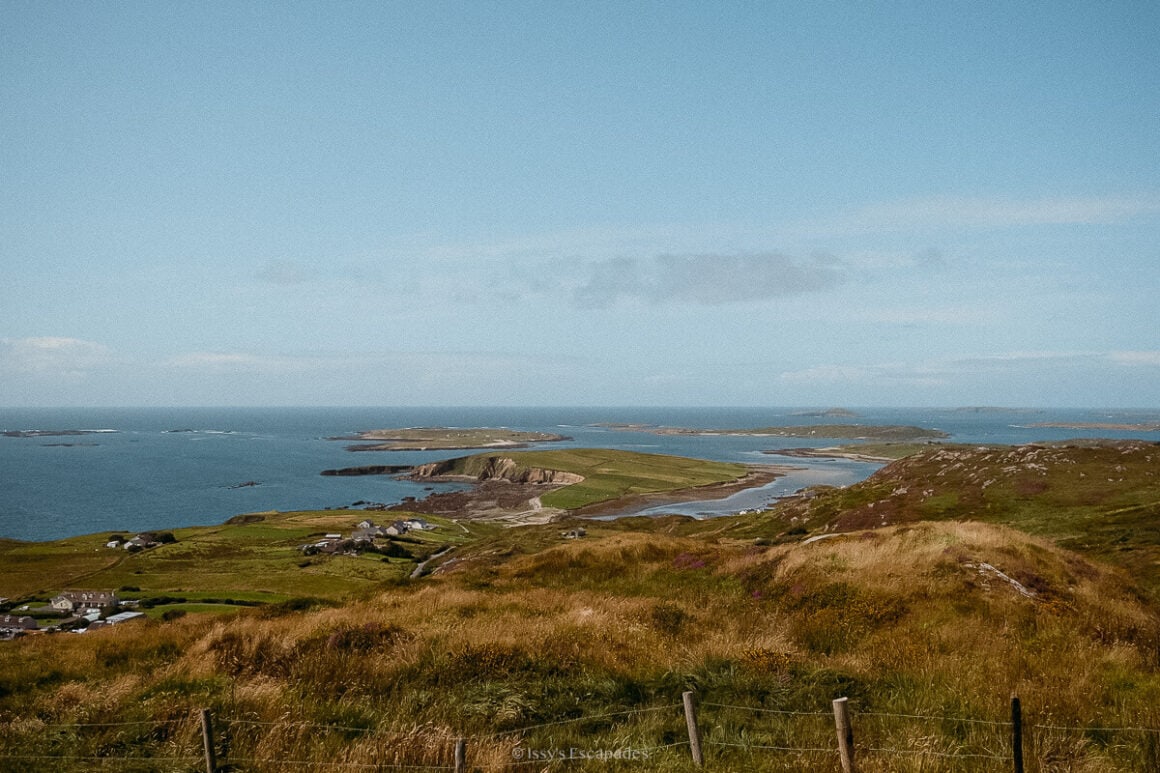


Drive the Sky Road, Connemara
This popular driving route starts from the town of Clifden and will provide you with some of the most gloriously unspoiled views of the wild waters of the Atlantic ocean. Rising sharply upwards from the town, the vantage point you’ll get from such an elevated position results in the most incredible views.
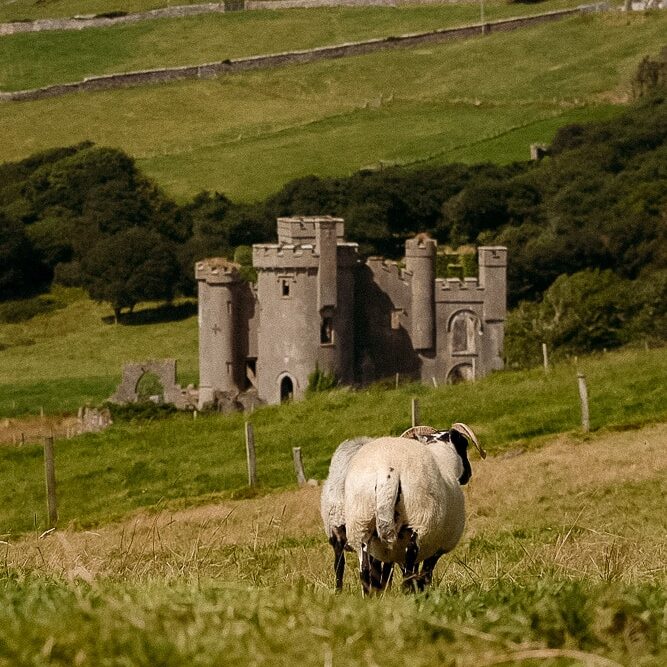
Highly worth stopping off along the way is the ruined Clifden Castle. It takes around 10 minutes to reach the castle on foot, but it’s highly worthwhile, as you’ll likely have a view of a lighthouse-adorned headline and sparkling blue waters all to yourself (although you may have to share the view with some sheep).
In total, this circular route is 16km and can be done within an hour, including stop off time. Add another 30 minutes at least if you plan on stopping at Clifden Castle.
RELATED READING | DRIVING THE SKY ROAD, CLIFDEN
Connemara Loop
The Connemara Loop is a little longer than the Sky road – spanning some 80km of roadway. If you’re seeking a deeper immersion into the wild landscape of Connemara, then completing this looped drive is definitely one of the top things to do in Connemara.
How long does it take to do the Connemara Loop?
The drive can take anything from a couple of hours to complete up to an entire day. If you have the luxury of time, then I would do exactly the latter and dedicate a whole day to discovering some of the diverse terrain and charming towns and villages in Connemara that are dotted along the route.
The route
The Connemara Loop is well signposted and takes in some of Connemara’s loveliest towns and villages, including Leenane, a little village nestled at the end of Killary Fjord which sits in the shadow of Mweelrea mountain, as well as Tullycross, a village that is well known for its traditional thatched cottages.


Starting from Maam Cross, you’ll make your way to Leenane village and Killary Harbor, before following the signs out along the Renvyle Peninsula, taking in some of Connemara’s best beaches, including Glassilaun and White Strand along the way.
You’ll make your way back towards the town of Letterfrack, pass Kylemore Abbey (if you have enough time, you could potentially plan your visit to Kylemore Abbey to coincide with the drive.
But you’ll need a few hours to spare) before driving through the heart-wrenchingly beautiful Inagh Valley and some of Connemara’s most breathtaking vistas.
Drive the Bog Road, Connemara
Within the first minute of travelling along the Bog Road, you’ll feel surrounded by a sense of hauntingly rugged, desolate, isolation. Here, you will witness some of Ireland’s Blanket Bog at its finest.
While it doesn’t have the same sweeping majesty that huge swathes of forestry, or vertiginous mountains might have, Blanket Bog is incredibly important to the local ecology.
They are home to many species of wildlife and absorb water, releasing it slowly throughout the year to fill streams and contribute to the healthy spawning of salmon and trout.

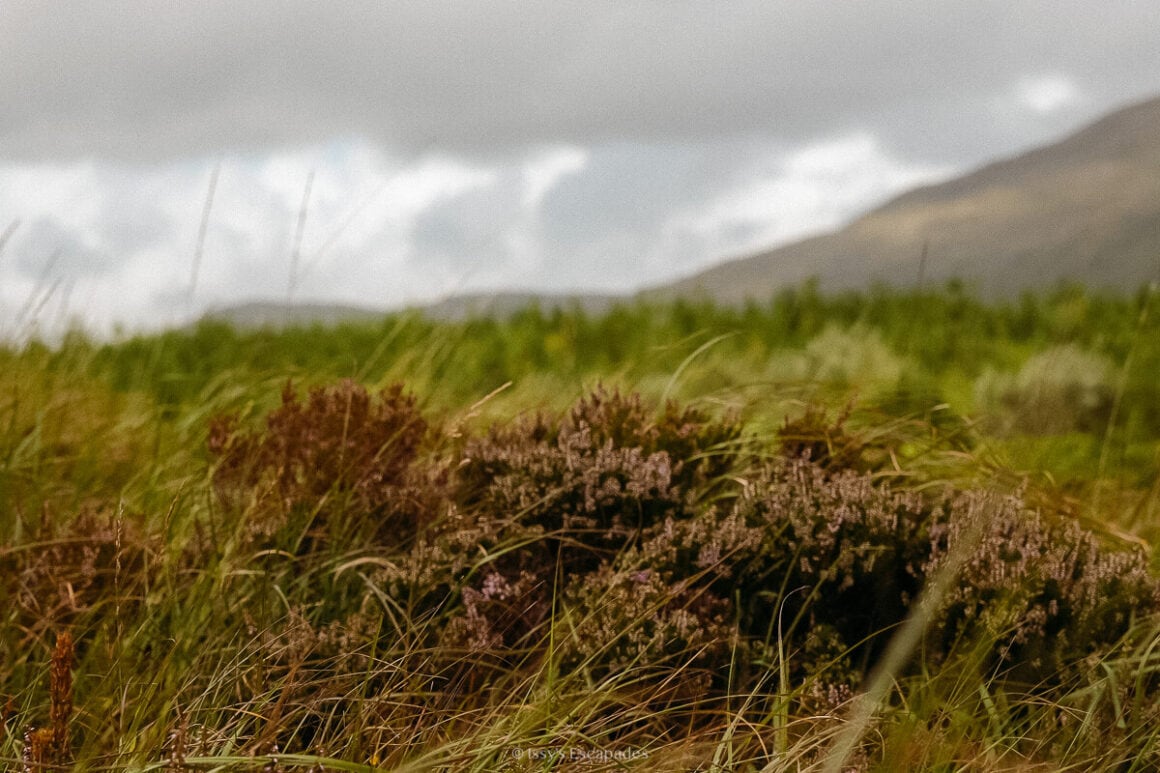
The setting of the Bog Road is exceptionally unique and almost feels stage-like, with a wide expanse of heather and moor grass that is punctured by small, dark lakes, set against the peaks of the Twelve Bens and Maumturk mountain ranges in the background.
The best way to describe how to get to the junction for the Bog Road, is if you’re travelling towards Roundstone from the Recess direction you want to leave the R314 and take the small road with the sign pointing for Clifden.
I’ve included a link to the spot on Google Maps here, as it’s much easier than trying to explain! If in doubt, or if you’re coming from the Clifden direction, just pop “Roundstone Bog” into Google Maps and that will lead you to the Bog Road.
The whole road is less than 10km in length and you’ll drive it in about 15 minutes if you don’t stop off to inspect further – but I highly recommend that you do, so allow time accordingly.
5 Go cycling in Connemara
Cycling some of the narrow, scenic roadways is one of the more fun activities in Connemara to undertake. Your options here are only limited by what roads you are or are not willing to cycle on. Many of the roads in Connemara are narrow, regional routes that see infrequent traffic, so they are perfect to cycle.
Even if you hit some of the main roads in Connemara, tourists for the most part will be driving slowly and anyone living locally who will drive faster will be well versed in manoeuvring both slow-driving tourists and cyclists (sorry guys).
Do keep an eye out for drivers, however, and respect the fact that for people living in Connemara, it could very well likely be their main route for getting in and out of work etc.

Any of the scenic drive routes I’ve listed in the section above this one make great cycling routes too. If you don’t have a bike with you, there are several bike shops in Clifden that offer bike hire in Connemara and some will also have e-bikes if you’re a less seasoned cyclist, or want a bit of extra power for those hills!
You can view a map of the routes here, but the most popular routes that you can cycle, which include many of the loveliest places to see in Connemara along their routes are the following:
- Sky Road Loop – 16kms (1 hour 15 minutes duration)
- Errislannan Loop – 14km (1 hour 15 minutes duration)
- Cleggan Loop – 33km (2 hours 30 minutes)
- Ballyconneely & Roundstone Loop – 40km (3 hours)
There is also a Connemara Greenway currently under construction. When completed, the 76km route will connect the city of Galway with the colorful town of Clifden in the heart of Connemara.
We cycled a 6km section of the route that has been finished which runs through the estate of Ballynahinch Castle when we stayed there and while short, it offered plenty of those moody Connemara views that you’re hoping to find.
When completed, the entire route will be a fantastic addition to both Galway and the region of Connemara.
Finally if you’re more of an adrenalin junkie then you should have a think about hitting the Derroura Mountain Bike Trail. The trail offers an exciting 14 km long track with some astounding views of both the Maam valley and the Twelve Bens.
6 Visit the stunning Killary Harbour
To be defined as a true fjord, the water held within the basin needs to be deeper than the sea it drains into and at Killary Fjord, the bed of the fjord descends to depths of up to 40m lower than the sea it siphons into.
The result of glacial activity, the retreating glacier left a steep, deep and narrow inlet and its effect on the surrounding landscape is one of staggering good looks.
At its most inland edge is sheltered the quaint village of Leenane, which sits in the shadows of Mweelrea, Connaught’s highest mountain. There are also fantastic views of the Maumturk Mountains, as well as Connemara’s well-known Twelve Bens range.

On the southern side of the fjord is a grass-covered road, which runs for approximately 9km and is well worth taking some time to walk.
While its setting may be one of such tranquil beauty, it came to fruition as a famine relief road in the 1840’s and serves as a haunting reminder of the devastation that this region once faced.
Also to be seen are the remains of an old famine village and its ruined cottages, along with hills that still show the gently curved lines of potato ridges where some of the local population tried to sustain themselves, before the Great Famine tragically decimated both the potato crop and much of the populace itself.
Today, however, the area of Killary Harbour is famed for its production of seafood and you’ll spot many rows of mussel rafts spanning the surface of the water.
As the area is so sheltered, unlike much of the rest of Ireland’s coast, you’re pretty much guaranteed calm waters and there is no better way to take in the natural surroundings than to hop on a Killary Fjord boat tour to take it all in.
If you’re lucky, you might even be joined along the way by some of the curious dolphins that often follow the boat. Tours run seasonally from April through October.
Foodie tip | No visit to Killary Fjord is complete without a visit to Misunderstood Heron, which counts itself amongst the best food trucks in the country.
Set in the most incredible location right on the edge of the fjord with sweeping views of its waters and mountainous backdrop, this fantastic outdoor eatery serves up flavour-packed homemade dishes using local produce in creative ways and it is not to be missed.
Open seasonally April – October and closed on Mondays & Tuesdays during this time.
7 Go hiking in Connemara
With such arresting scenery and a vast array of landscape and mountains in Connemara, then it should come as no surprise that one of the top things to do in Connemara is to go hiking.
There are many different hiking trails and walks of varying degrees of difficulty to be undertaken. I’ve included some of the best walks and hikes in Connemara below.
Diamond Hill
When you visit Connemara, one of the top experiences is climbing Diamond Hill. Rising from the rugged beauty of Connemara National Park, the summit rewards you with sweeping views across the countryside and out to the Atlantic. If you’re wondering what to do in Connemara for a good hike, this is a standout.
The trail starts and ends at the Connemara National Park Visitor Centre in Letterfrack, offering two routes to choose from – the gentler Lower Diamond Trail or the more challenging Upper Diamond Trail.
The lower trail includes a walk through bogland via a boardwalk, is 3km long and will take around an hour. You won’t reach the summit of Diamond Hill if you opt for this route.
The upper trail includes the more strenuous climb, after which you’ll be rewarded by those panoramic views of the patchwork of land and waters below.
To complete the full walk, you’ll commence via the first half of the lower trail, continue onwards and complete the full upper trail loop, before rejoining and finishing via the lower trail. The upper trail is an additional 3.7km, with the walk in its entirety talking around 2.5 hours to complete.
If you’re planning to visit Connemara National Park and are wondering what to do, this hike should be right at the top of your list.

Mám Éan
This terrific pilgrimage trail was recommended to us by our host Dominic at Lough Inagh Lodge and is accessed via a narrow bóithrín that weaves through farmland, with a small gravel carpark at the start of the walk.
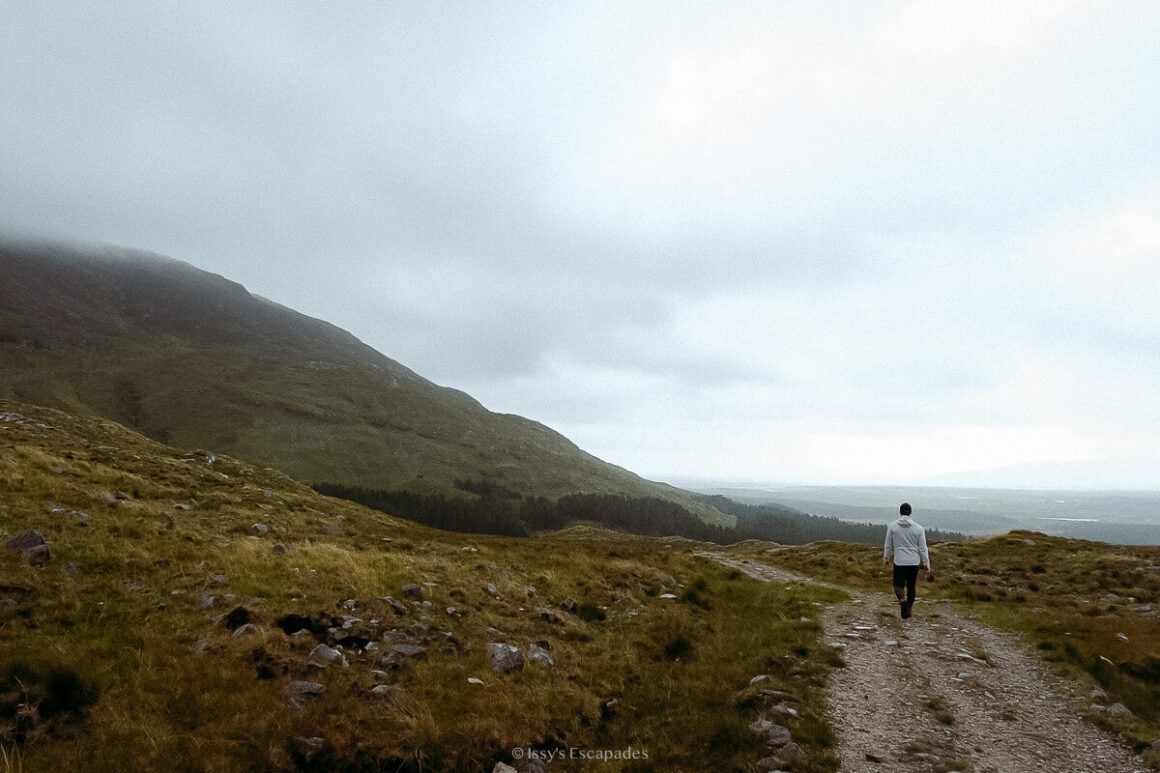
Also referred to as the Maumeen Mountain Pass, the walk follows a steep, rocky path upwards through the Maumturk Mountains.
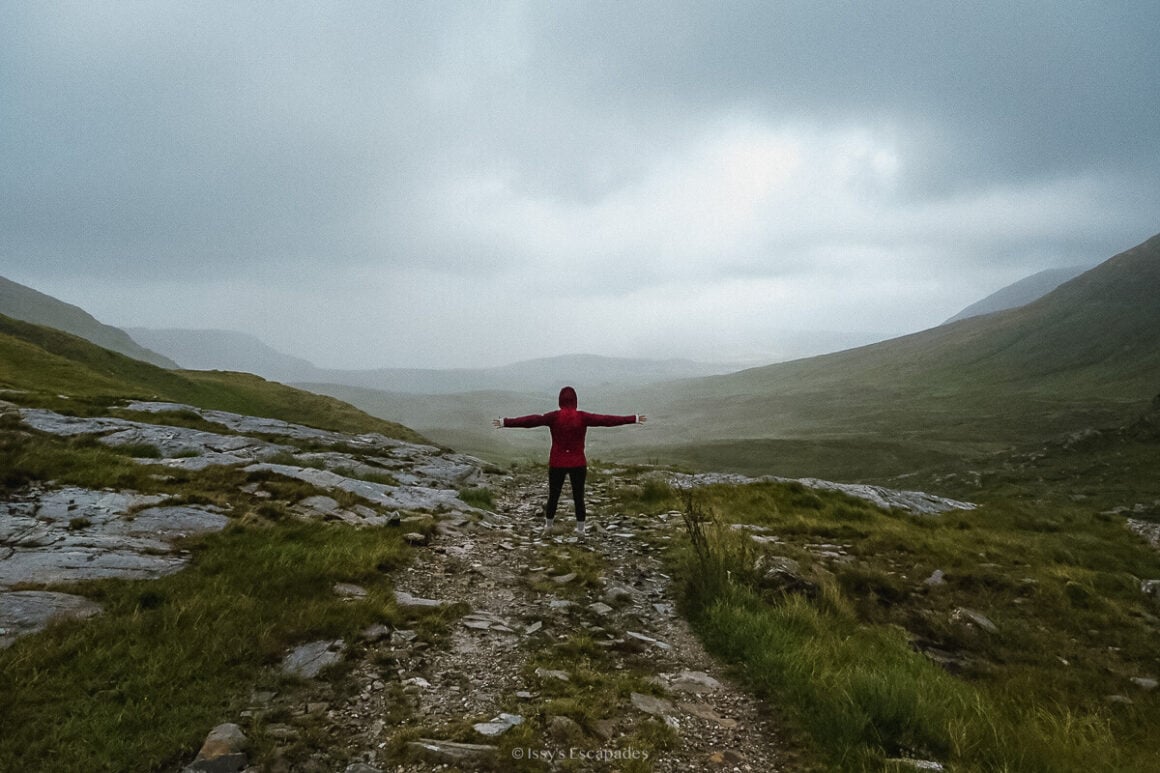
When we climbed (on a rather grey, miserable day), we ascended into thick clouds, blustery winds and sheets of rain – but, weirdly enough, this did not detract from the experience at all but rather made it!
At the top of the trail is a tiny chapel, dedicated to Saint Patrick, who is rumoured to have spent some time at that very spot.
As the winds were strong, we went only this far and returned back to the car, which took under an hour to complete. The walk to the chapel from the carpark is approximately 1.5km each way up and back.
You can also elect to do a number of longer versions of this hike, including walking the whole way to Maam.
However, for a longer walk that is easier to manage from a logistical perspective, as you’ll start and end in the Mám Éan carpark, this 10.5km looped route is the most popular and takes in some more sensational mountain scenery.
Errisbeg Trail
Starting and ending in the village of Roundstone, this 7.5km looped walk takes you through the Roundstone Bog complex, through rare bog habitat and to a modest peak of around 300m, from which you’ll receive some outstanding views of the Connemara landscape.
Killary Harbour Coastal Walk
Mentioned already in the Killary Harbour section above, this 9km stretch of grassy road follows the route of an old famine relief road along the southern shoreline of Killary Fjord.
One of the best walks in Connemara if you want more of a leisurely stroll, you can go as far as you want to hear before turning back, while receiving some beautiful views of the fjord and its surrounding mountain ranges.
Cong and Clonbur Forest Trail
A lovely spot if you wish to go walking in Connemara, this 6km forest walk passes through both Cong and Clonbur woods, taking in a variety of flora and fauna along the way. Starting at the village of Cong, the walk will take around 2.5 hours to complete.
8 Explore some of Connemara’s history
Pearse’s Cottage (Ionad Cultúrtha an Phiarsaigh)


Responsible for his leading role in the Easter Rising of 1916, which set off the chain of events that ultimately led to Ireland’s independence from Britain in subsequent decades, Patrick Pearse is one of Ireland’s most famous characters.
Both an intellectual and a revolutionary, Pearse brought a progressive way to the teaching of his students at his school in Dublin, St. Enda’s, and was a huge proponent for educational reform in the early 1900’s.
He became director of the Gaelic League, an association created to preserve the Irish language, later becoming a member of the Irish Volunteers and ultimately, a council member of the Irish Republic Brotherhood (or IRB), which was responsible for planning the Easter Rising.
On Easter Monday 1916, Pearse read the Proclamation of the Republic from the steps of the GPO and was later court-martialled and executed by firing squad for his role in the uprising.
During his lifetime Pearse developed a strong affinity with the area of Ros Muc in Connemara’s Gaeltacht and purchased land there, on which he built a cottage. He forged strong links with many of the local community, even offering scholarships to Irish-speaking boys of the area to St. Enda’s school.
Pearse Cottage is open to the public to visit, along with a newly developed, state of the art visitors centre, which offers an introduction to the Irish language, Gaeltacht culture and the local environment, all with a focus on the fascinating character that was Pearse.
Whether you have an interest in Irish revolutionary history or not, I’d highly recommend stopping by at what is one of the best Connemara tourist attractions for an hour to learn about both Pearse and the Gaeltacht area.
Plan your visit | Open daily from 9:30AM – 16:00PM. Tickets cost €5 for an adult, €4 for a senior & €3 for children. Family tickets are €13. More information can be found here.
Derrigimlagh Discovery Point
I was really impressed by the Derrigimlagh Discovery Point and it is another one that I would highly recommend makes it onto your Connemara places to visit list.
The site is famous for not one, but two reasons; firstly, as the crash landing site of Alcock and Brown’s first Transatlantic flight and secondly, as the place from which Marconi transmitted the first commercial transatlantic wireless message.
Today, Derrigimlagh is one of 15 Signature Discovery Points along the Wild Atlantic Way. Set in one of the most magnificent wetlands in all of Europe, there is a far-reaching, desolate openness to the site and a 5km signposted looped walk takes you through peatlands and a rich biodiversity of species.
Dotted along the route are six key stops, each with interactive exhibits that tell you either about the natural environment, Marconi’s operations at Derrigimlagh, or Alcock and Brown’s flight.
The area is strewn with tiny lakes and you can also see peat being actively removed from the bog. At the furthest point of the loop you’ll discover the ruined remnants of Marconi’s station and you’ll also happen upon a cairn and memorial to Alcock and Brown.


9 Go fishing in Connemara
Connemara is home to some of the best fishing in Ireland, offering access to privately-owned salmon and trout fisheries. Some of them even have their own complete river systems, with many fisheries providing tackle hire and tuition to visitors.
The Connemara region is absolutely teeming with rivers and lakes, with the opportunity to fish in both. Fisheries in Connemara include the following:
- Ballynahinch Castle Fishery
- Delphi Fishery
- Kylemore Abbey Fishery
- Lough Inagh and Derryclare Fishery
- Screebe Fishery
- The Erriff Fishery
- Culfin Fishery
Note that as with anywhere in Ireland, you will need a licence under Irish legislation in order to fish for salmon and trout in Connemara, and these can be purchased locally.
10 Visit some of Connemara’s castles
Some great places to go in Connemara include a visit to some of its castles. Kylemore Abbey is, of course, its most famous, with images of its exquisite form and almost surreal location responsible for bringing many visitors to Ireland.
While less sumptuous than Kylemore Abbey, Aughnanure Castle is also a wonderful stop off and is a must see in Connemara if you’re in the Oughterard area.
More on visiting each below.

Kylemore Abbey
Set on the shoreline of Pollacapall Lough in Connemara and nestled against a backdrop of lush, green mountain, is the profoundly romantic Kylemore Abbey.
The abbey began its life as a castle, built by British politician Mitchell Henry 1868 as a gift for his wife Margaret after they had travelled to and fell in love with the area in the 1840s on their honeymoon.
Tragically, Margaret’s time spent enjoying her castle was short lived, as she died in 1875 from a fever that she contracted in Egypt. Devastated by his loss, Henry constructed a beautiful memorial church a little further along the shoreline.
The church is a gothic cathedral in miniature and inside, houses coloured marble from each of the four provinces in Ireland.
The castle became an abbey in 1920, when it was purchased by an order of Irish Benedictine nuns who fled Ypres in World War 1. Under the nuns, Kylemore Abbey operated as a boarding school until 2010, when they were forced to close.
Today, as part of an arrangement with the Benedictine nuns who still live at the abbey, Kylemore Abbey is open to visitors. Several rooms of the house, which is in fantastic condition, are open to visitors, allowing a brief glimpse of the interior of the house.


The real boon lies within the grounds of the abbey, however, in the form of the charmingly intricate gothic church and a superbly maintained walled Victorian walled garden, that offers 6 acres of colourful Eden in which to lose yourself. When you are finished, too, there is also a cafe onsite should you be feeling peckish.
Planning your visit | The visitor’s centre and gardens open seasonally, which may change a little year on year. As a rough guide, you will not be able to visit in January and February. Tickets cost €15 for an adult, €12.50 for senior and students & under-16’s are free. Family tickets cost €38. Click here for more info and to purchase tickets.
Aughanure Castle
Aughnanure Castle is special, in that it is a true Gaelic tower house with extremely strong links through the ages to the noble Gaelic family that ran much of Connaught from it – the fearsome O’Flaherty family.
In fact, it was an O’Flaherty who finally handed possession of the derelict castle over to the state in 1952, which led to the castle’s eventual restoration and opening to the public.
Built by the O’Flaherty’s in the 16th century and located just outside of Oughterard near Lough Corrib, this powerful family ruled the west of Connaught for over 300 years from this 6-story bastion of power and defence.


Complete with a double bawn and dry harbour, the castle was the ultimate symbol of status and authority and was the place where the O’Flaherty’s conducted much of their business, scheming and war-lording from.
This informative article brings the family and their affairs at Aughnanure to life and is a very interesting read if you’d like to learn more.
Today, visitors can freely walk through the gates of the castle to observe this imposing fortress for themselves. It’s hard not to bring the castle’s former glory (and gory) days to mind when visiting.
You can access the castle itself and observe many of its defensive features, as well as the ruins of its former banqueting hall. The windows of the hall are decorated with elaborate carvings of vine leaves and bunches of grapes – again a symbol of the status of the O’Flahertys in their heyday.
Planning your visit | Tickets cost €5 for an adult, €4 for a senior & €3 for children. Family tickets are €13. Seasonal opening times – closed for winter months. More information & official opening hours can be found here.
11 Visit some of Connemara’s Islands
Inishbofin Island
Thought to have been inhabited by people for up to 10,000 years, Inishbofin has an ancient history dating back beyond the time of the Druids, and mythology and folklore have played an important role in shaping the island’s story.
Like many coastal locations with good views along the western coast, the island is also home to Dún Gráinne, the ruins of a fort used by legendary pirate queen Grace O’Malley during her exploits.
Sadly, too, it was used as a penal colony by Cromwell for Catholic clerics, who wrought great atrocities to those on the island at the time.
Incredibly scenic, Inishbofin has a number of spectacular beaches with crystal clear waters and also offers visitors 3 looped walks that take in the best of the island’s scenery, including cliffs, coves and harbours. It’s also an extremely popular spot with divers, due to its exceptionally good water quality.
The island is home to an exceptional array of wild flowers and birds, along with two colonies of seals at Stags Rock and Inishgort.
Getting to Inishbofin | Ferries depart from Cleggan Harbour to Inishbofin, with several sailings a day during the summer months, reduced to one per day in winter. More info can be found here.
Pine Island
Located around 20km outside Clifden at the mouth of the Inagh Valley, Pine Island is one of the most popular things to see in Connemara and is amongst its most photographed points.
The island lies within Derryclare Lough, around 200m offshore. What many visitors don’t know is that you can walk out to the island itself via a concrete walkway across the waters for an alternative perspective.
Omey Island
Located just off the village of Claddaghduff, Omey Island can be accessed via foot or car at low tide.
Red direction poles mark the way across the sands to this unique island, which is home to a wealth of heritage, including the ruins of a medieval church, which is surrounded by a semi-sunken village that unfortunately saw its demise during the Great Famine.
While four hundred people once lived on Omey Island, it now only supports a handful of part-time summer residents.
You’ll have gathered by now that epic views and scenery are a common theme in Connemara, and Omey Island is no different – you’ll find beautiful views here of both the Connemara landscape and the tumultuous Atlantic Ocean.

Inchagoill
Lough Corrib is dotted with many islands and its most interesting is Inchagoill, home to two ancient religious sites – the 5th century St. Patrick’s Church and the rather petite 12th century Church of the Saints. The island itself is a lovely slice of wood-filled land and secluded beaches.
I’ve visited the island many times and it’s a fantastically tranquil location, that is perfect for quiet contemplation and you can thoroughly understand just why the churches were built here all those years ago.
Unless you have access to a motor boat of your own (or have rented one), then the only way out to Inchagoill is via a boat tour. Corrib Cruises departs daily from Lisloughrey Pier June through September.
12 Visit some of Connemara’s towns and villages
There are some wonderful towns in Connemara, as well as a number of picturesque villages, each with plenty to do either in them or in the surrounding area, making them some of the best places to visit in Connemara.

Clifden
Clifden is a spirited, colourful town that occupies a beautiful section of coastline in the heart of Connemara. You’ll find plenty of things to do in Clifden, as well as lots of eateries and boutique stores.
There’s also much to do in the surrounding area and Clifden acts as a wonderful hub from which to explore the rest of Connemara from.
Some top things to do in Clifden, Connemara and the surrounding area include:
- Driving the Sky Road
- Visiting Clifden Castle (at the start of the Sky Road)
- Visiting the Station House Museum, which contains an eclectic collection that includes the history of Clifden and its founder, the Connemara Pony, the Galway to Clifden railway line, Marconi’s wireless station, Millars woolen mill and Alcock and Brown
- The Connemara Heritage and History Centre
- Drive out to Knockbrack Megalithic tomb
- Visit and explore the Derrigimlagh Discovery Point
Oughterard
Oughterard is a charming small town on the western shores of Lough Corrib and is one of the first Connemara towns that you’ll hit if you’re traveling to Connemara from Galway.
There is much to do in the area, including:
- Visiting Aughnanure Castle, the former fearsome O’Flaherty stronghold
- Exploring the unique Brigit’s Garden, 11 acres of wildflower meadows and native woodland surrounding four Celtic-themed landscaped gardens that have been designed by Chelsea Flower Show winner Mary Reynolds
- Taking a boat cruise on Lough Corrib and exploring some of its islands, like Inchagoill
- Hitting the Derroura Mountain Bike Trail Network if you fancy an adrenalin hit
- Descending into the depths of Glengowla Mines and visiting their working farm (one of the top things to do in Connemara for kids)


Roundstone
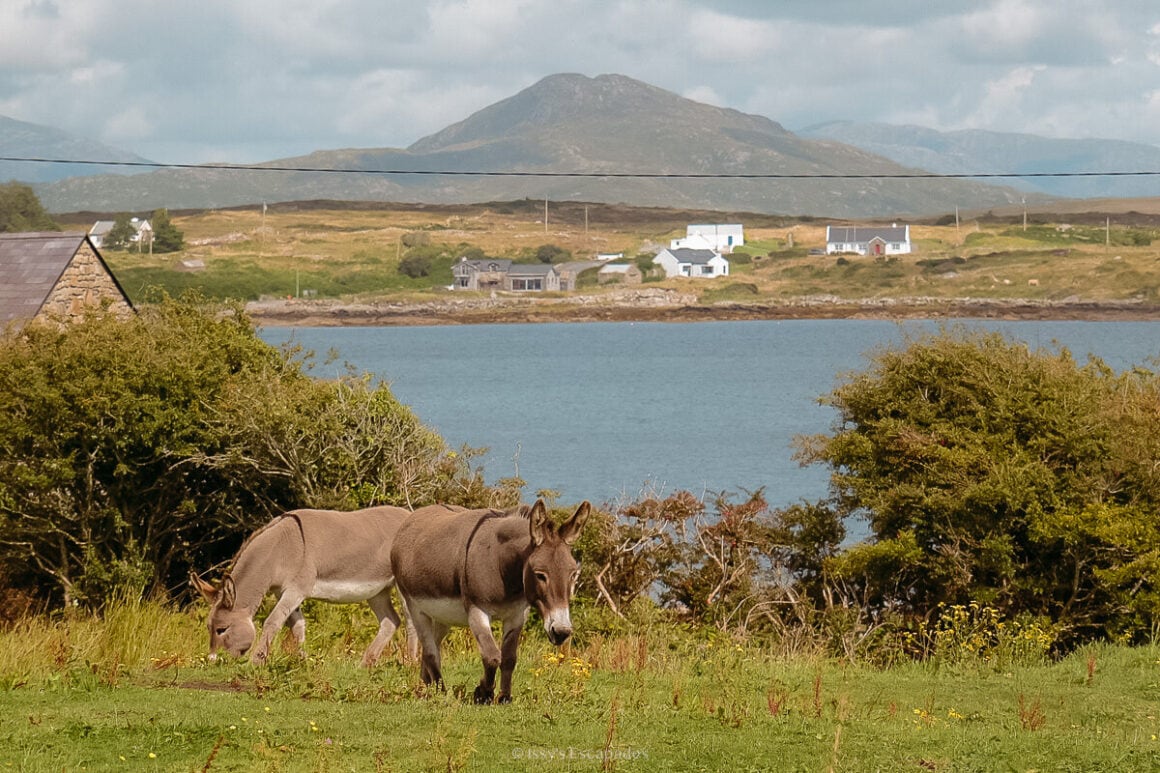
I have real affection for the small finishing village of Roundstone, set as it is along a stretch of sparking cerulean water with its hodgepodge of colourful houses and quaint harbour. Despite its diminutive size, it’s a thriving, buzzy spot that is extremely popular for good reason.
Top things to do in Roundstone and the surrounding area include:
- Spending some time at Dog’s Bay or Gurteen Bay beaches
- Visiting the highly unique Roundstone Musical Instruments & Crafts
- Grabbing one of the best toasties you’ll ever have at Good Stuff food truck, or having a fresh seafood lunche at Vaughans Bar & Restaurant at the Roundstone House Hotel
- Hop on a boat tour at the harbour with Roundstone Bay & Island tours
- Walk the Errisbeg Trail around the Roundstone Bog Complex
Letterfrack
Another of the lovely villages in Connemara, Letterfrack serves as the gateway to the spectacular Connemara National Park, with the main entrance to the park close to the village.
Known for its live traditional music, the town is set in exceptionally picturesque surroundings, sitting at the foot of Diamond Hill and the mouth of Ballynakill Bay.
Some top things to do in Letterfrack:
- Visit the Connemara National Park and climb Diamond Hill
- One of the top things to do near Letterfrack is to visit Kylemore Abbey, which is a few kilometres down the road
- Have a hearty, high-quality seafood meal Veldons Seafarer Bar & Restaurant, a Letterfrack institution
- Visit Books at One, a fantastic community bookstore
- Pop out to the Renvyle Peninsula and explore the area


Leenane
One of the most perfectly situated villages in Connemara, Leenane occupies a sheltered position at the end of Killary Fjord, amongst some of Ireland’s most magnificent scenery.
One of the best Connemara things to see is the fjord itself, but there are some other things to do in Killary Harbour, as well as things to do near Leenane to keep visitors busy.
- Take a Killary Fjord boat tour to take in the spectacular setting and learn about mussel farming
- Walk along the old Famine relief road on the southern shore
- Visit the Sheep and Wool Centre in Leenane village to learn about the old traditions of spinning, knitting and weaving and pick up a gift in the store
- If you’re feeling active, pop into the Killary Adventure Centre for an afternoon of fun
- Visit Aasleagh Waterfall, and see if you can spot salmon in the stream
- Pop over the boarder to Mayo and drive through the Doo Lough valley
- Take some time to relax at the Connemara Seaweed Baths. Check here for more information

Where to stay in Connemara
Hotels in Connemara can be a little hit and miss, but there are some truly outstanding places to stay in Connemara, in the form of hotels, guesthouses and lodges if you know where to look. Here are some of my favourites.
For a full rundown on where to stay, you can read my Best Accommodation In Connemara post.
Ballynahinch Castle Hotel
If you’re looking for the best hotel in Connemara, then you’ve come to the right place. Ballynahinch Castle is quite possibly the best situated hotel in the country too and offers guests plush but comfortable surroundings, an excellent food offering and a wonderful daily programme of outdoor activities.
My pick of the bunch if you’re searching for luxury hotels in Connemara.
Delphi Lodge
This is a rather special hunting lodge that’s been restored to its former glory. Nestled at the base of the tallest mountains in Connemara, this is the best place to stay in Connemara if fishing is on your agenda – it’s home to the Delphi Fishery and some of the best fishing in the country.
Its tranquil surroundings and convivial atmosphere will make all guests of Delphi Lodge Connemara very happy, however, and its dining experience is a truly fantastic event each evening.
Lough Inagh Lodge
The perfect place for weary travellers to lay their heads once they’re done with their Connemara sightseeing for the day, Lough Inagh Lodge is set right on the edge of Lough Inagh and many of its rooms have a view of its waters.
Extremely comfortable and warm with welcoming and helpful proprietors, this non-stuffy lodge also offers great meals prepared with local produce
Ardagh Hotel & Restaurant
Location wise, the town of Clifden is one of the best places to stay in Connemara and at Ardagh Hotel & Restaurant you’ll be within a few minutes drive of the town, while also being in a prime position on Ardbear Bay and the fantastic sea views that it offers.
This homely small hotel is beautifully decorated – make sure to check out its suite and sea view rooms.
Things to do near Connemara
If you’ve run out of things to do in Connemara, then there are plenty of things to do near Connemara also. Some of these include:
- Visiting the Georgian town of Westport
- Climbing Croagh Patrick
- Driving the Doo Lough Valley
- Visiting the Lost Valley of Uggool in neighbouring Mayo
- Visiting the Aran Islands
- Spending some time in Galway city
How many days do you need in Connemara?
Many visitors from abroad often visit on a day trip from Galway to Connemara and if you are tight on time, it can at least provide you with a visit to Clifden, Kylemore Abbey and possibly some of the Inagh Valley.
However, bear in mind that this is a region that many Irish families summer holiday in and it is for good reason.
I most recently spent a week in Connemara and could have easily spent more. There are just so many beautiful places to visit in Connemara and the more you see, the further you’ll scratch beneath the surface of the region and want to discover more.
So, in terms of how much time you need in Connemara, the answer is twofold. Firstly, if you have the luxury of time I would consider allocating all of your time to the region to travel deeply and plan a full holiday in Connemara of a week or more.
If time is not on your side, or if you’re visiting Connemara as part of an Ireland itinerary, then consider giving yourself around 3 days to do the area justice.
This will give you enough time to experience the region’s highlights, while not feeling like you are rushing around too much. You’ll have to understand, however, that you won’t fit in everything that you want to do.
Where to eat in Connemara
There has been somewhat of an exodus of chefs from Dublin and other larger urban centres since the pandemic hit and it would seem that some of these have wound up in the wilds of Connemara.
While Connemara has always taken pride in the provenance of its ingredients and in the honest, good cooking of the same, you’re now just as likely to find creative takes on traditional classics too, with tasty morsels being served from pop-up restaurants, food trucks and horseboxes.
Here is a snippet of what you can find in Connemara, from old favourites to new kids on the block – for me, discovering the region’s best eateries is one of the most fun things to do in Connemara!


(Editor’s note: since deciding to write this post, I realised that there are just too many great places to eat in Connemara to squish into one post. Thus, I have published a full post dedicated to the best restaurants and places to eat in Connemara.
I f you’re short on time, here are the names (if not the descriptions) of some of the best places to eat in Connemara:
- Misunderstood Heron (Killary Fjord)
- Lough Inagh Lodge Restaurant (Recess)
- Owenmore Restaurant at Ballynahinch Castle (Recess)
- Good Stuff food truck (Roundstone)
- Dooncastle Oysters food truck (Castle Demesne, near Kylemore Abbey)
- The Lamplight Wine Bar (Clifden)
- Mitchell’s Restaurant (Clifden)
- The Sea Hare (Cleggan – since moved to Clifden)
- Veldons Seafarer Bar & Restaurant (Letterfrack)
Connemara: map of attractions
To make it easy for you when you visit Connemara, I’ve included the majority of the things to do in Connemara in this post in this map. If you click on the star beside the title, you’ll be able to view and save it to your own Google Maps to have it for reference on your own phone when you visit.
Planning your trip to Connemara
When to Visit Connemara
Throughout the year, Connemara witnesses some of Ireland’s wettest weather. October experiences the most rainfall, with November, December and January not far behind it.
Temperatures will also be rather chilly throughout these months and you’ll often face a bracing wind as well as clouds that come down low over the mountains (making it hard to see all that stunning scenery).
The best time to visit Connemara is spring through summer, tapering off as the month of September draws to an end. From April, you’ll start seeing a burst of colour as many of Connemara’s diverse plant life begins to emerge.
It also happens to be the region’s driest month, making it a good month to visit if you want to travel in the shoulder season and aren’t too worried about the weather being that warm.
While you’ll never experience tropical weather in Connemara, the mildest months are June through August, making these wonderful months to visit if you’d like to swim in the sea, but these are also the region’s most popular.
Bear in mind that all children are off school in the months of July and August in Ireland and it can make securing accommodation in Connemara a little tougher – so make sure to book several months out if you’re planning on a summer sojourn.

How to get around Connemara
The giant appeal of Connemara is in its vast expansiveness and desolate landscape. The area isn’t too densely populated and so you will struggle to make your way round by public transport as there are not too many routes in operation.
While there are very good bus connection links between Clifden and Galway city, you’ll struggle a bit if you want to get anywhere else.
Leenane, Cleggan and Letterfrack are somewhat serviced (maybe once/twice a day) but outside of that, you are on your own and it would be a shame to miss out on so much of the rest of the region.
Without a shadow of a doubt, the best way to get around Connemara is by car. If you don’t have a car at your disposal, I would highly recommend that you rent one.
How do you get from Galway city to Connemara?
Getting from Galway to Connemara is relatively painless and there are two options that you can take; the first is via the lakes and has a better quality of road – follow signs to Clifden when you are leaving Galway city.
The second is the coastal route, which takes you through the Gaeltacht via some rather bumpy roads – take signs for ‘An Spidéal‘ for this one. Both are beautiful routes and if you’re just wanting to get from A to B in the most straightforward manner, take the first route.
If you want to reach Connemara by bus from Galway, there are two options.
- Bus Eireann – via the 424 and 419
- City Link – a twice daily service that departs Galway and travels to Clifden, then on to Letterfrack and Cleggan.
What is the nearest airport to Connemara?
If you’re flying into Ireland from abroad, then the nearest airport is Knock Airport at 77km away, which is a regional airport that serves some of the UK and mainland Europe.
You’ll find a better selection of flights and destinations to Shannon Airport in Co. Clare, which is 117km away from Connemara and which serves some North American destinations also.
Failing that, Ireland’s main airport, Dublin Airport, is an international hub and is approximately 240km distance from the heart of Connemara.

Before you go
Everything I check before a trip now lives on one page.
Seven shifts I run on every trip I plan, each one paired with the story that taught it to me and the steps for using it yourself — built to be printed, kept, and pulled back out before the next one.
It arrives when you join The Cultured Voyages Edit, a fortnightly letter on European cultural travel.
Things to do Connemara – planning your trip & common FAQs
What are the best things to see in Connemara?
If you’re limited on time, or want to only fit in a couple of things in Connemara to do, then top picks would be:
- Kylemore Abbey
- Spending time at one of Connemara’s beaches
- Pearse’s Cottage at Rosmuc
- Driving either the Sky Road or the Connemara Loop
- Going on a hike in Connemara
- Sampling some locally caught seafood at one of Connemara’s fantastic restaurants

Can you do a Connemara road trip in one day?
While you’ll by no means see everything, it is very much possible to get a great flavour of the region in one day, via a day trip from Galway.
In terms of what to see in Connemara in one day, for me, Connemara highlights include visiting Pearse’s Cottage, driving the Connemara Loop and then finishing your day with a stop off at Kylemore Abbey, before making your way back to Galway.
If you’d prefer to let someone else do the driving, then I’d recommend taking a day tour from Galway, like this one.
Can you drive through Connemara National Park?
No, it is not possible to drive through Connemara National Park. The best way to see the park is by hiking some of its trails. You can, however, drive through much of the region of Connemara and if you’d prefer to see the region by car, then I’d recommend you drive the Connemara Loop.
Where can I swim in Connemara
You won’t be shy of places to swim in Connemara. Take a look at the beaches section above for inspiration.
What are the best things to do in Connemara in the rain?
You may be hoping that you might be able to dodge some rainfall when you’re in Connemara, but that would be rather naïve of you, my friend! Either that, or you’d be extremely lucky.
It’s always useful to have some rainy day activities up your sleeve and the best places to visit in Connemara Ireland on a rainy day include:
- Pearse’s Cottage
- Hitting some seaweed baths at either Leenane or Clifden
- Having a long lunch at one of Connemara’s wonderful eateries, or spending some time in a cosy pub
- Go for a drive – depending on how thick the clouds are, if it’s not too heavy the light can pull some magnificent shapes on the mountains and appear to dance across the landscape. The effect is absolutely spectacular as you pass through the countryside.
- Visit the Station House Museum in Clifden
- Spend some time at Books at One in Letterfrack
- Hop from shop to shop in Clifden in between rain showers
While I’ve seen other guides recommend visiting Kylemore Abbey on a rainy day, I’d question whether they’ve actually visited Kylemore Abbey, or given it the full time it deserves. You’ll spend barely 20 minutes in the house, as only a few rooms are open to the public.
The highlight of a visit to Kylemore Abbey are the incredibly well maintained Victorian Walled Gardens, reached via a fairly substantial walk (or a short shuttle bus, if you’re not up to walking).
Much of a visit to Kylemore Abbey will be spent outdoors, making your way between points of interest or admiring the awe-inspiring setting – which is not an activity for a rainy day!
Where to next
- CONNEMARA ACCOMMODATION | The Best Accommodation In Connemara, From Castles To Coastal Cottages
- CONNEMARA RESTAURANTS | The Best Connemara Restaurants, From Fine Dining To Food Trucks
- THE SKY ROAD | Driving The Sky Road Clifden – A Short Guide
- CLIMBING CROAGH PATRICK | Essential Tips Before You Climb Croagh Patrick – Conquer The Reek
- THINGS TO DO IN WESTPORT | Things To Do In Westport, Ireland – An Irish Heritage Treasure
- 7 DAY IRELAND ITINERARY | 7 Day Ireland Itinerary – A Local’s Guide To Discovering The REAL Ireland
Like this post? Please share or pin for later

