Disclosure: Some of the links on this site are affiliate links. If you make a purchase through one of them, I may earn a small commission at no extra cost to you. Read my full disclaimer here. Thank you for your support!
Discover Kilkenny’s Medieval Mile through a local’s eyes in this comprehensive guide. Uncover the rich history of Medieval Kilkenny, get expert tips for visiting key sites along the route, and hear some of the more interesting tales from medieval Kilkenny.
As a local, I’ve always been fascinated by the stories that seem etched into the very fabric of Kilkenny. Many of these originate from medieval times, emanating from the powerful legacies of William Marshal and the Butler dynasty.
Marshal was a trailblazing Norman who married the daughter of an Irish princess and the man credited with leading the Norman invasion of Ireland; Strongbow.
His descendants later passed the baton on to the influential Butler family, whose own political endeavours (and successes and failures while carrying them out) were intrinsic to the fortunes of Kilkenny.
In this blog post, you’ll learn how to visit Kilkenny’s Medieval Mile.
I’ll cover each of the main sites that are featured on this popular tourist route, with information on how to, as well as my top tips for, visiting each of them.
However, I also seek to go further than this. You’ll also discover the captivating tale of medieval Kilkenny, which I’ve done by highlighting significant figures and events that shaped this city.
From its pre-Norman importance to its thriving merchant class and the dramatic events of the Irish Catholic Confederation, this guide aims to illuminate the medieval past that continues to define Kilkenny today.
By discovering some of this past, you’ll have far greater context for your visit in the present day. Hopefully, it will make your visit to Kilkenny that little bit richer for it.


What’s the significance of Kilkenny’s Medieval Mile?
Kilkenny’s Medieval Mile is a unique, historical path that stretches from Kilkenny Castle to St. Canice’s Cathedral. This distinctive route encapsulates a significant portion of the city’s medieval history, offering visitors a tangible connection to its past.
The Mile encompasses various historic sites, including well-preserved medieval buildings, ancient churches, and the vibrant High Street.
The significance of Kilkenny’s Medieval Mile lies in its ability to showcase the city’s importance during medieval times. Kilkenny was a major economic and political centre in medieval Ireland, reflected in the grandeur of its buildings from this period and the historical events that took place there.
The initiative to promote the Medieval Mile was a fantastic endeavour. As a local, I’m proud of how it serves to highlight Kilkenny’s unique status in Ireland for its well-preserved medieval architecture and urban layout.
Unlike many other Irish cities, Kilkenny has retained a significant number of its medieval structures, making the Medieval Mile an exceptional example of historical preservation and a vivid window into this particular part of Ireland’s past. It makes it a city that is highly worth visiting when travelling to Ireland.

RELATED READING | Is Kilkenny Worth Visiting? A Local’s 16 Pros (+5 Challenges)

An overview of Kilkenny’s medieval history
Before I go into the sites on the Medieval Mile in detail, I think it’s important to have some context as to what went on in Kilkenny during the medieval period.
I’ve set out a brief overview in this section, but will go into each of the key figures and events in more detail after the I’ve covered the key sites on the Medieval Mile and how to visit them.
I’m guessing that some have landed here just wanting to know how to visit the Medieval Mile – but please do continue to read on afterwards to learn more about the key movers and shakers in medieval Kilkenny!
1 | Kilkenny’s early beginnings
Before the Norman invasion of Ireland, Kilkenny was already a significant settlement, serving as the chief town of the Kingdom of Osraighe. This early importance is exemplified by St. Canice’s Round Tower, built around 1100 AD and the oldest structure in Kilkenny. It stands sentinel over what was likely the original town.
2 | Enter William Marshal
In 1207, William Marshal, Lord of Leinster – you’ll learn more about him and his wife later in this post – granted Kilkenny a charter, setting out his citizens’ rights.
This charter, later included in the 14th-century Liber Primus Kilkenniensis, showcased the city’s medieval prominence, and is still kept in Kilkenny’s Tholsel, or City hall, to this day.
Kilkenny Castle, previously a motte and bailey structure constructed by Marshal’s father-in-law, Strongbow, was soon set in stone. The castle soon became a central figure in regional politics. Marshal and his sons embarked on other building projects that included St. Canice’s Cathedral, the Black Abbey and St. Mary’s Church.
Marshal’s introduction of burgage plots for a rent of 12 pence a year spurred economic activity, turning Kilkenny into a bustling trade centre. Burgage plots were long plots of land, that included a section with one end on the main street; a shop front, if you like.


3 | Significant events of the 14th century
In terms of Kilkenny’s most significant events of the 1300’s, I’d probably say they were three (four if you include the Black Death, although that in part contributed to the second event I’ll outline below).
The first is that Kilkenny was host to Ireland’s first condemnation for witchcraft.
Dame Alice Kytler, and her servant Petronella, were found guilty of heresy and sentenced to death. Alice, aided by friends in high places was able to escape, but poor Petronella was flogged and burned at the stake, having been tortured for a (pretty wild) confession.
Secondly, was the passing of the Statutes of Kilkenny.
These thirty-five acts, passed by the Parliament of Kilkenny, aimed at preventing the Anglo-Normans from assimilating into Irish culture (which they had started to do pretty well, becoming, it was said, ‘more Irish than the Irish themselves‘).
Although largely ineffective in practice, the statutes are historically significant for highlighting the challenges in Anglo-Irish relations and affirming Kilkenny’s status as a medieval legislative centre.
Thirdly, was the acquisition of Kilkenny Castle by the Butler family.
The years following Marshal’s death in 1219 had been plagued by succession issues. The Lordship passed to each of Marshal’s five sons, each of whom died heirless. Lands that included Kilkenny were divided between the female line down through several generations, until the Butlers acquired Kilkenny Castle in 1391.
4 | Kilkenny flourishes under the Butlers
For over 500 years, the Butlers significantly influenced Kilkenny’s development. Closely aligned with the English monarchs (for the most part), their fortunes rose and fell alongside those of the monarchs that they chose to back.
Throughout the medieval period following their takeover, Kilkenny thrived economically and politically, dominated by influential merchant families. These families, often aligned with powerful entities like the Butlers, controlled local churches and contributed significantly to Kilkenny’s growth.
5 | Post-medieval period
During the post-medieval period, Kilkenny’s history reflected wider Irish events, with local families like the Butlers involved in significant historical events, including the Battle of the Boyne.
The Rebellion of 1641 brought forth the Irish Catholic Confederation, with Kilkenny at its heart until Cromwell’s conquest in 1649.
James II’s residency in Kilkenny Castle during the frigid months of 1689-1690 is a stark reminder of the city’s strategic significance.
Kilkenny’s medieval chronicle is not just a story of buildings, battles and political intrigue, but a vivid saga of a city at the crossroads of many of Ireland’s most tumultuous historical events.
The key sites of the Medieval Mile
This section will guide you through 12 principal sites that bring Kilkenny’s medieval era to life. From the imposing Kilkenny Castle to the serene St. Canice’s Cathedral, each location offers a glimpse into a time where history and daily life intertwined.
After delving into these fascinating sites, the subsequent section will equip you with practical tips for visiting, ensuring your experience along Kilkenn’ys Medieval Mile is both memorable and smooth.
1. Kilkenny Castle


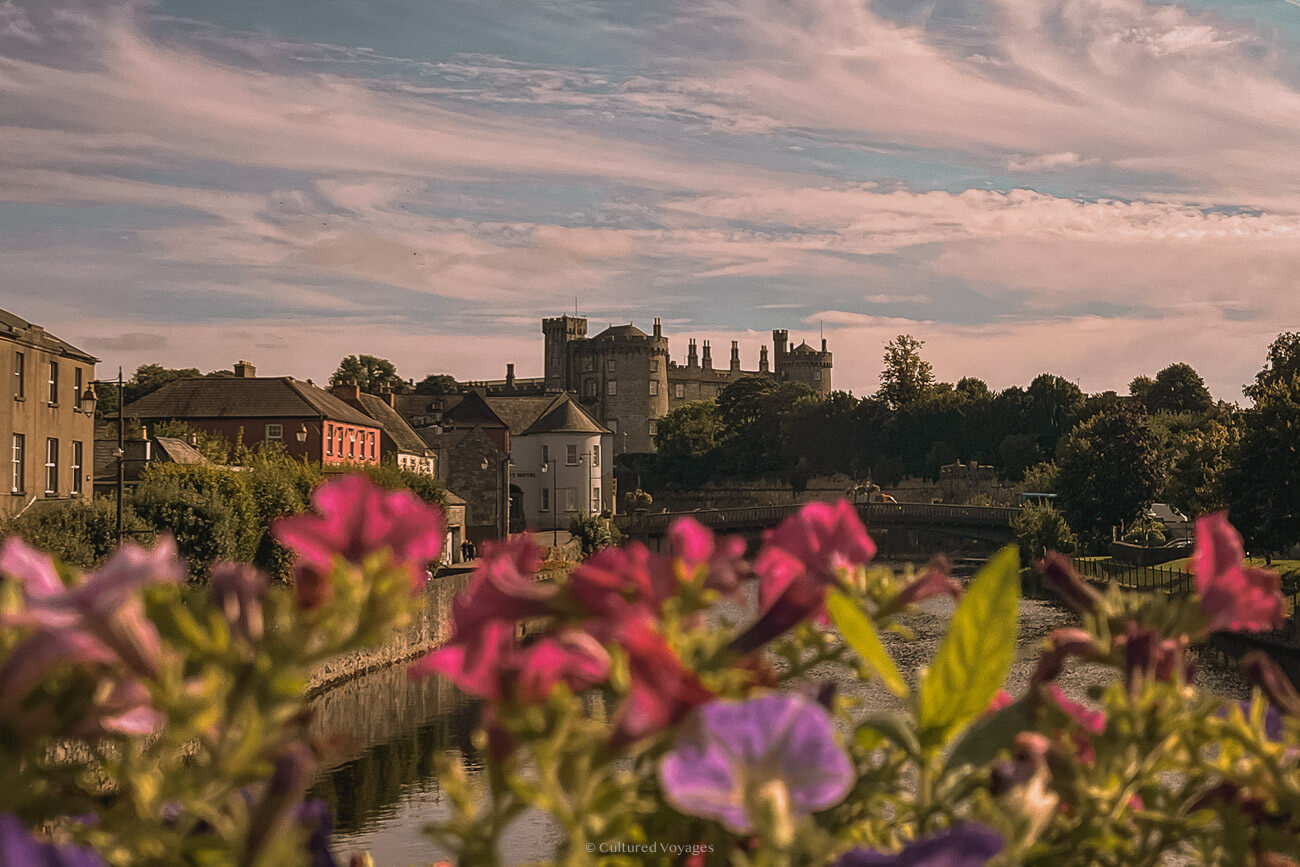
The most famous site along the Medieval Mile is without a doubt Kilkenny Castle; which is indeed one of the most famous castles in the country.
Kilkenny Castle was originally a wooden motte-and-bailey built by Richard de Clare, known as Strongbow, in the 12th century. The wooden structure was transformed into the stone fortress we see today in 1260, under William Marshal following his marriage to Strongbow’s daughter, Isabel.
Its commanding presence at a strategic fording point of the River Nore has made it a central figure in Kilkenny’s history for nearly a thousand years. The castle’s evolution from a Norman defensive structure to a symbol of Anglo-Irish power is a narrative that is firmly captured within its thick walls.
The Butlers of Ormonde, who acquired the castle in 1391, were instrumental in shaping the castle’s destiny, as well as that of Kilkenny.
Under their stewardship, the castle and city flourished, reflecting the family’s significant role in Irish history. Their legacy is also intertwined with notable figures like Lady Margaret Butler, the grandmother of Anne Boleyn, underscoring the castle’s connection to broader historical events of that era.
The castle’s story took a dramatic turn in the 17th century during the Irish Confederate Wars. Despite being a stronghold for the Protestant Butler family, it became the capital of Confederate Ireland, hosting the Catholic rebel movement’s parliament from 1642 to 1648.
This period was marked by a complex interplay of loyalty and conflict, reflective of the era’s turbulent politics.
During the siege of Kilkenny by Cromwell in 1650, the east wall and north-east tower of the castle were significantly damaged. They were later torn down.
In 1661, James Butler, the 1st Earl of Ormonde, remodelled the castle in the style of a French chateau following his return from exile. During the 19th century, the Butlers attempted to restore the building to its original medieval appearance. They also rebuilt the north wing and extended the south curtain wall.
In 1967, the castle was sold for £50 to the Castle Restoration Committee, a symbolic gesture acknowledging its importance to the people of Kilkenny. The event, attended by celebrities like Mick Jagger and Marianne Faithful, marked the beginning of a new era for the castle as a public heritage site.
As someone who grew up near Kilkenny city, the castle has always been more than a historical landmark; it’s a place that features strongly in the heart of the community. From the Castle Park, a hub of social life, to the Long Gallery with its striking ceiling, every corner tells a story.
When visiting, I recommend allowing time to fully appreciate both the castle’s interior and its expansive parkland. Regular guided tours run, which I advise taking if you’d like to learn more about the castle and its occupants’ lengthy history.
Do note that the interiors of the current castle are a Victorian manifestation and not a medieval one; the castle and its interiors underwent major refurbishment in the 19th century.
PLAN YOUR VISIT | Castle open daily with seasonal hours: October to March (09:30 – 17:00) and April to September (09:15 – 17:30). Admission costs €8 for adults, with concessions available. Consider the option of a guided tour for a more in-depth experience. Due to its popularity, it’s advisable to book tickets in advance. Parklands’ closing times vary across the year, detailed on their official website.
2. Shee Alms House


Once you leave the castle and Parade behind you, take a right down Rose Inn Street to view the front of the Shee Alms House.
Founded in 1582 by Sir Richard Shee, the Shee Alms House stands as a relic of medieval Kilkenny’s approach to community and care.
Initially built to house ‘honest, unmarried men‘ and widows over 50, it provided shelter to those who were blind, lame, or too infirm to work – in what was a rare medieval act of charity. This was a time when societal support structures were scarce, making the Alms House an essential refuge.
The building, with communal fireplaces and divided cells, paints a vivid picture of communal medieval life. Its continued restoration and research are crucial in keeping these stories alive, providing us with invaluable insights into the social fabric of medieval Kilkenny.
Excavations uncovered items like pottery shards and leather fragments, tangible connections to its past inhabitants.
Located very close to St Mary’s Church, it was strategically placed to be visible to Kilkenny’s elite, marking its patron’s charity in providing a sanctuary for the marginalised.
Recently, I discovered that research has been undertaken by the Medieval Mile Museum, to find out just who the ‘Shee’ family were, as it seemed like they turned up in Kilkenny out of the blue.
The Shee’s, it turned out, were in fact ‘Shea’s’ from County Kerry, and upwardly mobile family who Anglicised their names in an attempt to fit in with the primarily English/Norman elite who operated in Kilkenny.
Prior to its recent restoration works, the Shee Alms House was used as the Kilkenny Tourist Information Centre; I’m not sure what it’s intended future use is, but I will update this should I find out!
To the left of the Alms House, between Syd Harkin’s pub and Valley of Roses perfume shop, you’ll find steps that lead up to Mary’s Lane – take these to view the back of the Alms House, which show further unique architectural details as well as beautiful ironwork on the thick wooden door.
3. St. Mary’s Medieval Mile Museum


While it’s included as stop three on this guide, I’d actually recommend starting at the Medieval Mile Museum if you can.
Housed in the 13th-century St. Mary’s Church, I believe it to be a vital starting point for anyone exploring Kilkenny’s medieval history. The museum is a significant cultural addition to the city, and showcases an array of medieval artefacts, telling the story of Kilkenny through a meticulously curated collection.
Its educational value, particularly the knowledgeable guides, many historians themselves, makes a visit thoroughly enlightening. They’re constantly researching and learning more about medieval Kilkenny, so the guides are bursting at the seams with some really interesting stories and anecdotes to impart on visitors.
The museum’s location, where it occupies one of Ireland’s finest examples of a medieval church, fittingly connects the past with the present. At the museum itself, you can explore Ireland’s finest examples of medieval sculpture and the largest collection of Renaissance tombs in the country.
Notable exhibitions include the High Kings of Ossory, the foundation of the monastery by St Canice, and Kilkenny’s extraordinary civic records dating back to the 1200s. The Rothe Chapel, showcasing well-preserved medieval carvings, and the atmospheric graveyard are other highlights.
You can visit in a self-guided fashion, but I highly recommend that you take one of their reasonably priced tours, of which there are two kinds. The first is a tour around the museum and church grounds itself. The second is a walking tour of Kilkenny’s Medieval Mile.
I personally did the walking tour when a friend from Denmark was visiting; who also found it as interesting as I did (so it’s not just my biased, local opinion!). Tours run more frequently during the summer season (the walking tours are limited to one a day on weekends only in winter), so I’d advise checking what’s available.
The museum itself is closed on Tuesdays and Wednesday during the quieter months of November through February.
I really would recommend that you try your best to include the Medieval Mile Museum on your itinerary – it will vastly deepen your understanding of medieval Kilkenny and you’ll hear lots of weird and wonderful stories about Kilkenny’s medieval inhabitants along the way.
PLAN YOUR VISIT | Open Mar-Oct: Daily 9.30am-4.30pm; Nov-Feb: Thu-Mon, closed Tue-Wed. Admission: Adults €9, Concessions €7.50. Buy general entry tickets here. Museum & Graveyard Tours available, with family tickets at €30. Weekend Medieval Mile Walking Trail at 11am, Adults €15. Check the museum’s website for more details on opening times.
4. The Tholsel


Exit the Medieval Mile Museum, and you’ll be able to walk through the back of the Tholsel onto High Street.
The Tholsel was originally a 14th-century guildhall and now stands as a Georgian architectural gem. The fact that it’s still an iconic landmark along Kilkenny’s main street, and still in use, stands as a testament to the city’s evolution from medieval times to the modern day.
Constructed in 1761, it has played a significant role in the city’s administration, housing the meetings of Kilkenny Corporation, now known as the Borough Council. The Tholsel has been a pivotal site in Kilkenny’s civic life, overseeing various aspects of city management from water supply to street cleaning.
This historic building, marked by the tragic execution of Petronella de Meath in 1324, is deeply intertwined with Kilkenny’s medieval past. Underneath is sits the old jail and courthouse.
There are plans to transform it into a museum of Kilkenny’s civic history over the centuries (which is well document and of which there is a lot of material). I, for one, would greatly welcome this.
While currently not open for internal tours, its prominent location on High Street and striking exterior continue to make the Tholsel a significant landmark for visitors.
5. The Butterslip


Every time I duck down the Butterslip, it feels like stepping back into medieval Kilkenny.
This narrow alleyway, dating back to 1616 and originally lined with butter vendors, encapsulates the essence of the city’s historical market life. Its arched entry and stone steps beneath two houses create a quaint passage from High Street to St. Kieran’s Street.
To truly appreciate the Butterslip, one must take a moment to pause and look up at the window above the arch that crosses the alley – a small but significant detail that greatly contributes to making the Butterslip as charming as it is.
Though short and compact, this pedestrian-only lane, now flanked by souvenir shops and eateries, retains its medieval charm and is a must-visit for anyone wanting to experience the unique character of Kilkenny.
A little further up along High Street, you can also duck down the Market Slip.
6. Kyteler’s Inn

Kyteler’s Inn is an out-and-out institution in the city of Kilkenny. It sits at the foot of the Market Slip along Kieran’s Street.
Rooted in the 13th-century and established by the notable Dame Alice de Kyteler, it’s a true testament to the city’s medieval life and its legends. Alice, a wealthy Norman woman, famously evaded witchcraft charges, leaving behind a legacy that continues to intrigue.
Today, the inn is still going strong as a vibrant pub and restaurant, blending history with hospitality.
You can drop in for some food or a drink while going past. The pub is open throughout the day, with nightly traditional music to be heard throughout the summer season.
PLAN YOUR VISIT | Open daily with varying hours: Tue-Thu & Mon 11:30am-11:30pm, Fri-Sun 12pm-11:30pm. Experience traditional Irish music nightly during the high season, starting at 8pm Mon-Thu and at 6.30pm & 10pm Fri-Sun. See their website for more info.
7. Grace’s Old Castle/Court House

After Kytler’s Inn, make your way down Parliament Street towards Irishtown to what is now Kilkenny Court House, but was previously known as Grace’s Castle.
Grace’s Castle was originally built by William le Gras (a Norman) some time before 1210. The Grace family were descended from Raymond le Gros, who was a key figure in the Norman invasion of Ireland.
Initially, they used the castle as a townhouse. It remained a private residence until it was leased to the state in 1566 by James Grace, who was then the Governor of Ireland. After this point, it transformed into a gaol, and was used as such for around 200 years, later becoming a courthouse in 1792.
During excavations undertaken as part of renovations, several interesting discoveries were made, including the remains of prisoners who had been executed at the gaol.
While the courthouse may not offer tours, its presence in Kilkenny remains a significant link to the city’s medieval and early modern eras, a testament to the enduring narrative of a city that has seamlessly blended its past with the present over the centuries.
8. Rothe House and Garden


Rothe House is a prominent landmark on Kilkenny’s Medieval Mile. It was built by John Rothe Fitz Piers, a notable figure in Kilkenny’s merchant class.
Constructed in three stages from 1594 to 1610, this historic complex reflects the affluence and growth of the Rothe family, key players in the city’s trade and civic governance from the Middle Ages until the 17th century.
The architectural layout is particularly interesting.
The front shop, once a bustling commercial space, now leads visitors to the residential quarters, illustrating the blend of business and family life in the 16th century. The series of buildings, each marking a different stage in the family’s history, enclose tranquil courtyards, culminating in a meticulously recreated heritage garden.
This garden, planted with 16th-century flora, not only enhances the historical ambiance but also provides insights into the culinary and medicinal practices of the era.
John Rothe, deeply involved in Kilkenny’s political scene and mayor in 1613, and his son Peter, who faced exile under Cromwell, are integral to the city’s history. Their residence, now a museum, showcases original furnishings and offers a tangible connection to their lives and times.
Visiting Rothe House is truly like stepping back into Kilkenny’s medieval era.
It’s a unique experience to wander through this carefully preserved merchant’s dwelling, especially if you choose to take a guided tour, which will delve into the nuances of the period.
The back garden, with its views of St. Mary’s Cathedral and plants from the 16th century, is a serene retreat, echoing the lifestyle of a wealthy merchant family.
Transformed into a museum in 1966 by the Kilkenny Archaeological Society, Rothe House preserves a vital chapter of Kilkenny’s past. It’s a must-visit for anyone interested in experiencing the city’s rich history, offering an immersive journey through the life of a medieval merchant family.
PLAN YOUR VISIT | Open Nov-Mar: Tue-Sun, 10am-6pm (last entry 4pm); Apr, Oct: Tue-Sun, 10am-6pm (last entry 5pm); May-Sep: Daily, 10am-6pm (last entry 5pm). Guided tour times vary seasonally (check here). Admission: Adult €10 (guided)/€8.50 (self-guided), Child (7-17) €6/€4, Family €30/€24. Explore this historic site at your own pace or through a guided experience.
9. Smithwick’s Experience

If you like something a little more experential, then visiting Smithwick’s Experience may be right up your street. It offers deep dive into the rich history an brewing processes of Ireland’s oldest beer brand.
Tours here, lasting between 45 to 75 minutes, are not just about beer tasting.
They are a journey through a history that is intertwined with that of the city of Kilkenny, with a story that begin in a Franciscan abbey from the 14th century.
The Standard Experience includes a guided tour, ale tasting, and a complimentary pint, while the Masters of Ale Experience delves deeper with a sensorial masterclass.
It’s a vivid, interactive exploration of the brewing process and the Smithwick family saga, from John Smithwick’s discreet start in the 1700s under penal laws to the brand’s rise to national prominence.
The familiar, hoppy scent of Smithwick’s brewery from my childhood visits ‘into town’, though absent now due to Diageo’s relocation of brewing, remains a vivid memory for me to this day. After the COVID-19 lockdowns, Diageo announced plans to close down the experience permanently.
This was met by huge backlash locally, with local and tourism advocates fighting hard for it to remain open, in what was a big demonstration of the brewery’s cultural significance to the town. Diageo backtracked following pressure, and the experience, thankfully, is still going strong.
Booking in advance is wise, especially in summer.
The tour includes audio guides in multiple languages and for those not inclined towards beer, non-alcoholic options are available.
PLAN YOUR VISIT
- Open daily: Mar-Oct 10am-6pm (last tour 5pm), Nov-Feb 11am-5pm (last tour 4pm), closed specific dates.
- Tours run every 20 mins (Jul-Aug), 30 mins (Mar-Jun, Sep-Oct), and hourly (Nov-Feb).
- Sensory-friendly tours offered on the first Thursday of each month at 12pm. Ticket includes a 1-hour guided tour and a pint or soft drink and cost €18.
- Visit Smithwick’s Experience for more info and bookings.
10. Black Freren Gate


If you’re planning a visit to the Black Abbey from Parliament Street, then you’ll need to pass through the Black Freran Gate to reach it.
The Black Freren Gate is a relic of medieval Kilkenny, offering a glimpse into the city’s fortified past. This gate, now supported by metal bracing, is a remnant of the massive walls that once encircled the town, serving as a crucial link between the monastery and the High Town.
Named for the black cloaks of the Dominican ‘Black Friars’, it symbolises the intersection of daily life and monastic influence in medieval times.
Tucked away in a side street off Parliament Street, the gate stands near the Black Abbey, in contrast with the modern surroundings. It’s the only gate from the old Norman city walls still standing and is a poignant reminder of Kilkenny’s layered history, amidst a city that has evolved around these ancient remnants.
11. The Black Abbey


The origins of the Black Abbey date back to 1225, which is truly a remarkable testament to the city’s medieval history.
Founded by William Marshal the younger, Earl of Pembroke, this Dominican abbey is a blend of both architectural grandeur and historical resilience. Its most striking feature is the Rosary Window, a masterpiece of stained glass that captivates visitors with its intricate design and vivid colours.
This is a really special church.
The Abbey’s interior, marked by stark, unadorned stonework, exudes a sense of serene simplicity. It’s a truly ‘Irish’ church, devoid of the Caravaggio-draped maximalism found in many European churches.
When you enter, it feels like a truly spiritual place – indeed my grandmother seemed to think so, as it was from the Black Abbey where mass cards were obtained from, in an attempt to secure good exam results over the years!
Despite its lack of ornate decor, the Abbey is rich in atmospheric charm. On a recent visit to capture images for this blog, the sight of a man setting up the Christmas crib against the backdrop of the magnificent Rosary Window was a moment of divine beauty.
The Abbey’s history is a story of survival and transformation.
From its early days as a sanctuary for the Dominicans, through the turbulent times of the Black Death and the political upheavals under Elizabeth I, to its confiscation and subsequent use as a courthouse, the Abbey has stood witness to centuries of change.
Its restoration in the 19th century and its continuing role as a place of worship today are testaments to the enduring legacy of this historic site.
As a visitor, one should be mindful of its function as a church that is very much in use. Respect those who may be praying there, and if you want to explore without disturbing anyone, try time your visit around the prayer times outlined below.
PLAN YOUR VISIT | Open daily around service times. Daily Mass at 10:30am and 1:05pm. Sunday Mass: Sat Vigil 6.10pm, Sun 9.00am, 12.00noon, 6.00pm. Sacrament of Reconciliation available before daily Masses and Sat 12-1pm. Morning Prayer at 9.55am, Evening Prayer at 6.30pm.
12. St. Canice’s Cathedral and Round Tower

St. Canice’s Cathedral
St. Canice’s Cathedral has been a landmark of Kilkenny since the 13th century.
This cathedral, one of Ireland’s longest, is an exquisite example of Gothic architecture. Its construction began in the 1200s, on a site that had experienced Christian worship since the 6th century.
Originally part of the Diocese of Ossory, the cathedral now belongs to the United Dioceses of Cashel and Ossory, part of the Church of Ireland.
The cathedral’s interior, characterised by its high pointed arches, black marble columns, and impressive stained glass windows, including the replica of the 13th-century east window, adds to its spiritual magnificence.
The cathedral also houses significant 16th-century monuments and memorials, spanning a wide array of historical figures from the annals of Kilkenny.
It’s a place that’s known well to me. Growing up, I did a lot of singing performances, including as part of a chamber choir. I’ve performed many a time at St. Canice’s Cathedral, which with its soaring vaults and remarkable acoustics is a fantastic space for musical performances.
The Round Tower
The adjacent round tower, dating back to the 9th century, is a rare example of early Christian “Celtic Christian” round towers in Ireland, offering a climbable journey to the past. St. Canice, who established a monastery in Aghaboe in the 6th century, is believed to be the spiritual founder of this site.
The tower, standing 100 ft tall, once included a conical top, now replaced with a viewing platform accessible via internal ladders. From its summit, one can admire panoramic views of Kilkenny, echoing its original purpose as a watchtower and refuge during Viking raids.
I am quite a scaredy cat, and I’m embarrassed to say that I’m yet to make it up the tower (which you must do by a series of ladder-steps). It’s perfectly safe, but if you’re scared of heights then it may prove a challenge.


Important historical events involving the cathedral
Adding to the rich history of St. Canice’s Cathedral, this monumental building has been a silent witness to key events in Kilkenny’s history.
The Normans | As part of their conquest of Ireland, Normans intent on staying would construct a great big castle on one end of the town and a cathedral at the other. Kilkenny follows this very pattern.
Witchcraft | The cathedral’s connection to the infamous trial of Dame Alice Kyteler, accused of witchcraft in the 14th century, is particularly notable. It was during this tumultuous period that the central tower of the cathedral catastrophically collapsed, a dramatic event often associated with the trial’s tumult.
The Reformation | The dissolution of monasteries under Henry VIII’s Reformation brought a drastic shift in the cathedral’s role. It transitioned from a Roman Catholic church to part of the Church of Ireland, reflecting the broader changes in religious and political landscapes of the time.
Cromwell | Cromwell’s campaign in Ireland in the 17th century profoundly affected St. Canice’s Cathedral, with his siege of Kilkenny in 1650 leading to substantial damage.
This period was marked by significant suffering and loss, as Cromwell’s forces took control of Kilkenny, impacting both the city and its religious establishments.
Following this, the cathedral was left in a state of disrepair and was abandoned for years, reflecting the tumultuous and often brutal changes that swept across Ireland during Cromwell’s rule.
PLAN YOUR VISIT
- Open May-Sep: Mon-Sat 9am-6pm, Sun 1pm-6pm // Oct-Apr: Mon-Sat 10am-5pm, Sun closed // Last admission 30 mins before closing.
- Sightseeing ticket starts at €5. More info here.
- Tour options include self-guided and guided tours (Mon, Wed, Fri at 11am & 3pm).
- Tower climb: Adults €5.50, Children (6-18) €3, Concessions €5, Family (2 adults & 2 children) €15. Early visits recommended due to first-come, first-serve basis and potential queues.
Visiting the Medieval Mile: useful information
Map of the Medieval Mile
Where does the Medieval Mile start?
The Medieval Mile starts at the historic Kilkenny Castle, and then weaves a path that largely follows the route of High Street, continuing on down Parliament Street, until you reach St. Canice’s Cathedral. Some sites, such as the Shee Alms House, the St. Mary’s Medieval Mile Museum and the Black Abbey, are located just off these two main streets.
How long does it take to walk the Medieval Mile?
The route is around 2km in length and if you were to take a casual stroll along the path, then you can expect to walk the Medieval Mile in around 1 hour if you opt not to enter any sites that include an entrance fee. In-depth exploration however, including tours and site visits, can easily extend to a full day (or beyond).
As a guide, you should roughly allocate the following times for each of the following major landmarks that offer tours or a visitor experience if you intend on stopping in:
- Kilkenny Castle: 2 hours
- St. Mary’s Medieval Mile Museum: 1- 2 hours
- Rothe House: 1 hour
- Smithwick’s Experience: 1.5 hours
- St. Canice’s Cathedral & Round Tower: 1.5 hours
What are the key attractions along the Medieval Mile?
Apart from Kilkenny Castle and St. Canice’s Cathedral, explore Rothe House for a glimpse into a merchant’s life, the spiritual and serene Black Abbey, and the highly informative Medieval Mile Museum at St. Mary’s Church, which I believe to be a must-see along the route.


My tips for visiting Kilkenny’s Medieval Mile
Visiting Hours | Check individual sites for opening hours, especially outside summer, as they do tend to vary. Some sites, like the Medieval Mile Museum, close midweek during the winter months.
Time Management | Consider what you can realistically see in the time you have. If you want to visit each of the major landmarks I’ve listed above, as well as the Smithwick’s Experience, then you may not be able to fit these into one day.
I’ve noticed that the majority of attraction do not open particularly early, nor stay open particularly late, so this makes squeezing everything into one day particularly challenging.
Take a tour | I’d recommend that you take at least one tour somewhere along the way. I personally like those run by the Medieval Mile Museum, as they set you up for the rest of the route.
However, there is lots known about both the people and places of Kilkenny, so you won’t be getting the same re-hashed information everywhere you go if you opt to do more than one tour. You can also take tours of Kilkenny Castle, Rothe House, St. Canice’s Cathedral, as well as undertaking the Smithwick’s Experience.
Alternatively, you could elect to take the highly popular Shenanigans Walks tour, which walks by and includes lots of history and anecdotes about major sites along the Medieval Mile and lasts for 90 minutes. You can then explore key attractions of choice at your leisure afterwards.
Local events | Kilkenny hosts numerous cultural events and festivals throughout the year, spanning the fields of comedy, art, food, music, economics and more. These can add a unique, memorable experience to your visit if you time your stay in Kilkenny with one of these events.

PARKING TIP
The best spots to park at for easy access of the Medieval Mile sites are the Ormonde Street multi-story carpark, and the large outdoor carpark in Market Yard.
Key figures in Kilkenny’s medieval history
William Marshal and Isabel de Clare

In the annals of Kilkenny’s history, few figures are as pivotal as William Marshal and his wife Isabel de Clare. It would be remiss of me to write this post without adding something of substance about them.
William, a Norman knight and a key figure in the 12th-century Norman invasion of Ireland, was both a visionary and a strategist. His marriage in 1180 to Isabel, the daughter of Aoife MacMurrough and the renowned Norman leader Strongbow, was a significant event, blending Norman military strength with Irish royal lineage.
This marriage was not just a personal union but a powerful political alliance that profoundly influenced the medieval landscape of Ireland.
The couple’s most enduring legacy in Kilkenny is the establishment of Kilkenny Castle in 1195. This fortress was more than a military stronghold; it symbolised the dawn of a new era for Kilkenny, marking its transformation into a centre of Norman influence and administration.
Under their stewardship, Kilkenny blossomed into a hub of trade and commerce. The stable environment fostered by their leadership attracted merchants and skilled artisans, catalysing an economic upsurge.
Kilkenny’s remarkable prosperity under William and Isabel was also a result of their adept governance, which provided political and social stability, crucial for urban and economic growth. Their governance encouraged the growth of a vibrant urban community, where cultural and commercial exchanges flourished.
They were, in many ways, a medieval power couple, whose combined influence and heritage bridged Norman and Irish traditions, shaping the city’s socio-economic landscape.
Their legacy is not just in the stone walls of the castle but in the very essence of Kilkenny’s medieval identity, a city sculpted by power, ambition, and strategic alliances throughout the Middle Ages.
Merchant trading and European connections in Medieval Kilkenny

In medieval Kilkenny, the confluence of strategic location and economic acumen heralded a golden era, pivoting around a network of merchant families whose influence permeated every aspect of city life.
From the 13th century onwards, Kilkenny thrived as a significant trading hub, thanks to its position on the River Nore. This era saw the city emerge as a center for the production and export of woolen goods, connecting it to markets in England and continental Europe.
The prosperity from this trade is reflected in Kilkenny’s architecture, with buildings like the Tholsel (town hall) symbolising the affluence of this period.
This economic boom led to the rise of powerful merchant families, such as the Rothes, Archdekins, Archers, Cowleys, and Shees.
These families not only dominated the city’s economy but also played critical roles in its governance and social structure. Rothe House, built between 1594 and 1610, stands as a physical testament to the wealth and influence these families commanded.
These merchants were pivotal in Kilkenny’s civic and cultural development.
They often controlled local churches, either through generous donations or by placing family members in ecclesiastical positions. This influence extended to their involvement in significant political events, including the Battle of the Boyne and resistance during Cromwell’s conquest.
The dissolution of the monasteries presented new opportunities, which these families were quick to capitalise on.
Despite the loss of many of their grand mansions today, except for facades like those of the Rothe House, their extensive funerary monuments, mainly in St. Mary’s Churchyard, bear witness to their once-prominent status.
The merchants’ trade connections also facilitated cultural exchanges, bringing new ideas, styles, and influences to Kilkenny. This is evident in the city’s architectural diversity and cultural practices that developed during this period.
Thus, medieval Kilkenny’s role as a trade hub was central to its identity, with the wealth and cultural influences from these networks leaving a lasting impact on the city’s architecture, society, and history – aspects that continue to be visible and celebrated in Kilkenny today.
The intriguing tale of Alice Kyteler and witchcraft in Kilkenny


The tale of Alice Kyteler, entwined with Kilkenny’s medieval history, is a narrative steeped in mystery and dark superstition.
Alice, born into a wealthy merchant family, was known for her remarkable survival through four marriages, each ending with the untimely death of her husband under mysterious circumstances. Each time, she inherited considerable wealth, growing her influence in Kilkenny.
Her story took a sinister turn when she married her fourth husband, John le Poer, who suffered from unexplained ailments and died shortly thereafter.
This pattern of death and inheritance fuelled suspicions and whispers of witchcraft, eventually leading to formal accusations and Ireland’s first witchcraft trial in 1324, a landmark event in European witchcraft history.
Alice was accused of a litany of shocking deeds, from concocting malevolent potions to consorting with a demon named Robin.
The charges against her and her associates painted a picture of a coven engaging in sinister rituals, including the brewing of a witch’s concoction made from horrific ingredients and casting harmful spells.
These bizarre and terrifying accusations reflected the deep-seated fears and beliefs of the time, marking Alice’s trial as a sensational scandal in Kilkenny.
Alice’s cunning escape, leaving her maid Petronella de Meath to face a tragic fate, underscores the stark power dynamics and societal fears of the era. Her son, William Outlaw, was also implicated but avoided severe punishment due to his wealth, highlighting the societal inequalities of the time.
This story, part medieval soap opera and part historical tragedy, paints a vivid picture of a time when superstition and fear could dictate life and death.
Today, Kyteler’s Inn stands as a living testament to this turbulent chapter in Kilkenny’s past, inviting visitors to reflect on a time when allegations of witchcraft could upend lives and leave an indelible mark on history.
The Butler family in Kilkenny

The Butler family’s story in Kilkenny, beginning with Theobald Fitzwalter’s arrival in Ireland in 1185, is a rich tapestry of power, politics, and profound influence.
Granted extensive lands and the prestigious role of Chief Butler of Ireland by Prince John, Theobald laid the foundations for a dynasty that would shape Kilkenny’s destiny for centuries. By the 13th century, the FitzWalters, now known as ‘Butlers’, controlled vast territories, notably in County Tipperary.
James Butler, the 8th generation descendant, married into English royalty in 1327, fortifying the family’s prominence. His acquisition of Kilkenny Castle in 1391 marked the beginning of the Butlers’ indelible impact on the city.
The castle, originally a Norman stronghold, transformed under their stewardship into a symbol of their power and influence.
Throughout the medieval period, the Butlers were central figures in Ireland’s socio-political scene.
The 16th century saw Piers Rua Butler and the influential Fitzgeralds of Kildare intermarry, reflecting the strategic alliances of the time. Their burial in St Canice’s Cathedral offers a glimpse into the era’s fashion and wealth.
The Butlers’ story intertwines with significant historical figures and events.
Notably, a daughter from the Butler family married into the Boleyn family, linking them to Anne Boleyn (who was Margaret Butler’s granddaughter) and Elizabeth I. This connection brought them closer to the English crown, with ‘Black Tom’ Butler enjoying a close relationship with Elizabeth I.
However, the Butlers’ story was not without its struggles and intrigues.
Following Black Tom’s death, a complex legal battle ensued over the inheritance of Kilkenny Castle, reflecting the turbulent power dynamics of the time. Eventually, the castle remained in the Butler family until its sale in 1967, ending nearly 600 years of their stewardship.
In the centuries that followed, the Butlers continued to play a pivotal role in Kilkenny’s development. They transformed the castle from a medieval fortress into a French-style chateau and were involved in significant historical events, including the war between James II and William of Orange.
The Butler family’s legacy in Kilkenny is a narrative of power, strategic marriages, and enduring influence on the city’s cultural and architectural landscape. Their story, from medieval lords to modern times, mirrors the broader history of Ireland itself.

Exploring More of Kilkenny & Ireland’s Ancient East
If you’ve made it this far, you should now be fully armed with the knowledge and insights to fully appreciate Kilkenny’s Medieval Mile.
Whether you’re marvelling at the architectural splendour of St. Canice’s Cathedral or walking the storied streets of Kilkenny, you’re now ready to experience the city’s medieval magic firsthand.
For those eager to expand their exploration of Ireland’s Ancient East, I invite you to delve into related blog posts.
Discover the wonders of Kilkenny in greater detail, unravel the historical significance of the Rock of Cashel, and experience the scenic beauty of cycling the Waterford Greenway (coming soon).


Like this post? Please share or save for later…


