Disclosure: Some of the links on this site are affiliate links. If you make a purchase through one of them, I may earn a small commission at no extra cost to you. Read my full disclaimer here. Thank you for your support!
The Amalfi Coast is one of those destinations that’s both genuinely spectacular and very easy to get wrong.
I’ve been visiting this part of Italy in different ways for most of my life.
First, as a child on a family holiday, then as a young adult drawn in by the glossy, Instagram-facing version of places like Positano, and evolving in more recent years to a slow, independent traveller who’s far more interested in how a place actually works than how it looks in a photo.
What I’ve learned over time is this:
with only four days, the Amalfi Coast rewards thoughtful planning far more than ambition. Where you base yourself, how you move around, and what you don’t try to squeeze in matters just as much as what you see.
This itinerary is designed for travellers who want to experience the Amalfi Coast without spending half the trip stuck on buses, in traffic, or constantly repacking bags.
It’s car-free, ferry-first, and intentionally paced, with a focus on places that still feel human, lived-in, and culturally rooted, not just performatively beautiful.
This itinerary post is not a trip report from one 4-day visit, but is informed by numerous trips (and mistakes) over the years, perfected into what I think is the perfect itinerary for 4 days.
Before we get into the detail, here’s the quick version of how this 4-day Amalfi Coast itinerary actually works.

Table of Contents Show
This 4-day Amalfi Coast itinerary at a glance
4-Day Amalfi Coast itinerary in brief:
➊ Day 1: Amalfi & Atrani
➋ Day 2: Ravello, Minori & Lemon Trail Walk
➌ Day 3: Positano
➍ Day 4: Capri / chill day
Where to base
Amalfi – or neighbouring Atrani if you want somewhere quieter to sleep.
Amalfi Top Accommodation Pick | Atrani Top Accommodation Pick
I don’t recommend Positano as a base for a short trip like this (I explain why below).
How to get around
– Ferries first, always.
– Buses when you must (notably for Ravello).
– Taxis only as a last resort.
– You don’t need a car for this itinerary.
What to book early (especially in peak season)
- Ferries between Naples and Amalfi
- Amalfi–Capri ferries if visiting in summer
- Any boat tour or boat charter
- Accommodation (particularly in Atrani, which has limited options)
Best time to do this itinerary
This is a ferry-heavy itinerary, so it works best from late spring to early autumn.
I strongly prefer shoulder season – it’s calmer, less congested, and far more enjoyable.
Key planning decisions (this is what makes the itinerary actually work)

Where I recommend staying (and why I don’t suggest Positano as a base)
For a four-day trip, I recommend basing yourself in Amalfi, or just next door in Atrani.
Amalfi feels more lived-in to me than Positano. Yes, it’s busy during the day, but there’s something more enclosed and human-scaled about it – especially in the mornings and evenings.
It has a real centre, anchored by the cathedral, and it feels like a place people still live in, not just pass through.
Positano, on the other hand, has tipped very far towards commercialisation.
It’s exceptionally beautiful – I won’t argue with that – but it’s also eye-wateringly expensive, and not always in a way that feels justified. I’ve seen plenty of hotels there that I’d honestly describe as fairly mid-range, but priced firmly into “luxury” territory purely because they’re in Positano.
You can often get equivalent (or better) accommodation in Amalfi for similar money, without paying a premium for a postcode.
I sometimes think of it like this:
seeing only Positano and calling that “the Amalfi Coast” is a bit like visiting New York, or California and saying you’ve seen all of America. It’s one very specific – and very curated – version of the place, but it’s not the whole story.
That’s why, in this itinerary, Positano is something you visit, not somewhere I’d suggest anchoring your entire trip.
Atrani is a lovely alternative if you want somewhere quieter to sleep. It’s right beside Amalfi, so you run exactly the same itinerary, just with calmer evenings and mornings.
My Handpicked Stays for This Itinerary

Amalfi
Hotel Marina Riviera (splurge)
A standout seafront hotel with a pool terrace directly above the water. Central, walkable to the ferry port, and ideal for a short stay where views and convenience genuinely justify the splurge.
Amalfi Luxury House (affordable luxury)
A stylish, well-located B&B in the heart of Amalfi. No pool, but excellent design, comfort, and walkability. Best for travellers who plan to be out all day and want somewhere polished to return to.
O’ Lattariello (views-first stay)
Set high above Amalfi with extraordinary views and exceptional reviews. Access involves steep steps, so not ideal for limited mobility, but one of the most memorable viewpoints you’ll find at this price point.
Atrani (quieter, no large hotels)
Palazzo Ferraioli Hotel & Wellness
The most contemporary hotel in Atrani, with a sun terrace overlooking the village. Expect around 85 steps to reach it, but a noticeably calmer base than Amalfi once day-trippers leave.
Atrani House (apartment option)
A beautifully finished apartment with striking views over Atrani. Ideal if you want space and independence while still being steps from Amalfi. Access involves stairs, as is typical for the village.
Hotel L’Argine Fiorito (quiet and traditional)
An old-school but well-loved hotel set slightly away from the coast road. Reviewers consistently highlight the peaceful location and warm hospitality. A solid choice if quiet matters more than design.
How to get around: ferries first, everything else second

When I visit, I design all my Amalfi Coast itineraries around ferries first, always.
Not just because they’re efficient, but because they’re genuinely one of the best parts of the trip.
Arriving by ferry from Naples is a perfect introduction to the coast. You see the cliffs slowly reveal themselves from the water, rather than inching along a road in traffic. You step off the boat directly into the town instead of battling buses, tunnels, and queues.
A Cultured Voyages Guide
Seven shifts that take you from sightseeing to actually understanding a place – the same ones I use on every trip I plan.
A small but important tip from experience:
sit on the left-hand side of the ferry when travelling from Naples to the Amalfi Coast – that’s the side that hugs the coastline and gives you the best views as you approach.
What to book in advance
If you like certainty (I do), I recommend booking:
- Naples ↔ Amalfi ferries in advance
- Amalfi ↔ Capri if you’re visiting in peak season
- Inter-coast ferries (e.g. Amalfi–Positano) if travelling in summer
I personally like having tickets sorted ahead of time so I’m not making decisions in queues.
You can take a look at some schedules, durations and pricings (as well as book your tickets, if you’d like), using the Ferryhopper widget below, or by visiting the website. I find Ferryhopper the best booking platform for booking my ferry tickets whenever I’m in Campania.
What about buses?
Buses are sometimes unavoidable – Ravello, for example, requires a bus or taxi from Amalfi.
That said, buses on the Amalfi Coast can be extremely busy in summer, with long queues and standing room only. This is one of the main reasons I’m such a big believer in shoulder-season travel here. The entire coast feels calmer, more breathable, and far more enjoyable.
Taxis and driving
Taxis are best treated as a last resort. They are useful occasionally, but very expensive. I’ve paid €60 for an approximately 5-7 minute trip from Minori to Ravello!
I don’t recommend driving on the Amalfi Coast for a trip like this. You don’t need a car to run this itinerary, and the stress rarely justifies it. I go into that in much more detail in my dedicated post on driving the Amalfi Coast here.

Mopeds (only for a very small cohort)
If – and only if – you’re already a confident moped or motorbike rider (for example, you’ve ridden regularly in places like Southeast Asia, or you hold a motorbike licence), this can be an option.
But you’ll be sharing narrow roads with buses and cars, often in heavy traffic. This isn’t the place to learn or experiment.
A quick reality check on “Amalfi Coast hacks”
You’ll often hear places like Praiano described as a clever alternative to Positano.
In theory, that can work if your main goal is spending lots of time in Positano and you don’t mind transiting constantly. In practice, for a four-day, ferry-based itinerary, Praiano adds friction rather than removing it. Direct ferry access is more limited, and you end up structuring your days around getting elsewhere.
With limited time, accessibility matters more than location-hacking.
What I wouldn’t try to force into four days
Two things I see people regularly try to squeeze into an Amalfi Coast trip – and I think it’s a mistake:
Pompeii
If Pompeii is high on your list, I’d strongly suggest building in a night in Naples either before or after the Amalfi Coast, and visiting from there.
Trying to combine Pompeii, long transfers, and the Amalfi Coast into four days usually results in too much time spent moving, and not enough time actually enjoying where you are.
Ischia or Procida
I love both islands – but they’re far better as day trips from Naples than from the Amalfi Coast.
From Amalfi, the logistics of reaching Ischia and Procida are longer and more restrictive than most people expect. If they appeal to you, plan for them separately and you’ll enjoy them far more.
4-Day Amalfi Coast Itinerary: overview
| Day | Base | Focus | How you’ll get around | Why this works |
| Day 1 | Amalfi / Atrani | Arrive + settle in | Ferry from Naples; walking | A gentle arrival day that lets you acclimatise and enjoy the coast without rushing |
| Day 2 | Amalfi / Atrani | Ravello → Lemon Trail → Minori | Bus up to Ravello; walk; ferry back | Combines the most beautiful viewpoints on the coast with a quieter, more lived-in side of the region |
| Day 3 | Amalfi / Atrani | Positano (day trip) | Ferry | Lets you experience Positano properly without the cost or chaos of staying there |
| Day 4 | Amalfi / Atrani | Capri or slower alternatives | Ferry or boat | Keeps the final day flexible depending on crowds, energy levels, and season |
How to use this itinerary
This itinerary is designed to be linear and low-friction.
You’re based in one place for the entire trip, and each day builds naturally on the last, with no backtracking, no packing and unpacking, no designing your days around bus timetables.
I’ve also kept Day 4 deliberately flexible.
Capri is the classic choice, and I explain how to do it well later on – but depending on crowds, season, or how you’re feeling by that point, there are calmer alternatives that still feel very “Amalfi Coast”.
From here on, I’ll walk you through each day in detail, including:
- how to structure the day
- how long to allow
- and where a small change can make a big difference to how it feels
4 Day Amalfi Coast Itinerary: Day-by-Day Breakdown
Day 1: Arriving on the Amalfi Coast + exploring Amalfi & Atrani

Focus: Arrival, context, and getting properly oriented
Base: Amalfi (or Atrani)
Transport: Ferry from Naples; walking
The first day on the Amalfi Coast sets the emotional tone for the entire trip. I’ve learned over time that if you arrive rushed, overstimulated, or already behind schedule, it colours everything that follows. This day is designed to do the opposite: to ease you into the coast, give you historical and geographical context, and let Amalfi reveal itself gradually.
Arriving by ferry from Naples
If you’re following this itinerary as intended, you’ll arrive on the Amalfi Coast by ferry from Naples.
I’ve done this journey by road and by sea, and I much prefer arriving by water. From the ferry, you get a real sense of the scale of the place – the way the mountains rise sharply from the sea, how tightly packed the towns are, and just how dramatic the coastline actually is.
One small but worthwhile tip from experience:
sit on the left-hand side of the ferry when travelling from Naples to Amalfi. That’s the side closest to the coast, and the views are far better as you approach.
The ferry pulls directly into Amalfi’s harbour, which is one of the reasons I think it works so well as a base. Once you arrive, most accommodation is within walking distance, and you can settle in without immediately having to navigate buses or taxis.
One thing to note on the walking distance, however, is that Amalfi is set into a rather steep set of cliffs.
Many of its buildings, particularly places like its smaller guesthouses or apartments, are set into the incline at various rates of elevation, so you may need to huff and puff your way up several sets of steps (sometimes steep), along with your luggage.
So, do make sure you factor that into your accommodation choice.
Amalfi: first impressions and historical context


Amalfi is undeniably busy during the day now, but it’s worth remembering that this was once one of the great maritime powers of the Mediterranean.
Between the 11th and 12th centuries, Amalfi was the seat of the Amalfi Maritime Republic, trading widely and exerting real influence across the region.
That history is still legible in the town today. Amalfi was exposed to Roman, Greek, Arab, Norman, and Saracen influences, and you can see that layering most clearly in its centrepiece: the Cathedral of Sant’Andrea.
After checking in and dropping your bags, I’d spend some time simply walking:
- along the seafront
- then inland towards the cathedral
- and into the smaller, winding streets behind it
This gives you a feel for how the town works beyond the main thoroughfare, and where things start to quieten once you step away from the obvious routes.
Amalfi Cathedral (Duomo di Sant’Andrea)
I don’t think any visit to Amalfi is complete without spending time at the Duomo.
The cathedral dominates the town, with a long flight of steps that draw your eye upwards and anchors the surrounding streets. It was originally built to house the relics of St Andrew the Apostle, which were brought here from Constantinople in 1208.
If you go inside, allow 30–45 minutes and include the Cloister del Paradiso, a beautiful Moorish cloister that forms part of the complex.
Even if you don’t go in straight away, the piazza is a good place to pause, sit, and watch the town bustle around you.
A quieter side of Amalfi (optional stops)
If you have the energy and interest, there are a few places that add depth to Amalfi beyond the obvious:
- Arsenale di Amalfi – a small civic and naval museum that gives context to Amalfi’s maritime past
- Museo della Carta (Paper Museum) – an unexpectedly interesting look at the town’s long history of papermaking
Neither is essential on Day 1, but both are good options if you want to understand Amalfi as more than just a pretty stop on the coast.
Late afternoon walk to Atrani (10 minutes)


In the late afternoon, walk to Atrani.
From Amalfi, it’s a straightforward 10-minute walk along the road, passing through a short pedestrian tunnel. Atrani immediately feels different: smaller, more enclosed, and far more residential.
This contrast is one of the reasons I often suggest Atrani as an alternative place to stay. Even if you’re based in Amalfi, this short walk shows you a quieter, more lived-in version of the coast, and it’s particularly pleasant towards sunset.
Evening: dinner and winding down
For your first evening, I’d stay close to home.
Amalfi changes noticeably once day-trippers leave. The streets feel calmer, the pace slows, and the town becomes far more enjoyable. This is a good night for a relaxed dinner, a short walk afterwards, and an early night if you need it.
You don’t need to “do” much this evening. Tomorrow is one of the most rewarding days of the entire itinerary, and arriving into it well-rested makes a real difference.
Why Day 1 looks like this
This day isn’t about ticking sights off a list, but more about context and orientation.
By arriving by ferry, staying in one base, and spending time actually walking Amalfi rather than immediately leaving it, you get a much clearer sense of the place you’re using as your anchor for the next four days.
Everything that follows – Ravello, Minori, Positano, Capri – makes more sense once Amalfi itself does.

Day 2: Ravello, then down to Minori (with flexible walking options)

Focus: Height, history, and a more local side to the Amalfi Coast
Base: Amalfi (or Atrani)
Transport: Bus or taxi up to Ravello; walking downhill; ferry back when you’re ready
Day 2 is a slightly more active day, but it’s not a rushed one.
You’ll spend time on your feet, but nothing here is about dashing from place to place. The premise is simple: go up to Ravello, take your time there, then let the day gently unwind as you make your way back down, going by feel.
I’ve designed with day so that it is open-ended once you’ve finished in Ravello. From there, you decide how much further you want to go based on energy, heat, curiosity, and time.
Getting to Ravello from Amalfi
Ravello sits high above the coast, overlooking Minori and the sea beyond. That elevation is exactly what makes it special and it’s also why you’ll need to travel up rather than across.
From Amalfi, you have two sensible options:
- SITA bus
The bus runs frequently and takes around 20 minutes, zig-zagging its way up the mountain. In peak season it can be busy, so I’d aim to go earlier in the morning if possible. - Taxi
Although Ravello looks close on the map, the road climbs steadily and stretches the journey to around 7km. If buses are crowded or you simply want an easier start to the day, a taxi is a perfectly reasonable choice here. It will cost you at least €50 though.
Once you arrive, you’ll feel the shift immediately. Ravello is cooler, quieter, and far more composed than the towns below.
Ravello: take your time up here
Ravello is my favourite town on the Amalfi Coast. It’s not on the coast itself, but it occupies a commanding position above it, almost playing overlord to Minori below. With that comes some of the most ravishing views you’ll find anywhere in the region.
It’s also a town with strong artistic and cultural roots. Ravello hosts the annual Ravello (or Wagner) Festival, one of Italy’s most important music festivals, with concerts held outdoors in the gardens of Villa Rufolo in a setting that’s genuinely hard to beat.
This isn’t somewhere to rush through.
What I’d prioritise in Ravello


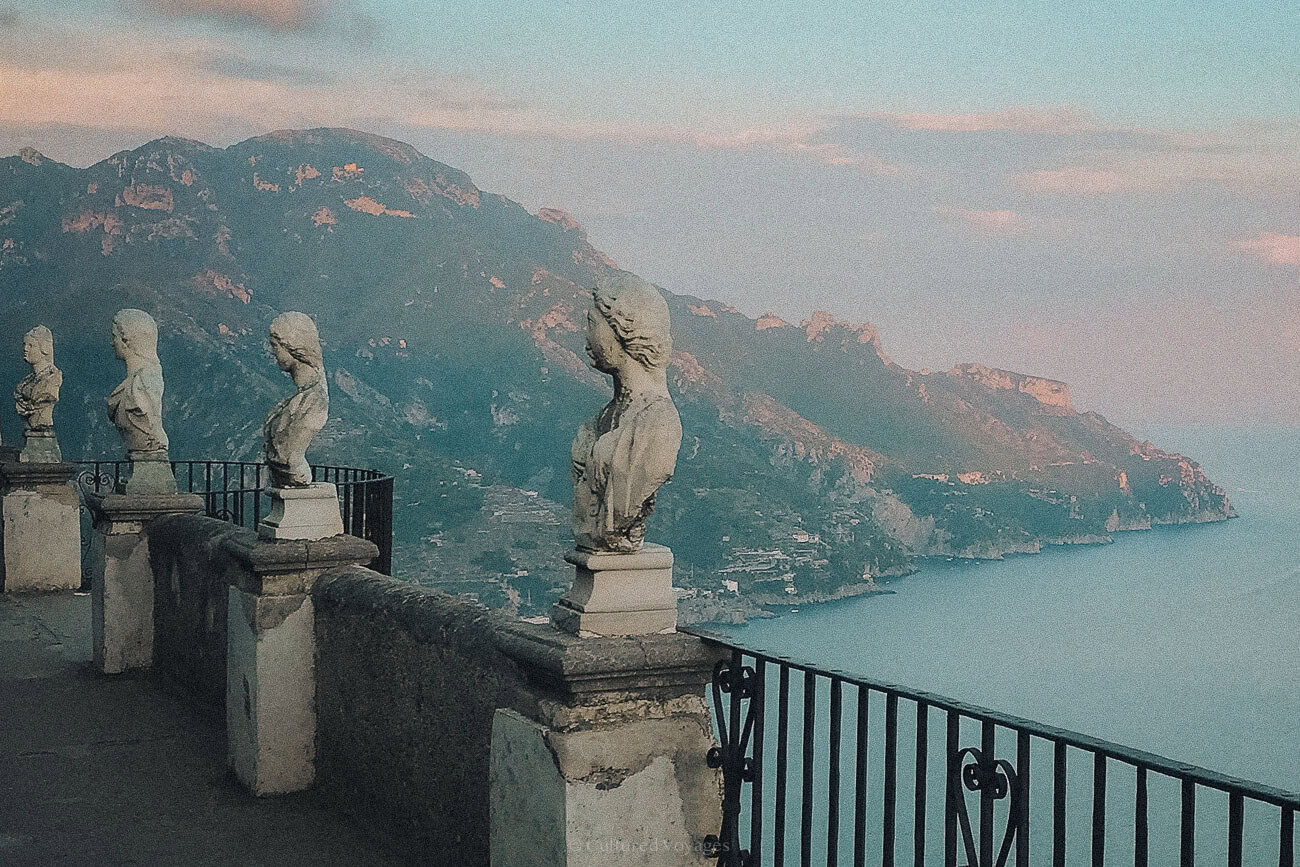
Villa Cimbrone is the first stop I’d make. Follow the winding stone paths through town until you reach the gardens, then take your time exploring. The Terrace of Infinity, with its line of white busts and vast views over the sea, more than lives up to its reputation. Allow at least 45 minutes here.
After that, make your way back towards the centre of town and visit Villa Rufolo, just off the main square. The gardens are smaller, but the viewpoint is one of the most iconic on the Amalfi Coast and closely tied to the town’s musical history.
Then, spend some time in the Piazza Duomo, where Ravello’s cathedral (originally built in 1086) anchors the town, and wander the surrounding streets. Ravello is elegant and refined rather than flashy, with boutiques, ceramics, and small details rather than spectacle.
Where to eat in Ravello
Ravello is a wonderful place to linger over lunch.
If you’re in the mood for something special:
- Rossellini’s (Palazzo Avino) – Michelin-starred, exceptional views, and a meal I still think about years later. Book well in advance.
For something more relaxed:
- Da Salvatore – wood-fired pizza, creative dishes, and some of the best views in town (book ahead and ask for a table with a view).
- Ristorante Pizzeria Vittoria – family-run, lively, and far more than just pizza; I’ve had excellent seafood pasta here.
- Mimì Bar Pizzeria – informal, busy, and recommended to me by a local; great pizza and an unfussy atmosphere.
Walking down from Ravello: choose your own version of the afternoon

From Ravello, you have several beautiful ways to make your way back down. None of them are difficult to navigate, and all are well signposted.
You’ll see ceramic tiles and wall signs pointing towards Minori and Amalfi, and there’s more than one possible route – I’d encourage you to feel it out and enjoy the journey rather than worrying about getting it “right”.
Here’s how I’d think about your options, in order of preference.
Option 1 (my favourite): Ravello → Minori → Lemon Trail to Maiori → ferry back to Amalfi
This is the fullest version of the day, and the one I’d choose if conditions and energy allow.
- Ravello → Minori:
A downhill walk of under 2km, taking around 30–45 minutes at an easy pace. It’s a steady descent via steps and lanes, passing homes and quieter residential areas. I’ve done this walk even in the evening after dinner. It’s beautifully atmospheric, with lights twinkling below and the sea dark and inky beyond. The views are equally beautiful (and certainly clearer!) during the day. - Minori:
Spend time here properly (see below). - Lemon Trail (Sentiero dei Limoni): Minori → Maiori:
The route is around 2km and takes 45–60 minutes at a relaxed pace. There’s a bit of up and down – some steps up out of Minori, then a gradual descent into Maiori – but it’s very manageable, and you can stop as often as you like. - Maiori → Amalfi:
Finish with a ferry back to Amalfi, letting the coastline slide past from the water.
This version gives you views, walking, culture, and sea without ever feeling frantic, and is a day very well spent.
Option 2: Ravello → Minori → ferry back to Amalfi
If it’s hot, or you’re feeling content after Ravello, this is a lovely, simpler option.
- Walk down from Ravello to Minori (30–45 minutes)
- Explore Minori at an unhurried pace
- Take the ferry back to Amalfi (around 10 minutes)
You still get the pleasure of descending through the landscape and arriving at the coast on foot, without committing to a longer afternoon walk.
Option 3: Ravello → Amalfi (via Atrani)
This is a beautiful route, but I’d recommend it with a few caveats attached:
- It drops all the way from Ravello down to Amalfi
- Involves well over 1,500 uneven downhill steps
- Hard on the knees, especially in warm weather
You’ll emerge in the tiny town of Atrani, then pass through the tunnel that links it with Amalfi.
Minori: where the day slows down


Minori is one of the Amalfi Coast’s quieter gems. It’s rustic, understated, and far less frequented by non-Italian visitors than many neighbouring towns.
Despite being so close to Amalfi, it offers a glimpse of what the coast might have felt like decades ago, before mass tourism reshaped so much of it.
I actually really enjoy staying in Minori itself. It works beautifully as a base for a longer or more food-focused trip, or as a second base on a slower itinerary.
For this four-day route, it’s a little far out for repeated day trips to places like Positano and Capri (it would add an extra 15 minutes or so each way to the commute, so it may be too much to do on two separate days) – but as a place to pass time in, it’s deeply grounding.
What to do in Minori:
- Spend time at the beach – around 250 metres long, with a mix of lidos and free sections, facing south and close to town.
- Visit the Villa Romana – a Roman villa buried by the eruption of Vesuvius in 79 AD, rediscovered in 1932, with underground chambers and preserved frescoes.
- Eat scialatielli – the local pasta dish that originated here; hearty, comforting, and exactly right after a walk.
- Do very little, on purpose – sit in a café, wander the piazza, enjoy the quieter patter of the town.
Where to eat in Minori:


- Giardiniello – long-standing, slightly more elevated, with a plant-filled terrace and excellent pizza.
- La Botte – a favourite of mine: authentic, cosy, and very reasonably priced.
- Salvatore De Riso – the Amalfi Coast’s most famous pastry chef; worth stopping by even if only briefly.
When you’re ready, simply hop on the ferry and head back to Amalfi, or head onwards to Maiori via the Lemon Walk.
Why this day is shaped this way
I’ve shaped this day so it stays flexible.
Ravello gives you the views and the elegance; Minori, excuse the pun, brings things back down to earth. The walk in between connects the two without overcomplicating things. Do more if you feel like it, stop when you don’t.
Day 3: Positano as a day trip (and how to enjoy it without being overwhelmed)

Focus: Iconic scenery, managed crowds, and knowing when to step away
Base: Amalfi (or Atrani)
Transport: Ferry both ways
Positano is the Amalfi Coast at its most recognisable. It’s also where you’re most likely to feel overwhelmed, overspend, or come away thinking the coast is all spectacle and no substance.
I enjoy Positano, but I enjoy it in small, intentional doses. That’s why, in this 4 day Amalfi Coast itinerary, Positano is very deliberately framed as a day trip, not somewhere you base yourself.
The aim today isn’t to tick boxes. It’s to experience Positano’s beauty, wander its streets, have one really good meal – and then decide, based on how you feel, whether to linger or leave.
Getting to Positano from Amalfi
Take the ferry from Amalfi to Positano.
The crossing takes around 30 minutes, costs roughly €22, and runs frequently throughout the day in season. More importantly, it gives you the right arrival into Positano: by sea, with the town rising up in front of you exactly as you’ve seen it in photos.
I wouldn’t bother with the bus for this journey unless ferries aren’t running. The road is slow, often congested, and far less pleasant than approaching Positano from the water.
If you can, aim for an earlier ferry. Positano is noticeably calmer before late morning, and arriving early gives you breathing room.
How to approach Positano (this matters more than what you do)


Positano is steep, busy, and intensely visual. The best way to enjoy it is to let go of the idea that you need to cover ground quickly.
I usually start by wandering:
- up and down staircases
- through quieter side streets
- away from the most obvious choke points near the port
This is also a good time to browse.
Positano is one of the best places on the Amalfi Coast for shopping – linens, beachwear, handmade sandals, leather goods. I tend to take mental notes rather than buying immediately, then come back later if something sticks.
The Roman Villa beneath Santa Maria Assunta (worth considering)
If you have any interest in Ancient Roman sites, the Roman Villa beneath the Church of Santa Maria Assunta is well worth your time.
Discovered beneath the church crypt, this remarkably well-preserved villa was buried during the eruption of Vesuvius in 79 AD. You can walk through its underground chambers and see frescoes that have survived almost two millennia.
I often suggest this to people who are tempted by Pompeii but don’t have the time. It’s obviously not on the same scale, but it offers a very tangible glimpse into Roman domestic life, right in the heart of Positano, without needing a separate day trip.
Lunch: book ahead and use it as a refuge
This is the part of the day I’d be most deliberate about.
By late morning and early afternoon, Positano can feel mobbed. Rather than fighting for a table, I strongly recommend deciding where you want to eat in advance and booking it well ahead of time.
That way, when the town is at its busiest, you have somewhere calm to retreat to.
Here are the places I’d consider, depending on mood and budget:
Da Adolfo
Reached by a small boat shuttle from near the port (look for the boat with the red fish on the mast). Rustic, relaxed, and set in a little cove away from the main town. You’ll need to book well in advance, especially if you want a sunbed as well as lunch.
Li Gali Restaurant (Hotel Villa Franca)
High above Positano, with a view where the sky seems to merge into the sea. The food is modern, refined, and focused on locally produced ingredients, and it’s earned a Michelin star for good reason. This is a great option if you want something elevated..
Bruno
More moderately priced, lively without being chaotic, and with excellent views over the coastline. When you book ahead ask for a table with a view.
Il Ritrovo
Located in a small square high above Positano and offering a free shuttle from town (contact them in advance about this). Warm, attentive service and a menu rooted in local ingredients, with plenty of seafood. This is a lovely option if you want to step away from Positano’s intensity altogether for a few hours.
Afternoon options: decide how much Positano you want

After lunch, this is where you check in with yourself.
If you’re enjoying Positano:
- head to Fornillo Beach for a quieter, more relaxed swim than Spiaggia Grande
- continue wandering the streets at a slower pace
If you’re starting to feel done:
- take a ferry back to Amalfi
- have a drink by the water
- enjoy the contrast in pace
I wouldn’t try to squeeze in the Path of the Gods today unless you’re very keen. It’s a 7km hike and deserves fresher legs and a dedicated day.
Why this day is shaped this way
Positano is spectacular, but it’s intense.
By treating it as a day trip, arriving early, booking lunch ahead, and giving yourself permission to leave when you’ve had enough, you get the best of it without letting it dominate your sense of the Amalfi Coast.
Day 4: Capri (or a slower alternative if you’re not feeling it)

Focus: Big views, Roman history, and finishing the trip well
Base: Amalfi (or Atrani)
Transport: Ferry to Capri (seasonal), then funicular/bus on the island
Capri is one of those places that can feel completely contradictory in the best possible way.
You step off the ferry into a harbour full of yachts and day-trippers, and yet, not far away, you have ancient ruins, quiet paths, and viewpoints that make you stop mid-sentence.
I’ve visited multiple times, and what I’ve learned is this: Capri is still worth it, but it works best when you don’t try to wrestle it into a rigid plan. It rewards people who choose one or two priorities, then leave space for the island to unfold.
This final day is designed to give you a Capri day that’s realistic from the Amalfi Coast, while also giving you an elegant Plan B if conditions (or your energy) aren’t on your side.
Option A: Capri as a day trip from the Amalfi Coast


Before you commit: a quick reality check
Capri is easiest as a day trip from Naples or Sorrento. From the Amalfi Coast it’s still doable, but it’s more dependent on:
- seasonal ferry timetables
- sea conditions
- and how quickly return crossings book out
If ferries aren’t running, or the sea looks rough, skip ahead to Option B below. A “non-Capri” Day 4 can still be a brilliant finish.
Getting to Capri (what to book early)
If you’re doing Capri, I’d book the key ferry legs in advance, especially in peak months. You can often be flexible with intra-coast ferries day-to-day, but Capri is the one that can catch people out.
The most useful ticket to have locked in is usually the return, because later crossings are the ones that tend to sell out first.
Arriving at Marina Grande, and your first decision

When you dock at Marina Grande, you’ll be faced with your first choice: funicular or bus.
- Funicular to Capri town (my default)
It’s quick once you’re through the line, and it drops you right by the Piazzetta. The queues can be long, but the system is at least fairly organised once you’re in it. - Bus to Capri town / Anacapri
The buses are very small (they have to be), which means queues can move slowly. Personally, I’ve watched as a couple of full buses left before I could get on, which ate in valuable day-trip time.
If you’re prone to seasickness, I’ve learned to sit towards the back of the boat on choppier crossings. It makes a difference.
How I’d structure Capri in a day
I don’t think there’s one “perfect” Capri day. People want different things: coastal views, Roman history, a boat trip, a little glamour, or just the feeling of being there.
So instead of forcing you into an hour-by-hour itinerary, I’d suggest you build your day around:
- one anchor experience
- one supporting experience
- and a booked lunch so you have somewhere calm to land when the island is at its busiest
Also, I know the departure point is slightly different, but to get a more in-depth view of how to manage Capri as a day trip, read my Guide to Visiting Capri on a Day Trip from Naples.
Anchor option 1: Classic Capri views (high reward, low effort)
If what you want is that iconic Capri scenery without overcomplicating the day:
- Gardens of Augustus
This is one of the best-value stops on the island and gives you the classic dramatic coastal views. It’s also the sort of place that gets more crowded as the day goes on, so earlier is kinder. - A brief pass through the Piazzetta
I’m not anti-Piazzetta; I just think it’s better treated as a glance, not a destination. It’s far nicer early or later, and the café prices can be eye-watering.
This option leaves you with lots of time for either a boat element or something more historic.
Anchor option 2: Roman history and quieter corners (my favourite way to experience Capri)


This is the side of Capri that makes me like it more each time I return.
- Villa Jovis (Emperor Tiberius’ largest villa)
The walk puts a lot of visitors off, which is exactly why it stays calmer. The ruins are genuinely interesting, and the views feel more spacious and less performative than Capri town. - Villa Lysis as a follow-on
A completely different layer of Capri’s history – more eccentric, more “how did this end up here?”, and a nice counterpoint to the Roman scale of Villa Jovis.
If you’re the sort of traveller who likes history and atmosphere, this route is often the one that ends up being the standout.
For me, personally, this is a standout option.
Anchor option 3: Capri from the water (best scenery, most weather-dependent)
If the sea is calm and you want the coastline properly, a boat tour is hard to beat. Capri’s drama is coastal, and seeing it from the water makes a difference.
The Blue Grotto can be magical, but it’s also the most unpredictable: choppy seas, cancellations, queues, and a very brief time inside. If it’s a priority for you, I’d try to do it earlier rather than later.
Lunch: book it, and use it as a pressure valve
As is the case with Positano, If you take one tactical tip from me for Capri, let it be this: book lunch well in advance, especially in peak season.
Capri tends to feel busiest between late morning and mid-afternoon. Having a table reservation means that when things start to feel mobbed, you can step out of the crush and take a breath.
A few good options from my own notes:
In Capri town
- La Capannina – a long-standing favourite, old-school in the best way. Book ahead.
- Lo Sfizio – a more local-feeling option, away from the tightest tourist churn.
- Da Giorgio – good value by Capri standards, with lovely views if you reserve well.
In Anacapri
- Columbus Capri – produce-led and genuinely rooted in place.
- Da Gelsomina – family-run, a little more of a “you made the effort to get here” feel, and a lovely setting.
If you want something very “Capri” and atmospheric (and you don’t mind that it’s popular for a reason):
- Da Paolino – dinner under lemon trees.
Afternoon: choose what you still have energy for
After lunch, I’d do a quick check-in with yourself.
If you still feel curious and fresh:
- head to Anacapri for a different pace
- and if you’re up for it, Monte Solaro gives you a completely different viewpoint across the bay
If you feel “Capri’d out”:
- start making your way back towards Marina Grande
- give yourself buffer time for queues
- and keep the return crossing stress-free
Option B: If you skip Capri (a very good Plan B)

If ferries aren’t running, the sea looks rough, or you simply don’t want your final day to be dominated by queues and transport, I’d do one of these instead.
Alternative 1: Make it a boat day on the Amalfi Coast
If you do one thing with your final day, I’d prioritise seeing the coast from the water properly.
Even if you’ve been using ferries all week, a dedicated boat trip (or a private charter if that’s your style) gives you a different relationship with the coastline: less commuting, more lingering, and that sense of “this is why people fall in love with this place”.
Alternative 2: A quieter-town day (or simply doing less)
If what you want is softness rather than a “final big hit”, go the other direction along the coast and spend your day in a quieter rhythm.
That could mean heading towards places like Cetara or Vietri sul Mare, or it could mean something even simpler: a swim, a long lunch, a final ferry ride, and a last evening somewhere you’ve enjoyed.
There’s nothing wrong with repeating what’s worked best for you across the four days. It can often be the most satisfying way to end a trip.
Why this day is shaped this way
I’ve built Day 4 around one core concept: finish well.
Capri can be extraordinary, but it isn’t always effortless, especially from the Amalfi Coast. So you get a Capri plan that’s realistic and flexible, and you also get permission to pivot if conditions (or your energy) aren’t there.
Either way, the point is the same: you end the trip feeling like you experienced the coast properly, not like you spent your final day fighting logistics.
How to actually make this 4-day Amalfi Coast itinerary work

By this point, you’ve seen how the days fit together and why the itinerary is shaped the way it is. What’s left is making sure it runs smoothly in practice without overplanning or unnecessary stress.
Getting to the Amalfi Coast
Most people will arrive via Naples, which makes sense if you’re flying in, visiting Pompeii, or combining the Amalfi Coast with Capri or the Bay of Naples islands.
From Naples, the most straightforward options are:
- a direct ferry to Amalfi (seasonal), or
- train or bus to Salerno, then ferry along the coast
If ferries are running, I’d always prioritise arriving by sea. It avoids traffic entirely and gives you your first proper sense of the coastline before you even step ashore.
Salerno is a particularly good alternative if you’re arriving by train (especially if you’re coming from the likes of Rome by fast train) or travelling in shoulder season, when ferry services are reliable but less frenetic.
Ferries: what to book in advance (and what can stay flexible)
Ferries are the backbone of this itinerary, but that doesn’t mean you need to lock every crossing in months ahead.
The ones I would prioritise booking are:
- your arrival onto the Amalfi Coast
- your departure off the coast
- and, if you’re doing it, Capri – especially the return crossing
These are the routes that book out first in busy periods.
Short hops along the coast (Amalfi–Positano, Amalfi–Minori/Maiori) generally run frequently during the season and can often be booked closer to the time.
That said, I personally prefer having tickets in hand, particularly in summer, rather than relying on same-day availability.
Outside ferry season, you’ll need to adjust expectations – which is why this itinerary works best from spring through early autumn.
Luggage and why staying in one base matters
One of the biggest things that will make or break a short Amalfi Coast trip is how often you move with luggage.
Dragging suitcases onto buses, through ports, or up steps quickly becomes exhausting and is completely unnecessary on a four-day trip.
Basing yourself in Amalfi or Atrani keeps everything simple:
- ferries leave directly from town
- evenings are walkable
- and you’re not repeatedly packing up and relocating
It’s one of the main reasons I wouldn’t split this itinerary across multiple bases.
Driving on the Amalfi Coast
You’ll see plenty of rental cars on the coast, but for this itinerary, I wouldn’t recommend driving, and you can read more as to why in this post here.
Between narrow roads, summer traffic, parking challenges, and the sheer effort involved, a car adds more stress than flexibility, especially when ferries already do the job far more efficiently.
This route is designed so you simply don’t need one.
When this itinerary works best (seasonality and crowds)

This itinerary is built around ferries, walkability, and moving at a human pace, which means when you go matters.
I’m a big believer in shoulder season travel on the Amalfi Coast, particularly for a short trip like this. It’s not about avoiding people entirely (that’s unrealistic here), but about keeping the experience pleasant rather than punishing.
The best time to do this itinerary
For this four-day route, I’d aim for:
- May, early June, September, or early October
During these months:
- ferries are running frequently
- the sea is usually calm enough for crossings
- walking days (Ravello, Minori) are far more comfortable
- and towns feel busy but not completely overwhelmed
Visiting in peak summer (July–August)
This itinerary can be done in high summer, but it comes with trade-offs.
Expect:
- fuller ferries and earlier sell-outs
- very busy late mornings and early afternoons
- hotter walking conditions, particularly on downhill routes
- and less spontaneity overall
If you’re travelling in summer, I’d:
- book key ferry routes well in advance
- start days earlier
- treat lunch reservations as non-negotiable
- and be realistic about how much walking you want to do in the heat
Outside ferry season
If you’re travelling late autumn or winter, this exact structure becomes harder to replicate.
Reduced ferry services mean more reliance on buses and taxis, and Capri becomes less reliable as a day trip. At that point, I’d rethink the shape of the itinerary rather than force it.
A final word on crowds
The Amalfi Coast is popular for a reason. What makes the difference is how you move through it.
This itinerary avoids:
- unnecessary base changes
- peak-hour buses
- and trying to see everything
Instead, it leans into timing, ferries, and choosing depth over coverage – which, in my experience, is the only way the Amalfi Coast really works.
Frequently asked questions about this 4-day Amalfi Coast itinerary
Is 4 days enough for the Amalfi Coast?
Yes, if you are realistic.
Four days is enough to experience the Amalfi Coast well without rushing, provided you do not try to see everything. This itinerary focuses on a handful of towns, moves primarily by ferry, and avoids unnecessary backtracking. If you also want to include Pompeii, Naples, or multiple islands, I would either extend the trip or rethink the scope entirely.
Can you do this itinerary without a car?
Yes. In fact, it is designed that way.
This route relies on ferries and walking, with occasional use of buses or taxis only where they make the most sense. Driving adds stress rather than flexibility on a short Amalfi Coast trip, and you will not miss anything by skipping it.
Is Capri worth it on a 4-day Amalfi Coast trip?
It can be, but it is optional.
Capri is undeniably beautiful, but it is also the most logistics-heavy day of the itinerary and works best in good weather. That is why this plan offers alternatives. If you would rather stay closer to the coast or move more slowly, you will not feel short-changed by skipping it.
Should I stay in Positano instead of Amalfi?
For this itinerary, I would not recommend it.
Positano is stunning, but it is expensive and busy, to the point of it being overtouristed. Staying in Amalfi or Atrani keeps ferry connections simple and evenings calmer, while still allowing you to experience Positano as a day trip.
Is this itinerary suitable in summer?
Yes, with some adjustments.
In July and August, expect heavier crowds, hotter walking conditions, and less spontaneity. Book ferries and lunch reservations in advance, start your days earlier, and be flexible with optional walking routes. The overall structure still works, but the summer rewards planning.
What if I have more or less time?
If you have more time, this itinerary extends naturally into a longer Amalfi Coast stay or pairs well with Naples, Ischia, or Procida.
If you have less time, I would prioritise Amalfi, Ravello, and one additional day trip rather than trying to compress everything.

Before you go
Everything I check before a trip now lives on one page.
Seven shifts I run on every trip I plan, each one paired with the story that taught it to me and the steps for using it yourself — built to be printed, kept, and pulled back out before the next one.
It arrives when you join The Cultured Voyages Edit, a fortnightly letter on European cultural travel.
Continue Planning Your Amalfi Coast Trip

If you’re building out the wider trip around this itinerary:
- 10 Day Amalfi Coast Itinerary – the expanded version for those with more time, following the same ferry-first, car-free approach with more depth at each stop
- Things to Do in Ravello – Ravello plays a central role in Day 2 of this itinerary; this covers the villas, walks, restaurants and shopping in more detail
- Is Ischia Worth Visiting? – if you’re considering extending the trip to include one of the Bay of Naples islands, Ischia is the one I’d add first
Related reading for the Amalfi Coast


Like this post? Pin for later!


