
Disclosure: Some of the links on this site are affiliate links. If you make a purchase through one of them, I may earn a small commission at no extra cost to you. Read my full disclaimer here. Thank you for your support!
Two days in Naples is enough to begin to understand the city – and this guide covers how to spend them well, with a day-by-day itinerary split across both halves of the historic centre, specific restaurant picks, and honest advice on what to book in advance and what to skip.
Naples is one of Italy’s most overlooked city breaks.
Visitors touch down at the airport or arrive at Napoli Centrale and immediately head south to the Amalfi Coast, treating the city as a five-hour layover on the way to somewhere else. It’s a mistake.
Naples is older than Rome, richer in layered history than almost anywhere on the peninsula, and has a food culture that doesn’t owe anything to anywhere else.
It’s also a little rough around the edges – and that’s part of it. This is a real, lived-in city that hasn’t been sanded down for tourism, and once you accept that, it becomes enormously appealing.
I’ve visited Naples multiple times and each trip deposits something that stays.
Da Attilio was my introduction to proper Neapolitan pizza in the city – star-shaped, crusts stuffed with ricotta – and it set the bar so high that I’ve been measuring every pizza against it since.
It is, without question, one of the best pizzerias in the world.
Beneath the city, 40 metres underground, the sheer scale of the warren of caves, tunnels and aqueducts the Ancient Greeks dug under Naples is genuinely astounding – you are standing inside a living piece of history that most visitors walk straight over without knowing it exists.
And at the National Archaeological Museum, the colossal Hercules from the Farnese collection stopped me in a way I hadn’t expected – if you have any interest at all in ancient sculpture, and in the ancient treasures recovered from Pompeii, set aside at least two hours and don’t rush it.
Two days, worked through properly below.

Table of Contents
- Your 2 Days in Naples: At a Glance
- What to see in Naples in 2 days
- Recommended places to eat during your 2 days in Naples
- Where to stay for this 2 days in Naples itinerary
- Orientating yourself for your 2 days in Naples
- Things to know before planning a 2 day Naples itinerary
- Naples itinerary (2 days) – some common questions
- Planning the rest of your Naples trip
Your 2 Days in Naples: At a Glance
| Key Stops | End of Day | |
| Day 1 – North of Spaccanapoli | Catacombs of San Gennaro → Castel Sant’Elmo → Spaccanapoli → Gesù Nuovo → Veiled Christ → Via San Gregorio Armeno → Archaeological Museum | Aperitivo at Piazza Bellini |
| Day 2 – South toward the seafront | Santa Chiara cloister → Naples Underground → Spanish Quarter & Maradona mural → Piazza del Plebiscito → Galleria Umberto I → Castel Nuovo | Sunset walk along Lungomare Caracciolo |
Cultured Voyages Top Naples Resources
→ Trains: Check Omio to search schedules and buy tickets
→ Ferries: Search ferry schedules and book tickets here
Top Tours & Experiences in Naples
⭑ Catacombs of San Gennaro (*Cultured Voyages top pick*)
⭑ Street Food Tour with Local Guide (perfect for foodies)
⭑ Sightseeing tour by e-bike (cover more ground in less time)
Best full/half-day guided experiences from Naples:
⭑ Pompeii Ruins & Mount Vesuvius Day Tour
⭑ Sorrento, Positano & Amalfi Full-Day Tour from Naples
Cultured Voyages recommended accommodation
→ Grand Hotel Santa Lucia (waterside luxury with sea views)
→ Decumani Hotel De Charme (central hotel with old school charm)
→ Artemisia Domus (extremely well-located luxe-for-less pad)
→ La Casa Sul Nilo (old world luxury on a budget)
What to see in Naples in 2 days
A note on day trips: most 2-day Naples itineraries I’ve seen carve out one of those days for Pompeii or the Amalfi Coast. I’d push back on that. Naples has enough to fill two full days on its own – and if you want day trips, add a third day. You’ll thank yourself for it.

2 Day Naples Itinerary – Day 1
From a logistics perspective and the ease of getting between sights, we are going to split the city of Naples in two for this itinerary.
Taking the aptly named Spaccanapoli (“Naples Splitter”) as our reference point, the first of your two days in Naples, Italy will primarily be spent exploring the area north of this line, starting at the most northerly point and working your way downwards.
Stop 1: Catacombs of San Gennaro

Time required: 1 hour
The area of Naples is renowned for its tuff rock and over the millenia, natives of Naples have dug a warren of spaces underneath the city, for various uses.
One such use was as a place of burial and worship and the Catacombs of San Gennaro offer visitors a glimpse into Naples’ oldest Christian cemetery, dating back to the 2nd century AD.
Named after Naples’ primary patron saint, San Gennaro (who was at one stage buried there), the complex is a sprawling one and is much bigger (and thus far less scary!) than other catacombs you may be familiar with.
If you’re following a Naples two day itinerary, a visit to the Catacombs of San Gennaro is a fascinating experience.
There are two catacomb chambers – an upper and lower one – which as well as housing the tombs and graves you would expect, also contain three underground basilicas, together with a large baptismal font.
A visit to the catacombs offer a fantastic opportunity to contribute to a local regeneration project. But for the efforts of Cooperativa La Paranza, a local not-for-profit organisation, the tombs may not, even today, have been open to the public – which really would have been a shame.
They are home to an incredible array of frescoes, mosaics and Byzantine paintings that stretch right back to the 2nd century AD.
Conservation is an ongoing project, with new artworks being discovered and with profits from the tourist experience going back to both the local community and to restoring the unique artwork contained in the catacombs.
A thoroughly fascinating and worthwhile visit for both history buffs and non-history lovers alike.
BOOK TICKETS | Visits possible through official guided tours only, open Monday – Sunday from 10am – 5pm. Purchase your tickets in advance here. Your ticket also gets you entry to the nearby Catacombs of San Gaudioso (valid for 12 months).
Stop 2: Castel Sant’Elmo

Time required: 1 hour (plus approx. 30 minutes to reach on foot & funicular from Catacombs of San Gennaro)
Your next location takes you from underground to being very much above it. If you’re following a two day Naples itinerary, make sure to visit Castel Sant’Elmo.
A Cultured Voyages Guide
Seven shifts that take you from sightseeing to actually understanding a place – the same ones I use on every trip I plan.
This magnificent castle sits high above the city of Naples, with commanding panoramic views of the city, the Bay of Naples, the Sorrento Peninsula, and the looming presence of Mount Vesuvius.
It is a ginormous bastion of strength, built in a hexagonal star shape with a large moat and a “double tenaille‘ design.
Standing at the foot of the walls, its height is truly staggering and it is very difficult to distinguish where the rock ends and the walls of the fortress begin – they merge into one gargantuan show of strength.
First references of the fortress date back to the 14th century, although the complex took on its current hexagonal shape during the reign of Charles V, Holy Roman Emperor, during the 16th century.
To reach the walls of the fortress (where the best views are), you’ll trudge upwards through an internal tunnel, past various watchtowers, where you’ll be offered tantalising glimpses of the sprawling city below through various windows and arches.
The buildings at the top of the fortress are now in use as the headquarters of the museum network of Campania, but there is a museum which you can visit. With time fairly limited during your two days in Naples, however, I’d skip this first time round.
To get to Castel Sant’Elmo, you’ll need to make your way to the upmarket Vomero district. The easiest way to do this is to walk from the Catacombs of San Gennaro, soaking in the hubbub and daily neighbourhood activity along the way, to the funicular station at Montesanto.
Here, you can purchase a one way ticket up the steep hill for €1.20 and need to get off at the ‘Morghen‘ stop, from which it’s a few minutes’ walk to the entrance of the fortress.
DETAILS | Open every day from 8.30AM to 19.30PM – ticket office closes at 18.30PM. General adult admission costs €5.
Better to have cash or buy in advance from here, as to pay with card we needed to purchase tickets online and couldn’t get adequate internet coverage for same.
Stop 3: Spaccanapoli


From Castel Sant’Elmo, you will then make your way into the belly of the historical centre to one of Naples’ most famous thoroughfares; Spaccanapoli.
Not one street as such, but instead a sequence of streets that combine along a route of about 2km or so, Spaccanapoli is one of the city’s most important historical thoroughfares.
Its origins reach back to the Greco-Roman era, where it was one of three main roads, or ‘decumani‘ that crossed the ancient city of Neapolis when it was founded in the years before Christ.
You won’t find the street listed on Google Maps; starting at Piazza del Gesù Nuovo, it combines a series of streets that lead one after another, until it crosses Via Duomo and leads away from the city centre.
The route literally splits the city in two, and thus is the meaning of the term Spaccanapoli , which translates as “Naples splitter”.
A narrow path, Spaccanapoli is bursting with life, noise, food and shopping and is broken by quaint piazza, ornate palazzo and several of Naples most important churches, including Sansevero Chape, Gesù Nuovo Church and the serenely beautiful Santa Chiara complex.
You’ll find yourself return to Spaccanapoli more than once during your time in Naples and many of the city’s most famous attractions, along with a whole host of eateries, can be found either on or in the vicinity of this route.
Yes, it is touristy, but there is also something rather intoxicating about Spaccanapoli, where you can become one of the millions who has walked this ancient route during its millenia of existence.
FOODIE TIP | You’ll likely be feeling peckish at this point.
Some places to eat around Spaccanapoli (and Via dei Tribunali) include Tandem Ragu, La Locanda Gesu Vecchio and Antica Trattoria Da Carmine for a trattoria style meal and Pizzeria Palazzo Petruchi and Sorbillo.
Stop 4: Gesù Nuovo Church

Time required: 15 – 30 minutes
This remarkable church is incredibly deceiving and lends itself to the idiom that one should not judge a book by its cover. Located in the piazza it has given its name to, Piazza Gesu Nova, it marks the starting point of the famous Spaccanapoli.
Having started its life first as a palace in 1470, it was sold to the Jesuits in the 1580’s who converted it to a church when was confiscated from its owners, the Sanseverino family.
What one finds, as a result, is a rather austere exterior that is studded with stone, diamond-shaped protrusions, which give no real clue to the purpose of the building that lies behind such a facade.
The interior, however, is positively staggering. Finished in the Baroque style, the church is full of resplendent marble decorations and important frescoes and boasts three bronze bas-reliefs at its altar, one of which is a reproduction of Leonardo da Vinci’s the Last Supper.
It’s free to go inside and sit down to admire this feast for the eyes – and you’ll likely want to sit down, as there is an almost overwhelming amount on display.
DETAILS | Free admission. Open 7AM – 1PM and 4PM – 8PM daily.
Stop 5: The Veiled Christ and Sansevero Chapel
Time required: 45 minutes – 1 hour
Naples is home to a world-renowned statue of exceptional craftsmanship – that of the Veiled Christ. It features the deceased figure of Jesus Christ, lying on a a piece of marble and shrouded in the most exquisitely delicate, transparent death veil.
Created by Giuseppe Sanmartino in 1753, Sanmartino was not originally the intended artist behind this work, stepping in following the death of the chosen sculptor, Antonio Corradini.
Sanmartino achieved what perhaps Corradini wouldn’t have done, casting to one side the previous terracotta scale model his predecessor had begun with, creating instead an incredibly touching and lifelike representation of Christ in the moments after his death, suffering still etched on his face and limbs.
The statue is housed in the petite Sansevero Chapel, a small church that was built to honour the Madonna by the Duke of Torremaggiore, which was enlarged in the early 17th century by the duke’s son in order to create a family mausoleum.
Today, the chapel features the Veiled Christ at its centre, but this is overlooked by many other allegorical statues by Italian artists of note, with a glorious fresco termed the Glory of Paradise overlooking all from the ceiling.
If you’re an appreciator of art and sculpture then this is an unmissable stop while discovering Naples in two days. If you are not, however, then perhaps give this a miss.
The chapel is small and visits are limited each day. While there are other treasures on show, the number is limited due to the chapel’s diminutive size, so you may only get the most out of this experience if you’re the sort who likes to spend time examining pieces in detail.
DETAILS & BOOKING TICKETS | Open daily, except Tuesdays from 9AM – 7PM. Adult tickets cost €8 (+ €2 booking fee) and sell out quickly – purchase them a few weeks in advance here.
There is also a great opportunity to visit with a guide and learn about the centro storico, on this highly popular Veiled Christ & downtown guided tour.
Stop 6: Via San Gregorio Armeno


Time required: 15 minutes
Via San Gregorio Armeno may strike you as being a little bonkers, and I feel this relatively short street represent’s Naples’ unique quirkiness. Lined with colourful shops bedecked in figurines, a large proportion of these represent nativity scenes and characters all year round.
Like much in Naples, there is a backstory that reaches back into the depths of history. Before Christianity was mainstream, the street was once home to a temple dedicated to the Roman goddess Ceres and small terracotta figurines that were crafted nearby were left in devotion to her.
Over time, nativity scenes, or ‘presipio‘ became highly popular in Naples by the end of the 18th century and so the little statues became Christian in appearance.
Today, you’ll find a wider range of characters in the mix, from butchers to celebrities and this busy street provides some light intrigue to visitors. It is also easy very easily reached, as it is sandwiched between Via dei Tribunali and Spaccanapoli.

Stop 7: Naples National Archaeological Museum


Time required: at least 2 hours (but you could spend a full day here)
Naples National Archaeological Museum is housed in a positively gargantuan building, that was formerly built as an army barracks in the 16th century.
Today a grand building of endless marble rooms and sweeping staircases, the museum houses a number of various collections, each treasures in their own right.
First and foremost, is the extensive collection of artefacts that have been recovered from Pompeii and Herculaneum. This ranges from entire walls of villas, painted with vivid frescoes and some ordained with mosaics, so a huge collection of daily objects like pots, pans, plates and glassware.
The excellent condition of many of these is staggering – one could pluck them from their cases and easily use them in their own homes today. Also a must see is the room named the “Secret Cabinet” by the Bourbon monarchy.
This is a collection of erotic items and artwork that were gathered from Pompeii. If you are planning on visiting Pompeii, then viewing this collection in the museum is a compulsory complementary activity to help you get the best understanding during a site visit.
On the ground floor, are two major collections. The first is the Farnese Collection, which this famous family gathered throughout the generations and which now represents on of the most important art collections from Greco-Roman antiquity.
The sculpture collection was perhaps my favourite in the entire museum, with the colossal statue of Hercules a particular highlight for me.
The second ground floor collection is the Egyptian Collection. This is one of the largest of its kinds in Italy, housing more than 2,500 pieces and it’s sadly somewhat eclipsed by the more novel artefacts from Pompeii and Herculaneum upstairs. If you have time, however, do try to fit in a visit.
TIP | The Archaeological Museum opens later than many other attractions in Naples, so if you are trying to fit in quite a lot then it is a good idea to visit the museum as one of the last things to do on a given day.
It also imposes a self enforced time limit on your visit – closing time – which isn’t a bad thing with only 2 days in Naples, as you could spend hours and hours poring over the treasures inside.
BOOK TICKETS | Open daily except on Tuesdays from 9AM – 7.30PM. Tickets can be purchased on site, or you can buy in advance here, permitting you to skip the line if there is a queue.
First Sundays of the month are free. The collection is vast and people’s personal interests vary, so if you’d like a more in-depth, personalised visit then this private guided tour is very well reviewed.
Stop 8: Piazza Dante and Piazza Bellini


When you finish at the Archaeological Museum, you will be very close to both Piazza Dante and Piazza Bellini, which are both excellent places to round off your day at with an aperitif before dinner.
The larger of the two is Piazza Dante, which is a bit grander than nearby Piazza Bellini, which attracts many students and late night revellers once the sun goes down.
Piazza Dante really displays Naples’ former grandeur, containing a large monument of Dante, four monumental churches, as well as the soaring archway of Port’Alba, which connects Piazza Dante to neighbouring Piazza Bellini.
By day, it’s lined with rather retro stalls selling books and records and groups of older men sit in huddles outside the cafés that line the square. Many of these bars serve alcohol come evening time and make brilliant people spotting perches.
Leafy and intimate, Piazza Bellini has an altogether special claim to the visible remains of the ancient walls of Greek Neapolis at its core.
Surrounded by railings, foliage and a whole host of bars, these ruins (and the piazza itself) sit on the decumanus maximus, which is one of the ancient Greek streets which crosses Naples.
Of particular interest also, is the street of Via San Sebastiano that leads from Piazza Bellini towards Via dei Tribunali, which is packed with the shops and workshops of musical instrument sellers.
COCKTAIL TIP | You will find endless (and often trendy) bars in the area of Piazza Bellini and in the streets that leads from it towards Via dei Tribunali and Spaccanapoli.
If you can’t decide which catches your eye, then the upmarket Cisterna Bistro and slightly grungier Monkey’s both offer extensive cocktail lists and generous snacks with street side tables.
2 Day Naples Itinerary – Day 2
Taking our line from the across the historical centre at Spaccanapoli, the second portion of this 2 days in Naples itinerary focuses on the southern part of the historical centre, starting at the horizontal line of Spaccanapoli and working down towards Naples’ shoreline.
Stop 1: Complesso Monumentale di Santa Chiara


Time required: 1.5 hours
Complesso Monumentale di Santa Chiara is a large religious complex, but its crowing glory is the vividly decorated cloister set at the heart of this sanctuary within Naples’ heaving centro storico.
I recommend visiting the cloister first thing upon opening (9.30 Monday through Saturday, 10.00 on Sunday), as it means you’ll get to enjoy the serene surroundings as they were designed to be – in relative peace and quiet – before it starts to get busy around forty-five minutes after it opens.
At the centre of the cloister are two avenues that are a riot of yellows and blues. Constructed between 1739 and 1742, octagonal pillars are adorned in majolica ceramic tiles.
In between each of these pillars are elaborately decorated benches, again tiled, that depict scenes from the countryside, the sea, and mythology. Not only that, but the walls of the cloisters are covered in frescoes depicting the saints and scenes from the Bible.
There is also a museum onsite, showcasing a range of Neapolitan history and there is also of course the church itself, which occupies a large part of the complex. Built originally in the Gothic style, the church underwent elaborate baroque redecorating in 1742.
During the second world war, however, the church was almost complete destroyed due to bombing. When it was rebuilt, the older Gothic style with its pierced rose window was the style the church was restored to, and it was reopened to worshippers in the 1950’s.
DETAILS | Cloister open 9.30AM – 17.30PM Monday – Saturday and 10AM to 14.30PM on Sunday. Tickets €6 adult admission, €4.50 reduced and available at the door.
Stop 2: Napoli Sotterranea (Naples Underground)


Time required: approx 1.5 hours
Napoli Sotterranea, or ‘Naples Underground’ in English, offers a fascinating glimpse into the extent of the warren of underground caves, tunnels and aqueducts that lie some 40 metres beneath the surface level of the city of Naples.
This network stretches to some 450km, with the original caves dug by the Ancient Greeks, who used the tuff rock to build the city of Neapolis in the 4th century BC.
When the Romans came along, they spotted the opportunity to put this space to use, expanding the network and constructing aqueducts to supply water to the city.
Towards the latter half of the second millenium AD the aqueducts gradually fell out of use, but found a new purpose during the heavy bombings of World War II, where they served as bomb shelters and protected the lives of approximately 200,000 citizens.
Conditions were, however, pretty appalling, with some even choosing to face the dangers of living above ground rather than stick it out below.
It is only possible to visit on a guided tour and these are run frequently during the day. A word of warning, in that these don’t seem to run with any limits on numbers and that I was part of a huge crowd (I’d estimate about 80) and that it was quite hard to hear the guide.
For the most part, the caverns are ginormous, but there is a section (that is optional) where you have to make your way through a dark and really narrow section of about 100m and this is the only way to see some of the water cisterns.
All in all, it’s an extremely worthwhile visit as the sheer scale of what appears to be a whole other world underground is absolutely astounding, but just do bear in mind that you may have to join a large group and that it might not be the best tourist experience you’ll ever have.
BOOK TICKETS | Open daily, with guided tours in English running at 10 am, 12 pm, 2 pm, 4 pm and 6 pm.
It’s a bit manic in the queue upon arrival (everyone must wait outside), so join the line and then flash your pre-purchased ticket at staff once it starts to move. Buy Naples Underground tickets here.
Stop 3: Quartieri Spagnoli (Spanish Quarter) and Maradona Mural


Time required: 1 hour
This atmospheric district’s name and history stretches back to the Spanish occupation of Naples in the 16th century. It was here that Spanish soldiers used to frequent to undertake some rather unsavoury activities and the area was rife with crime and prostitution.
Today, the Spanish Quarter hums along in a highly characterful way. Take to the narrow, criss-cross of streets to discover sheet-laden balconies, busy corner stores and locals going about their day-to-day activities.
It’s a unique neighbourhood, and one should prioritise a visit when visiting Naples for 2 days.
Of particular note is the Maradona mural found on Via Portacarrese. Created in 1990 by Napoli fan Mario Filardi, a giant painting of Naples’ favourite adopted son adorns the side of an apartment building.
A bizarre, colourful shrine of sorts has popped up beneath it, with a festoon of flags, jerseys and figurines filling the small square below it.
The Spanish Quarter is also home to an open-air market, called Pignasecca after a local legend that purports the area was home to a pine forest populated by magpies. Whether it’s true or not, you’ll today find an array of foodstuffs to buy, including some of Naples lip-smackingly good street food.
There are a couple of churches of note to visit too.
Santa Maria della Mercede is a church decorated after the Baroque fashion that is one of Naples’ most monumental churches, while the Church of Sant’Anna di Palazzo affers a treat for lovers of art history, boasting 17th century stucco decorations and a sublime high alter.
Time required: 45 minutes – 1 hour
FOODIE TIP | It’s now probably around time for lunch and there’s a fantastic pizzeria just on the outskirts of the Spanish Quarter called Pizzeria Da Attilio – I wouldn’t skip it if you’re nearby.
Optional Stop: Bourbon Tunnel
Time required: 1 hour
I’ve included the Bourbon Tunnel as optional, as an ‘either-or’ alternative to Naples Underground. Like the former, it’s a tunnel that has been dug under the city of Naples but was constructed much more recently and for alternative reasons.
While King Ferdinand III was on the throne in the 19th century, he was the subject of an assassination attempt in 1856, following which he (understandably) became increasingly paranoid, having also seen off three revolutions and an exile of 16 months.
Fearing for his safety, he embarked on an extremely ambitious underground building plan, which was a tunnel that led from the palace to his main army barracks.
The tunnel is a masterpiece of engineering, having to circumnavigate what already existed below surface, including Roman mines, an underground river and a Renaissance aqueduct.
The tunnels were never used for their intended purpose and today house a haunting and rather weird collection of vintage vehicles, which were seized under Mussolini and dumped below ground, in a practice that was kept going for several more decades after Mussolini’s demise.
It’s a little tricky to visit, as openings times are limited to the end of each week.
Depending on your particular interests, they make a great alternative to Naples Underground, or as another attraction to see during your 48 hours in Naples if you have a specific interest in the unique, underground aspect of Naples’ history.
BOOK TICKETS | Open Friday – Sunday only, with guided tours running at 10am, 12pm, 3pm and 5pm. Tours last 1 hour and can be purchased in advance here.
Stop 4: Piazza del Plebiscito


Time required: 15 minutes
Piazza del Plebiscito is Naples’ emblematic main square, home to the Bourbon’s Royal Palace of Naples along with the enormous San Francesco di Paola Basilica, which is a Neoclassical style church of some scale.
There’s not a whole lot to do in the square itself, but it’s an access point to both the Bourbon Palace and the basilica, where it’s definitely worth popping your head inside to admire the scale and satisfying symmetry of this huge edifice.
The palace is a highly interesting visit, where visitors are presented with the chance of learning the history of Naples from the Bourbon perspective (much of the city you see today is the legacy of its Bourbon rulers).
However, it likely will be too much of a squeeze to fit in with just two days in Naples, so I’ve left a visit off this Naples 2-day itinerary.
FOODIE TIP | While a bit of a tourist trap and rather pricey to boot, Piazza del Plebiscito is home to the legendary Gambrinus, an historic coffee house that is steeped in tradition.
Indoors offer high ceilings and lots of gilt finishings, but outdoors there is a beautiful covered area, full of foliage offering bursts of green, red and pink flowers in a rather elegant setting.
Indifferent wait staff swoosh around authoritatively but it’s all part of the experience! Order an aperitif and you’ll also be served up with a whole host of snacks for your trouble.
Stop 5: Galleria Umberto I
Time required: 15 minutes
If you’ve travelled to Milan before, then Galleria Umberto I in Naples is going to strike you as rather familiar. This elegant 19th century shopping arcade has soaring ceilings and a domed glass roof that floods the arcade below.
While not the luxurious hotspot that it once was when it was originally built, it was constructed following the unification of Italy as part of the Risanamento project that aimed to revitalise great cities that included Naples amongst their number.
Part of a clean-up project, at the time the neighbourhood was run down and dangerous and the arcade provided a safe space for shopping.
You likely won’t be shopping while you drop in these days, but it’s highly worth a visit from an architectural standpoint alone.
Stop 6: Castel Nuovo
Time required: 15 mins (but longer visits also possible)
If you’re in the vicinity of Galleria Umberto I and Naples seafront then it’s hard to miss Castel Nuovo (New Castle), it’s name is a little misleading as it’s really not that new at all, dating way back to the 13th century when it was built between 1279 and 1282 by King Charles I of Anjou.
Once the Spanish has taken the city of Naples from the French, Alfonso V of Aragon did some redecorating, with the castle taking on the medieval Renaissance structure that remains to this day.
Even if you don’t have time for a visit you’ll likely pass this castle at some stage and it’s worth observing even from the outside. If you do spend more time at the castle, it’s home to a fresco-filled chapel (some even by Giotto) and a collection of artwork by Neapolitan painters from the 17th to early 19th century.
Stop 7: Lungomare Caracciolo

Time required: 1+ hours
Lungomare Caracciolo is a long, wide boulevard that stretches along the shoreline of Naples.
It takes in several areas of the city, starting at Via Acton and including the upmarket area of Chiaia, where you’ll find Naples’ luxury stores, before it ends at the ascent towards Posillipo, an elevated neighbourhood that offers sublime views of the city.
One of the most famous point of interests along the way is Naples oldest standing fortification, Castel dell’Ovo, which sits out on its own little headland watching over the sea. It translates directly to English as “Egg Castle” and it’s rather unusual name is attributed to a local legend.
The story goes that the Roman poet Virgil hid in the foundations of the fortress a magic egg, with the instructions that were the egg ever to be broken that Naples would be subject to a catastrophe.
There’s not a whole lot to see at the castle, which is mainly used as a venue for temporary events, but it’s certainly historic and grants visitors some exceptional views of the Gulf of Naples as well as the opportunity to soak in some of the city’s lengthy history.
Castel dell’Ovo provides a wonderful backdrop for sunset in Naples, as does Lungomare Caracciolo in general – hence why I suggest you round out your second day of sightseeing in Naples with a relaxed stroll along the seafront to take in the purple hues as the sun dips down below the horizon.
Recommended places to eat during your 2 days in Naples

There are two dishes that I would prioritise trying while in Naples. The first is Naples most famous – pizza- and the second is one or the other (or both!) of Naples most popular pasta dishes; any form of pasta alla Genovese or Neapolitan ragu.
Both include a hearty, slow-cooked base of meat and onions, with the ragu containing an additional element of tomatoes in the recipe.
While by no means exhaustive, below are a list of some great places to eat in Naples that I have personally eaten at, were heavily researched in advance and that I can recommend for you to try too.
Pizzeria da Attilio
This no-frills family run pizzeria sits a couple of streets in from Via Toledo, close to the Spanish Quarter. It is famous for its star-shaped pizzas, complete with crusts stuffed full of ricotta.
Having now returned from Naples, I’ve been dreaming about this pizza ever since and this this is the first place I would go back to when visiting again.
***
Palazzo Petruchi Pizzeria
Set in an atmospheric square in the heart of Naples’ historical centre, this is an upmarket pizzeria that serves artisan pizzas and an extensive wine list.
We opted for some of the seasonal specials, which included toppings of pumpkin served atop a pumpkin cream and a sensational salami and mint combination, all washed down with a beautiful Campanian red wine.
***
L’Antica Pizzeria da Michele
While debates will rage on as to whether this is Naples’ best pizzeria, it’s certainly amongst its most famous, finding immortality when featuring Julia Roberts in a scene from Eat, Pray, Love having been around since 1870. It really does serve up some exceptional pizza, however, with a focus on simplicity.
Its bases are doughy yet light and its tomato sauce is deliciously sweet. Take a ticket (and potentially wait several hours) for a table, or join a shorter queue for takeaway and eat streetside, straight from the box.
***


La Locanda Gesu Vecchio
This is a truly excellent restaurant, that we couldn’t get a table at first time we tried – so my advice here would be to book ahead. A slightly fancier take on a local Neapolitan trattoria but without any pretentiousness.
My Genovese ragù was outstanding and they also have a dedicated (and extensive) gluten free section on the menu, a detail that many other establishments could take note of.
***
Tandem Ragù
Tandem took the concept of a Neapolitan Nonna’s cooking and made it mainstream. The whole premise of Tandem’s offering centres around Neapolitan ragù, although the menu does stretch to other classics too.
Such has been its success, that there are now a number of Tandem restaurants around the city of Naples, all offering good value dining. Booking is imperative.
***
Antica Trattoria Da Carmine
This is one of those Italian trattoria that you dream about visiting. Stepping inside this old-school restaurant, you’re immediately transported back a few decades, but in the best possible way.
Set right at the entrance to Naples Underground on Via dei Tribunali, it’s the perfect spot for popping into for a leisurely lunch while sightseeing. Service is warm, welcoming and extremely efficient – this is a well oiled machine that stretches back a couple of generations.
A great atmosphere and an extensive menu, full of local dishes.
Where to stay for this 2 days in Naples itinerary
When you look on the map, Naples is quite a sprawling city so you may be wondering where it is best to place yourself for two days of exploring.
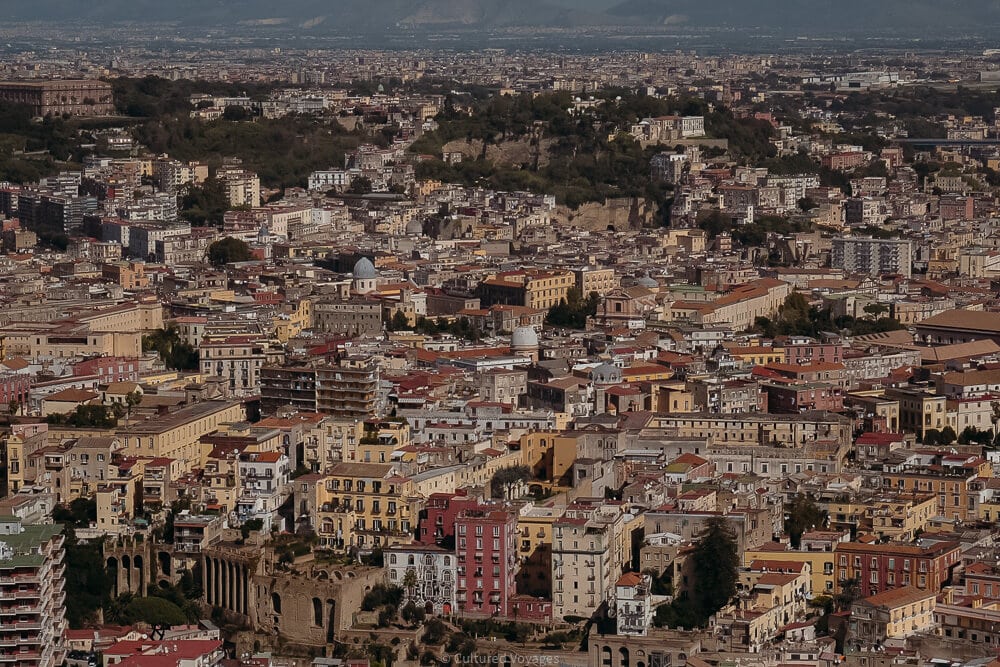
Most of the activities and attractions on this 2 day Naples itinerary are placed in and around the historic city center so this is the best place to stay if you’re planning on spending a relatively short time in the city.
Below, are some hand-picked places to stay in Naples that each offer something unique, as well as being well positioned for exploring the city from.
If you’d like more options, read this dedicated post with the best places to stay in Naples. I go through eight of the best neighbourhoods to stay in and handpick properties for each.
Cultured Voyages top accommodation picks
Quatrum Napoli | plush guesthouse with rave reviews
This luxurious guesthouse is located in the heart of Naples’ historical centre and offers contemporary comforts in an historic Neapolitan building.
***
Grand Hotel Santa Lucia | waterside luxury with sea views
This Art-Nouveau hotel dates back to the turn of the 20th century and is situated along the seafront, offering guests sweeping views of the Bay of Naples as well as quick and easy access to Naples’ historic centre.
***
Decumani Hotel De Charme | central hotel with old school charm
With parquet floors and unique antique furniture, this hotel is set in a historic building in a very central location. Its common spaces are grand, boasting golden stuccoes and 18th century mirrors.
***
Artemisia | extremely well-located luxe-for-less pad
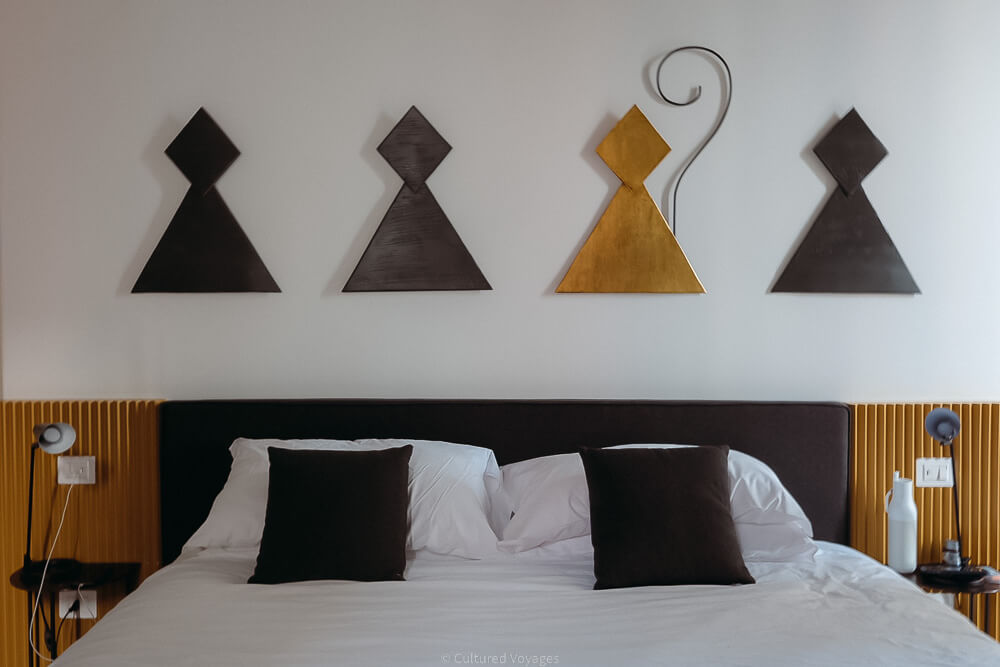
This is a super stylish boutique guesthouse in the heart of Naples historic center. Functional, modern bedrooms have been placed in old spaces with wooden beams and exposed brick in a sympathetic and complementary way, some even offering a spa bath.
***
La Casa Sul Nilo | old world luxury on a budget
Located slap bang in the middle of Naples’ centro storico, you really couldn’t do much better than this location wise. The decor draws on Naples’ grand days of old, with a nod to old world luxury in the form of deep, rich colour schemes, grand floor to ceiling windows and plush finishings throughout.
As a note, if your search takes you beyond these properties listed, try to keep around the area of Spaccanapoli, Piazza Bellini, Piazza Dante, Via Toledo and Piazza Plebiscito for optimum positioning.
While the area of Piazza Garibaldi might offer properties that seem to be good value, be aware that this area is that of Napoli Centrale, the central train station.
In most big cities, the area around main train stations tends to be a bit unsavoury and Naples is no different in this regard.
Orientating yourself for your 2 days in Naples

With two days in Naples that you will want to make the most of, one of the best things to do is to quickly orientate yourself with the city. There are three main streets that you should find on the map and get your bearings in relation to; Via Tribunali, Spaccanapoli and Via Toledo.
Both Via dei Tribunali and Spaccanapoli (which literally mean’s “Naples Splitter”, run on an east-west axis and are parallel to each other. Much of Naples’ centro storico is set in around around these two streets.
Just to the west of these two streets is Via Toledo, Naples’ most famous shopping street, which runs on a north-south axis from Piazza Dante right down to the coastline at Piazza del Plebiscito.
Once you orientate yourself in relation to these, finding your sense of direction in Naples will be much, much easier.
Things to know before planning a 2 day Naples itinerary
Where is Naples?
The city of Naples is located 140 miles south-west of Rome, along a rather beautiful stretch of the Tyrrhenian Sea.
Set in the Gulf of Naples, the city is theatrically overlooked by the infamous Mount Vesuvius, a volcano currently in a period of active rest that is most known for its fatal eruption in 79AD and the destruction it wrought on the nearby towns of Pompeii and Herculaneum.
The capital city of the Campania region, it is the third largest city in Italy, second only to Rome and Milan and is also regarded as the ‘capital city’ of southern Italy.
Naples history in a nutshell
Naples is one of the oldest continuously inhabited cities in the entire world, with a foundation that stretches back to the Ancient Greeks in the first millennium BC.
The ancient city was renamed Neápolis in the 6th century BC and then passed into the hands of the Romans, following which it was ruled by a succession of Goths, Byzantines, Lombards and Normans.
Over the generations, it grew to be a wealthy, powerful city and served as an important cultural hub for the region. During the period of 661 – 1139 AD, it served as the capital of the Duchy of Naples.
Following this, it was capital of the Kingdom of Naples from 1282 – 1816, after which is served as the capital of the Kingdom of the Two Sicilies, until Italy became unified in 1861.
In terms of cultural legacies, amongst the many great public buildings, squares and palaces that still remain to this day, Naples is also famous for the role it played during the Baroque period, where it nurtured some of the greatest talents the world has ever known, including Caravaggio and Bernini.
While Italy was under Fascist dictatorship during WWII, Naples succumbed to heavy bombing from Allied Forces – although once the Allies landed in Italy and had liberated Sicily, when they arrived in Naples the city had already rose against and freed themselves from the Nazis.
Is 2 days enough for Naples?
Two days are sufficient for Naples, although if time is on your side and this is your first time visiting the city (particularly as an art and history lover) then I’d highly recommend that you push this to three days if possible.
Two days, however, will allow you to see much of this vibrant and interesting city.
You’ll be able to learn about it’s far-reaching history, discover some of its artwork, explore its fascinating warren of streets, soak in its serene coastal setting and sample some of its mouth-watering cuisine in a two day period.
Common questions: read this post if you’re travelling to Naples
If you’ve yet to commit to a trip to Naples, or are in the midst of planning and booking same, then you’ll likely have some of the following questions and concerns:
- is Naples worth visiting
- how many days do you need in Naples
- is Naples safe
- what is the best time to visit Naples
- how to get to and around Naples
I’ve answered these questions in full (amongst several others), in this dedicated guide to Naples. Make sure to give it a read when pulling together your Naples itinerary.
2 days in Naples on the map
For your ease of reference and to help you to find your way around Naples, I’ve distilled all places mentioned on this itinerary (including places to eat) on the map below. On the map you’ll also find Via Toledo, Via Tribunali and Spaccanapoli marked too.
Naples itinerary (2 days) – some common questions


Is it worth visiting Pompeii when you only have 2 days?
This is a tricky one that I somewhat battle with an answer for, having visited Pompeii a couple of times before I had visited Naples. Personally, I believe that a visit to Pompeii is imperative, especially if you have an sort of interest in history, or indeed human civilisation in general.
However, I do also believe that Naples is so terribly overlooked for more spoken about gems (like Pompeii and the Amalfi Coast) and that if it is your first time visiting Naples that you should dedicate 2 whole days to it in full to do it any sort of real justice.
If you’d like to go to Pompeii and wish to use Naples as your base, then I would recommend adding a third day to your itinerary. You can read my suggestions for how to spend 3 days in Naples here.
If you are in a pinch and are tied to 2 days in Naples at a maximum, but really do want to visit Pompeii, then I would suggest booking a guided tour of Pompeii, where you’ll be able to get the best out of your time in Pompeii under the tutelage of an expert guide and could visit across half a day.
This small-group, 2 hour tour with an archaeologist receives excellent reviews.
Is it worth visiting Ischia/Procida/Amalfi Coast when you only have 2 days in Naples?
With only two days in Naples to play with, then I think incorporating a day trip to the Amalfi Coast, Ischia, Procida or Capri is a little bit of a stretch too far and will leave you with very little time to spend in the city itself, which would be a shame.
If you have three or more days to spend in Naples, it is more realistic then to start considering day trips. If you do only have two days maximum and want to plan a day trip, use this one day Naples itinerary and then plan your trip on the second day.
READ NEXT | Ischia vs Capri: Which Island Paradise Should You Visit?
What are the must see attractions in Naples in just 2 days?
The National Archaeological Museum and the Sansevero Chapel are the two I’d prioritise above everything else. The museum for the Pompeii collection and the Farnese sculpture room – set aside at least two hours.
The Sansevero Chapel for the Veiled Christ, which is one of those pieces of sculpture that genuinely stops you in your tracks. Both require advance booking.
How can I make the most of my 48 hours in Naples?
Book the Catacombs, the Sansevero Chapel and the Archaeological Museum in advance – all three have limited capacity and the first two sell out regularly. Split the city as this itinerary does: north of Spaccanapoli on day one, south toward the seafront on day two.
Eat at Da Attilio for lunch on day two – book ahead. And give yourself an unscheduled hour somewhere in the middle. Naples rewards wandering.
If you’ve got longer than 2 days in Naples – some popular day trips from Naples
If you have three or more days to spend in Naples and don’t want to move accommodation to another base, then there are a number of places that you could explore visiting from the city.
The most obvious of these are the ruins of Pompeii and/or Herculaneum, together with a trip up Mount Vesuvius itself. This tour combines a trip to both Pompeii and Vesuvius.
Secondly, you could consider a visit to any of the major islands in the Bay of Naples, namely Ischia, Capri or Procida. Capri is the most famous of the three and it’s possible to visit by an organised tour if you wish.
Otherwise, you’ll be able to take one of the regular ferries that departs from Naples’ port. You can search ferry routes here.
Thirdly, are Sorrento and the Amalfi Coast. Personally, I’m of the opinion that the Amalfi Coast is a destination that one should spend a few days on, rather than visit as a day trip.
As a frequent visitor to the region, much of a visit to the Amalfi Coast is about easing yourself into the pace of life and it is very much a ‘take it slow’ sort of destination, once you know how to avoid the crowds.
It’s easy to spend a week or more there – and I’ve detailed just how to do that in this 10-day Amalfi Coast itinerary.

Before you go
Everything I check before a trip now lives on one page.
Seven shifts I run on every trip I plan, each one paired with the story that taught it to me and the steps for using it yourself — built to be printed, kept, and pulled back out before the next one.
It arrives when you join The Cultured Voyages Edit, a fortnightly letter on European cultural travel.
Planning the rest of your Naples trip
If two days has done what Naples usually does – which is convince you to come back for longer – the 3 days in Naples itinerary adds Capodimonte, the Bourbon Tunnel and a day trip option to Pompeii or the islands.
Still building the full picture? My guide to where to stay in Naples covers all eight neighbourhoods with handpicked hotel picks for each, and the food tours guide is worth a look if eating your way through the city is part of the plan.

You’ll find all our Naples travel guides below—or head to our Naples destination hub for more tips, itineraries, and local insights.
Related reading for naples


Like this post? Please save or share for later


