
Disclosure: Some of the links on this site are affiliate links. If you make a purchase through one of them, I may earn a small commission at no extra cost to you. Read my full disclaimer here. Thank you for your support!
Is Venice worth visiting? This guide gives you a clear, honest answer, covering 22 things that make it unforgettable, its 7 biggest downsides, and how to experience it without the crowds or tourist traps.
Venice is one of the most visited cities in the world. But ask a group of travellers whether it’s worth visiting, and you may get wildly different answers.
Some say it’s the most beautiful city on Earth, a place unlike any other, where history, art, and sheer improbability collide. Others will tell you it’s an overcrowded, overpriced tourist trap, slowly sinking under the weight of its own fame.
With all that in mind, is Venice really worth visiting? In my opinion, it’s an absolute yes — but only if you know what to expect and know how to avoid the crowds, as well as avoid common mistakes.
I’ve been to Venice multiple times, in different seasons, with various levels of planning.
I’ve experienced it at its most magical — wandering empty alleyways on quiet afternoons and watching the golden light flicker on the Grand Canal in the early morning.
And I’ve seen its worst — shuffling through swarms of tourists in St. Mark’s Square in summer, paying too much for an underwhelming meal.
The truth is, Venice isn’t ‘perfect’ (nor is anywhere, for that matter) — but it is still extraordinary.
Here’s a realistic, no-nonsense guide to whether Venice is worth visiting, including 23 reasons why it’s incredible and a few downsides you need to prepare for — as well as how to do just that.
In Short: Is Venice Worth Visiting?
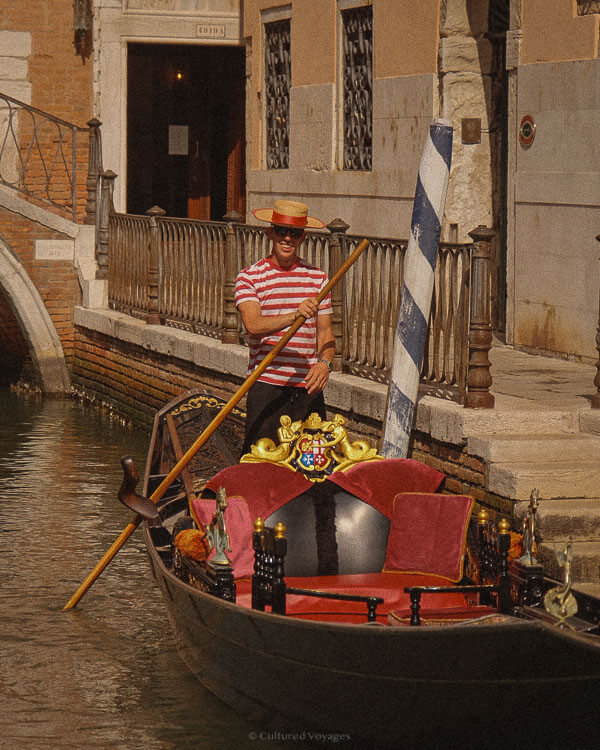
Yes, Venice is absolutely worth visiting — but only if you do it right.
It can be crowded, expensive, and overwhelming if you don’t plan well, but when experienced at the right time and in the right way, Venice reveals itself as one of the most beautiful and fascinating cities on Earth.
With its floating palaces, shimmering canals, rich history, and incredible art, Venice is a place like no other. It is fragile, fleeting, and utterly unique. And that alone makes it worth seeing at least once in your life.

Why Venice is Worth Visiting (22 Reasons to Go at Least Once)
1 Venice is Unlike Any Other City in the World
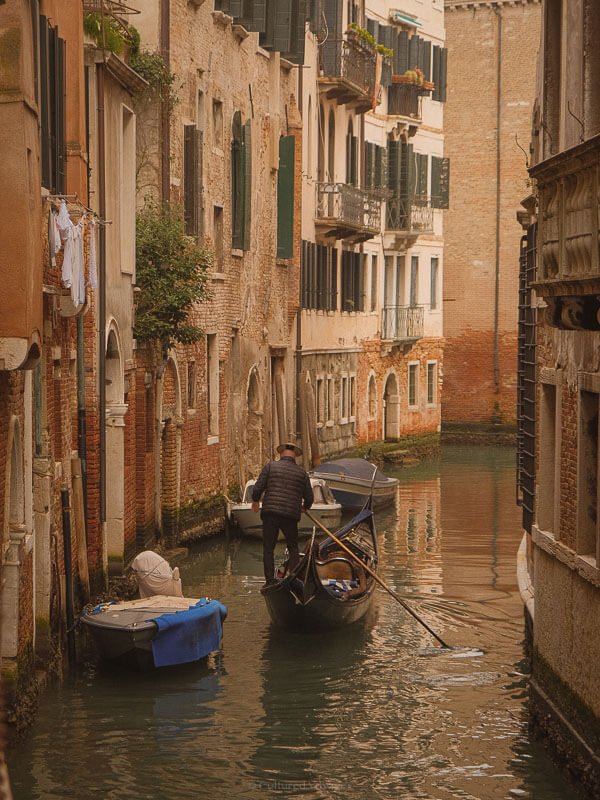
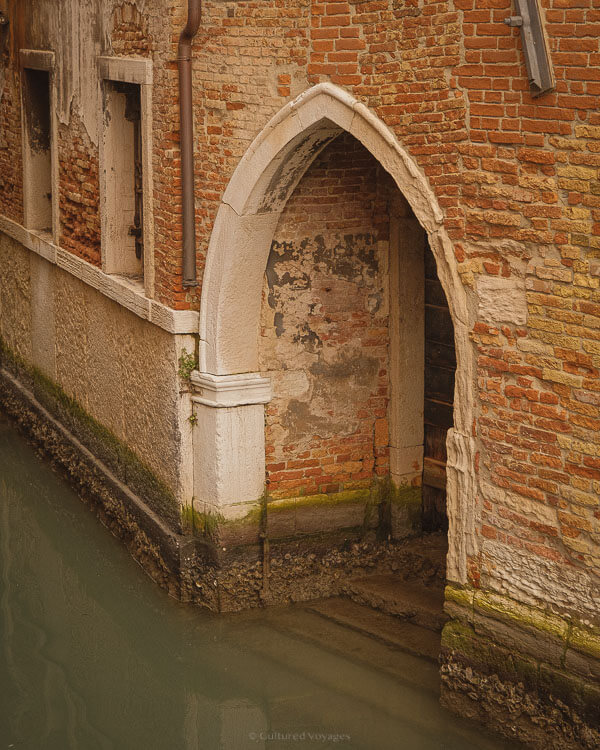
Venice exists in defiance of nature, a city built on wooden stilts in the middle of a lagoon, where water replaces streets and boats replace cars.
Instead of stepping onto a pavement, you step onto a floating dock. Instead of taxis, you take a vaporetto (water bus). Even the city’s bridges, arching over narrow canals, seem designed more for poetry than practicality.
This isn’t just a historic novelty but is something that shapes the entire experience of being there. The moment you arrive, whether by train, boat, or bus, you feel it: Venice moves differently.
You walk, you glide…you dodge the crowds! All jokes aside, it’s a place where every turn feels like a scene from a painting, where even the ordinary feels a little bit surreal. That, alone, makes Venice worth seeing at least once.
2 There Are No Cars — Only Canals, Bridges, and Boats
Most cities are designed around roads. Venice, meanwhile, is designed around water.
That means no traffic lights, no honking horns, no fumes from buses or motorbikes. Instead, the city flows with the gentler sounds of boat engines humming on the water, waves lapping against stone, and footsteps echoing through alleyways.
But there’s a trade-off: you will walk — A LOT.
The city is made up of 118 islands connected by 400+ bridges, and even though it looks compact on a map, there are no shortcuts. What seems like a 5-minute walk could take 15, thanks to the maze-like streets and the frequent zig-zagging over bridges.
For some, this is a hassle. But for others, like myself, it’s what makes Venice so special.
Walking here isn’t just about getting from A to B—it’s about getting lost, turning a random corner, and discovering a hidden square or an empty canal where it feels like you’ve stepped inside a piece of artwork.
3 Venice is Rather Easy for Tourists to Navigate
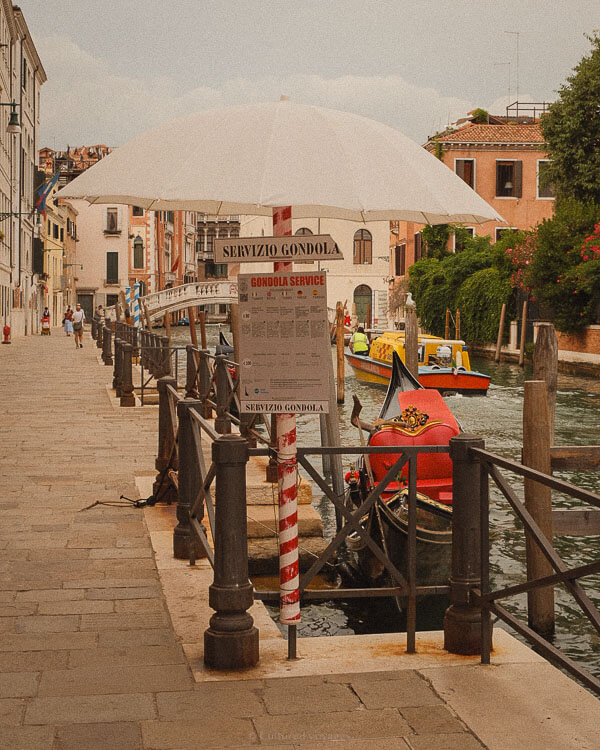
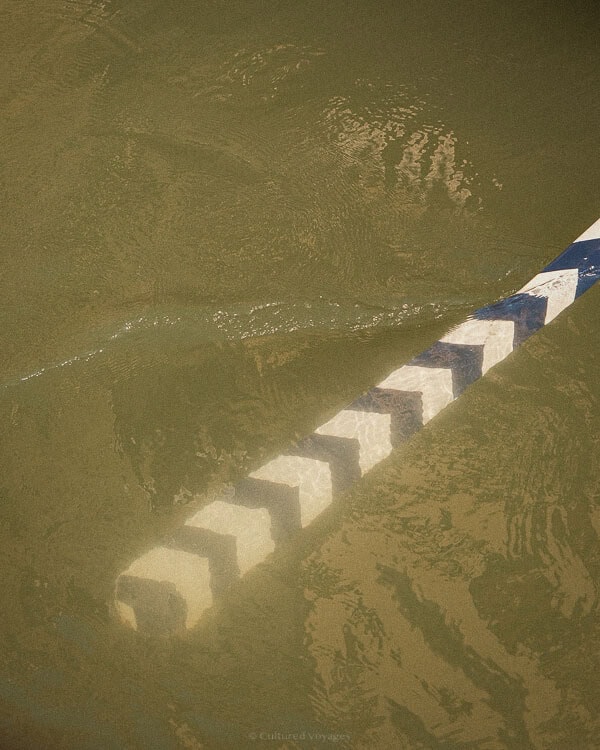
For all of Venice’s quirks—its canals, its lack of cars, its maze-like alleys—it’s actually one of the easiest places to visit as a tourist.
You won’t struggle with language barriers, even in smaller, local spots. Every time I attempt my broken Italian in Venice, even when somewhere considered to be ‘off-the-beaten-track’, people immediately switch to English with great grace.
Menus, signs, and transport information are all easy to understand, and even if you get lost, you’re never too far from a main landmark or vaporetto stop.
I find the public transport to be straightforward and easy to figure out (as long as you know which vaporetto line you need), and while the city can feel like a labyrinth, you can always just follow the bright yellow signs pointing to major landmarks like San Marco or the Rialto Bridge that adorn the buildings.
The biggest challenge, however, is tourist congestion. Venice is designed for visitors, but during peak season, that means crowds everywhere. Even then, however, it’s a case of ‘every cloud has a silver lining’.
The city’s layout means you can usually duck down a quiet side street and instantly escape the chaos, even in the madness of summer.
4 Gondola Rides Are Magical & Unique

Let’s get this out of the way first: Gondola rides are expensive. A 30-minute ride costs €80 during the day and €100 in the evening. That’s more than most budget flights in Europe.
But does that mean you should skip it? Not necessarily.
A gondola ride is not just about transportation—it’s about seeing Venice from the water, the way it was meant to be seen.
The best part is not gliding down the Grand Canal (which is usually crowded), but floating through the hidden back canals, where the water is still, the houses lean close, and the only sound is the creak of the oar.
If you don’t want to spend the money but still want to step into a gondola, take a traghetto—a public gondola ferry that crosses the Grand Canal in just a few minutes for €2. It’s not private, but it gives you a small taste of the experience.
Personally, I can’t think of anywhere else in the world that you travel around the streets by boat, making Venice utterly unique in this regard.
RELATED READING: 👉 How to Take a Gondola Ride in Venice (Without Getting Ripped Off) (coming soon)
5 The Grand Canal is One of the Most Beautiful Streets in the World

Venice doesn’t have grand boulevards or avenues—but it does have the Grand Canal, a curving, 3.8-kilometre waterway that is arguably one of the most beautiful streets on Earth.
Lined with palaces, historic merchant houses, and churches that rise straight out of the water, the Grand Canal has been Venice’s main artery for centuries.
There’s no shortage of ways to experience it:
- Take Vaporetto Line 1 – This slow-moving water bus runs the length of the Grand Canal, stopping at historic landmarks along the way. It’s Venice’s best budget-friendly sightseeing cruise. For fewer stops but the same route over a shorter time duration, hop on Line 2.
- Stand on the Rialto Bridge – The view from here, especially at sunset, is one of the most iconic images of Venice (although personally, I prefer the one from Ponte dell’Accademia).
- Experience it at night – When the day-trippers leave and the palaces light up, the Grand Canal takes on an even more dreamlike quality.
6 Venetian History is Fascinating (And Everywhere You Look)
Venice shouldn’t have been powerful.
It started as a collection of wooden huts on stilts, built by refugees escaping invaders from the mainland. And yet, over the centuries, it became one of the wealthiest and most powerful republics in the world.
Unlike other Italian cities that were ruled by kings or popes, Venice was a merchant republic, governed by the Doge and an elite ruling council.
While Venice thrived on commerce and diplomacy, it was also a formidable naval and military power, defending its territories through a legendary fleet, strategic alliances, and wars against both European rivals and the Ottoman Empire.
You don’t need to be a history buff to feel Venice’s past—it literally surrounds you when you’re there.
The grandeur of Venice wasn’t just built on trade—it was shaped by power struggles, espionage, and shifting alliances.
Hidden behind the ornate facades of its noble palazzi, rival families manoeuvred for influence, shaping the city’s fate from private salons and candlelit chambers.
Palazzo Grimani and Palazzo Pisani Moretta once hosted secret meetings between Venetian elites, while the imposing Arsenale, Venice’s naval heart, produced warships at a pace unmatched in Europe.
Even the city’s quieter canals once carried messages between spies, smugglers evading the Republic’s strict trade laws, and nobles exiled for political betrayal.
7 Venice’s Architecture is a Masterpiece in Itself
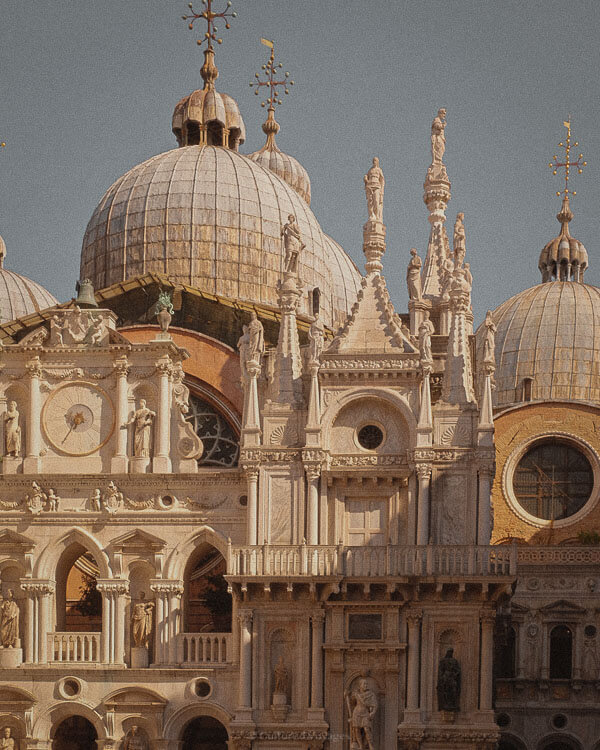
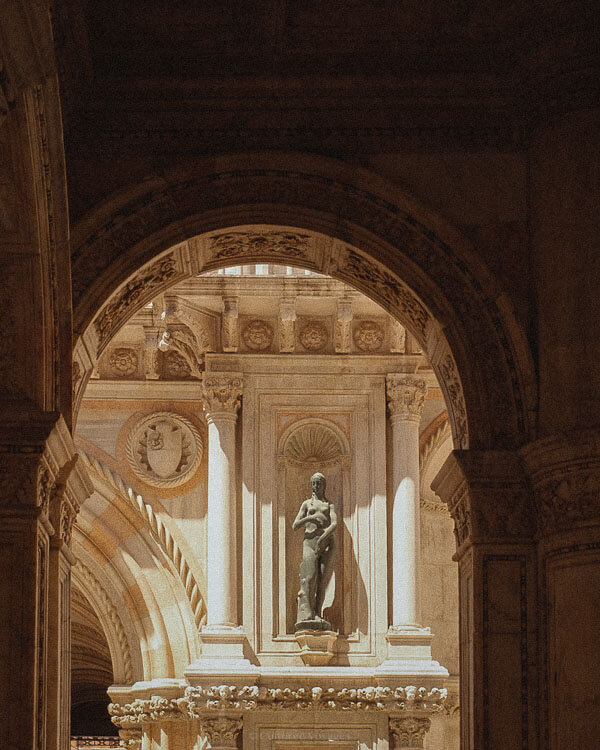
Venice is a city that looks like nowhere else. You can visit without ever stepping foot inside a museum and still feel like you’re walking through a work of art.
The city’s architecture is a blend of Gothic, Byzantine, and Renaissance styles, shaped by its unique history as a trade hub between Europe and the East.
Nowhere is this clearer than in St. Mark’s Basilica, with its gold mosaics, onion-shaped domes, and treasures looted from Constantinople.
The Doge’s Palace, meanwhile, is a masterpiece of Venetian Gothic architecture, its delicate marble façade hiding a history of power, intrigue, and imprisonment.
But the real magic of Venetian architecture isn’t just in its famous landmarks—it’s everywhere you turn.
It’s in the crumbling facades along narrow canals, where exposed brick peeks through faded frescoes. It’s in the wooden shutters and flower-filled balconies of hidden courtyards.
It’s in the simple fact that the entire city appears to be floating, a maze of grand palaces and quiet alleyways, all resting on ancient wooden stilts.
Everywhere you turn, Venice feels both impossibly grand and beautifully fragile—a city built to impress, yet always at risk of slipping into the sea. It makes it incredibly special.
8 The Doge’s Palace is One of the Most Incredible Buildings in Europe
The Palazzo Ducale (Doge’s Palace) was the nerve centre of Venetian power for centuries.
This stunning Gothic palace, with its pink-and-white marble facade, looks almost delicate from the outside. But step inside, and you’ll find grand halls where laws were passed, deals were made, and enemies of the state were condemned.
The Hall of the Great Council is jaw-dropping—its ceiling drips with gold, and it houses the world’s largest oil painting, Tintoretto’s Paradise. But the real intrigue lies in the hidden chambers, where the Venetian Republic’s rulers plotted behind closed doors.
The palace connects to the Prison of the Inquisition via the Bridge of Sighs, named for the sighs of prisoners who caught their last glimpse of freedom before being led to their cells. Among them? Casanova, who famously escaped in 1756.
Even if you’re not a history buff, the Doge’s Palace is one of the most atmospheric places in Venice.
RELATED READING:
👉 How to Visit the Doge’s Palace – A Complete Guide
9 St. Mark’s Basilica is Covered in Gold (Literally)

Few churches in the world can match the sheer splendour of St. Mark’s Basilica.
Its five domes rise above St. Mark’s Square, their Byzantine curves unlike anything else in Italy. But the real magic is inside—the walls and ceilings are covered in 8,000 square metres of gold mosaics, shimmering like fire when the light hits them.
Venice’s wealth wasn’t built on conquest, but that didn’t stop its rulers from “borrowing” treasures from elsewhere.
The basilica’s most famous relics—the bones of St. Mark himself—were smuggled out of Egypt by Venetian merchants in 828 AD, hidden in barrels of pork to fool Muslim customs officers.
Outside, the Horses of St. Mark, cast in ancient bronze, were looted from Constantinople during the Fourth Crusade. Today, St. Mark’s Basilica stands as more than a church but as a symbol of Venice’s past wealth, ambition, and bold defiance of time.
10 The Rialto Market is a Glimpse of Daily Venetian Life
While much of Venice is filled with tourists, the Rialto Market still belongs to the locals.
Every morning, just steps from the famous Rialto Bridge, vendors set up stalls overflowing with fresh seafood, seasonal vegetables, and bright citrus fruits. The scent of saltwater and fresh basil lingers in the air, as fishmongers gut the day’s catch and call out their prices.
This market has been the beating heart of Venetian commerce for over 700 years. In the days of the republic, it was here that spices from the East, fabrics from Asia, and exotic goods from across the known world changed hands.
Today, it’s where chefs and home cooks alike come to buy ingredients for the day’s meals.
Even if you’re not buying, the Rialto Market is worth visiting for its atmosphere alone. It’s one of the few places where you can still see Venice functioning as a real city, beyond the postcard-perfect canals.
The pungent wafts of fish as you approach, coupled with the aggressive seagulls who loiter and bicker for the end-of-day spoils, lends the market a very grounded edge amongst all the glamour of Venice, and that, in particular, is what I love about it for.
11 Venice is a Living Museum of Renaissance Art

Venice isn’t just aesthetically beautiful but has helped shape aesthetics in another form via the history of Western art.
While Florence and Rome focused on sculptural perfection, Venetian painters were obsessed with light, colour, and movement, creating works that still feel alive today.
At the Gallerie dell’Accademia, you can stand before Titian’s dramatic altarpieces, Veronese’s opulent banquet scenes, and Tintoretto’s dynamic storytelling. Each brushstroke captures the energy of a city that once ruled the waves.
I went on a gallery spree on my last visit and kept being bowled over by the sheer volume of world-class art in each collection. It almost seemed never-ending and was such a demonstration of how prolific the city of Venice and its artists were in driving forth this world-changing evolution in art and humanities.
Beyond the galleries, art is woven into the fabric of many of Venice’s other buildings—from the ceiling frescoes in churches to the paintings tucked away in quiet corners of palaces.
Even if you’re not usually into museums, it’s impossible not to be moved by the artistry that seems to seep from Venice like a deliciously sweet syrup.
RELATED READING:
👉 15 Best Museums and Galleries in Venice You Can’t Miss
12 Carnival & Venetian Masks Make the City Feel Whimsical

Few places do spectacle and mystery like Venice.
Every February, the city transforms for Carnevale di Venezia, a festival dating back to the 13th century. For two weeks, masked figures in elaborate gowns glide through the streets, gondoliers row in costume, and grand masquerade balls unfold behind candlelit palazzo windows.
But masks in Venice weren’t just for Carnival—they were a part of everyday life.
In the 18th century, Venetians wore them to hide their identities while gambling, conducting secret affairs, or making shady political deals. Some of the most famous masks include:
- The Bauta – A full-faced mask with a prominent chin, allowing the wearer to eat and drink without revealing their identity.
- The Moretta – A silent mask worn by women, held in place by biting a button, making it impossible to speak.
- The Plague Doctor – With its long beak, it was originally designed for physicians treating plague victims.
Even today, Venice’s mask-making tradition lives on, and stepping into an authentic mask atelier is like stepping into another world.
13 Venice’s Murano Glass & Burano Lace Are Legendary
Venice isn’t just famous for its canals—it has centuries-old craftsmanship that’s still alive today.
Murano glass has been hand-blown on the island of Murano for over 700 years.
In the 13th century, Venice moved all its glassmakers there to keep their trade secrets safe (and to prevent fires in the main city). Murano artisans perfected techniques like millefiori (multi-coloured floral patterns), gold-infused glass, and delicate filigree designs.
Meanwhile, Burano is known for something softer but no less intricate—Venetian lace.
In the Renaissance, Burano lace was the most prized in Europe, commissioned by kings and popes. Unlike machine-made lace, true Burano lace is handmade, often requiring months to complete a single piece.
Both Murano and Burano are worth visiting not just for their crafts but for their unique atmospheres—Murano’s glass-blowing studios feel almost alchemical, while Burano’s rainbow-coloured houses look like something out of a child’s storybook.
14 Venice’s Artisan Traditions Go Beyond Murano & Burano

While Murano glass and Burano lace get most of the attention, Venice has a long tradition of artisan craftsmanship beyond those famous exports. If you want unique, high-quality souvenirs that go beyond the usual trinkets, here’s what to look for:
- Handmade Venetian Paper & Bookbinding – Venice has a centuries-old tradition of decorative paper-making and leather-bound journals. Shops like Il Papiro and Paolo Olbi sell beautiful, hand-crafted notebooks, stationery, and marbled papers.
- Furlane Slippers – Originally worn by gondoliers, these soft, velvet shoes with recycled rubber soles are now a sought-after Venetian craft. Look for authentic ones at Piedàterre. They are REALLY beautiful!
- Traditional Mask-Making – Beyond the mass-produced masks in tourist stalls, you can visit authentic workshops like Ca’ Macana, where artisans still craft masks using traditional methods from Venice’s Carnival history.
- Handcrafted Jewellery & Metalwork – Some workshops in the city still practice goldsmithing and metal engraving, producing intricate rings, necklaces, and homeware that reflect Venice’s historic craftsmanship.
Many of these artisan traditions are at risk of disappearing, so if you want to take home something truly Venetian, support these local makers instead of buying factory-made souvenirs from the shops that line the main thoroughfares.
15 Venice is a Food City If You Know Where to Look
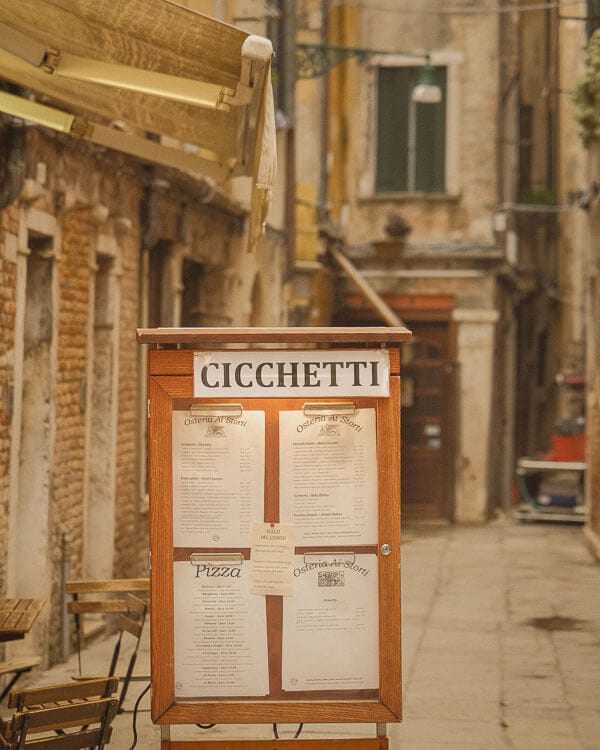
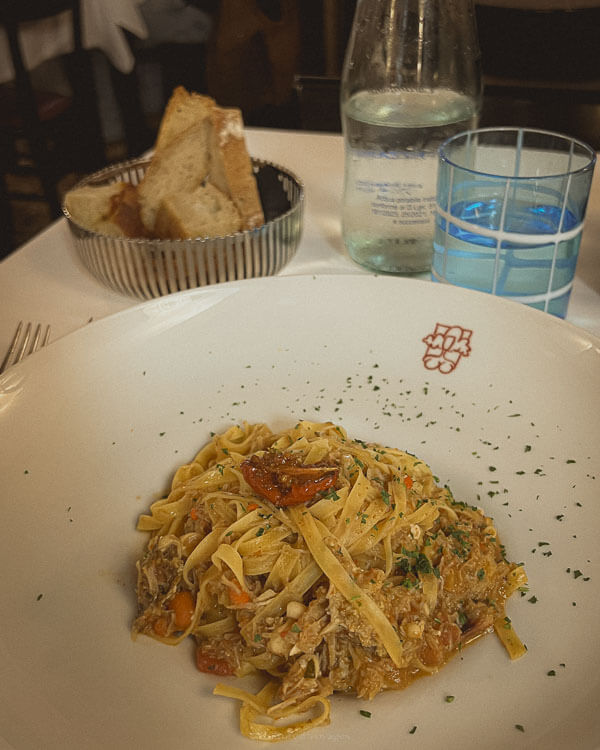
Venice tends to be overlooked for its food, mostly because tourist-heavy areas are full of overpriced, mediocre restaurants and most visitors don’t actually know what Venetian cuisine centres on, nor could they identify some of Venice’s best-known dishes.
But if you know where to go and choose to educate yourself a little in advance of your trip, Venetian cuisine is as rich as its history and, like other places in Italy, is built around its geographical location.
Unlike other Italian cities that are famous for pasta, Venice is all about seafood, risotto, and cicchetti (small shareable snacks). Some of the best dishes to try include:
- Sarde in Saor – Sweet-and-sour sardines, a dish that dates back to Venetian sailors who needed food that could last at sea.
- Bigoli in Salsa – A simple but delicious dish of thick spaghetti with an anchovy and onion sauce.
- Risotto al Nero di Seppia – A jet-black squid ink risotto, rich with briny, umami flavour.

pro Tip
Avoid anywhere with a tourist menu. Instead, look for tiny, local bàcari (wine bars), where you’ll find some of the best food in the city for a fraction of the price.
RELATED READING:
👉 Where and What to Eat in Venice – A Foodie’s Guide
16 Cicchetti Culture is One of Italy’s Best-Kept Secrets
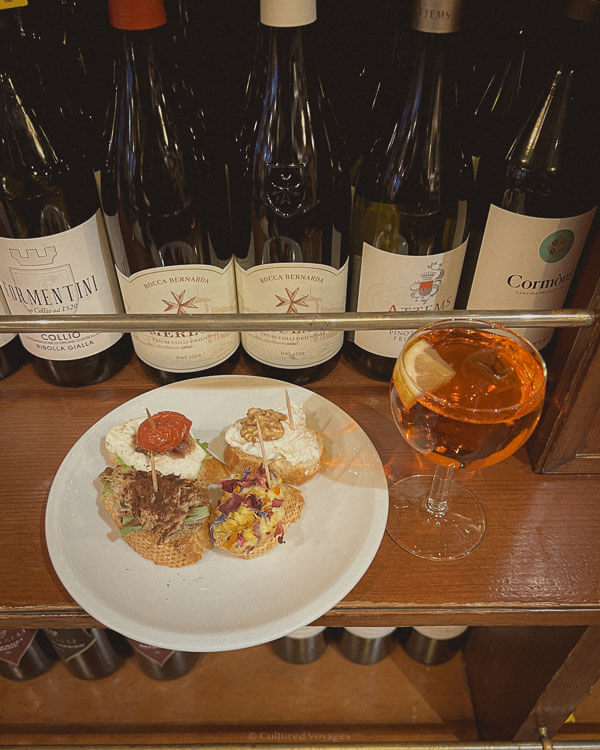
One of my favourite things about Venice is how effortless eating can be.
Unlike the rest of Italy, where meals are often long, sit-down affairs, Venice has its own way of doing things—snacking on cicchetti (small bites) while standing at a counter, with a glass of wine or a spritz in hand.
It’s much akin to the tapas culture of Seville, if you’re looking for a comparison.
For locals, cicchetti is not a meal replacement but more of a pre-dinner aperitivo or a quick lunch stop.
Most Venetians will order one or two cicchetti and an ombra (small glass of wine), chat for a few minutes, and then head off. They’re not typically “bàcari-hopping”—that’s more of a tourist thing or something done on special occasions with friends.
For visitors, though, this way of eating is perfect. Between sightseeing, you can pop into a bàcaro for a quick snack and drink, or if you want to experience a few different spots, do a mini cicchetti crawl.
Different bàcari are known for different specialities, so trying a few places is a great way to experience the variety. One of my personal favourites was Cantine del Vino già Schiavi, where they are known for their cocoa-dusted tuna crostino—a strange but rather tasty combo.
At Bacareto da Lele, I spent just €8.60 on two ham and porchetta sandwiches and a glass of Treminer wine—one of the best budget meals I had in Venice.
You can keep things really affordable—in a non-touristy bàcaro, you can spend just a couple of euros for a drink and a snack.
RELATED READING:
👉 Best Cicchetti in Venice – 10 Top Spots, Must-Try Bites & Insider Tips
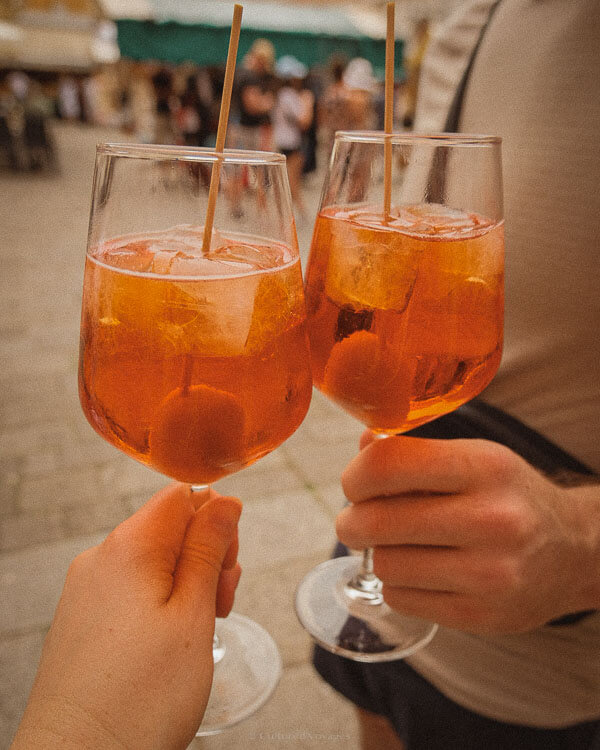
17 The Venetian Spritz Is More Than Just an Aperol Drink

The spritz is Venice’s most iconic drink, but it didn’t start out as the bright orange Aperol version you see everywhere today.
It actually dates back to the 19th century, when Austrian soldiers stationed in Veneto found the local wines too strong and diluted them with water. Over time, bitter liqueurs were added, Prosecco replaced still wine, and the modern spritz was born.
But in Venice, it’s not all about Aperol. While that’s the version most tourists know, you will also find:
- Select Spritz – A true Venetian favourite, made with Select, a bittersweet liqueur invented in Venice in 1920.
- Campari Spritz – A deeper red, stronger and more bitter than Aperol.
- Mezzo-Mezzo – A 50/50 mix of Campari and Aperol, for something in between.
- Cynar Spritz – Made with Cynar, an artichoke-based liqueur with a herbal, earthy flavour.
- White Spritz – No bitter liqueur at all—just Prosecco and soda water, simple and refreshing.
One of the best things about ordering a spritz in Venice is the price. In a non-touristy bàcaro, you can pay as little as €2-3, compared to €8-12 in St. Mark’s Square.
It’s the perfect drink to pair with cicchetti, and you’ll see Venetians sipping them at all hours of the day—yes, even mid-morning, like the fellows I spotted outside Bar Al Mercà at 10am on a midweek morning!
18 The Venice Biennale is One of the Most Important Art Events in the World

Venice doesn’t rest on its past laurels but continues to shape the future of art. Every two years, the Venice Biennale transforms the city into a global stage for contemporary art, turning palaces, shipyards, and entire islands into temporary exhibitions.
The Giardini and Arsenale host the main pavilions, where countries showcase their most innovative artists. But the real magic happens outside these spaces, where the city itself becomes part of the art.
One year, Damien Hirst unveiled a collection of sculptures encrusted with coral and barnacles, presented as artefacts from a fictional shipwreck (Treasures from the Wreck of the Unbelievable).
Another year, Ai Weiwei exhibited his powerful installation S.A.C.R.E.D. inside the Church of Sant’Antonin — a six-part work of iron boxes depicting his 81-day incarceration in China.
Each box, titled Supper, Accusers, Cleansing, Ritual, Entropy, and Doubt, had small slits for viewers to peer inside at dioramas showing Ai under constant surveillance—eating, sleeping, even using the toilet, always flanked by guards.
Even if you don’t visit during Biennale season, Venice is still a very modern art city.
The Peggy Guggenheim Collection, housed in her former home on the Grand Canal, has some of the best Picasso, Pollock, and Dalí pieces in Europe. The rest of the city is dotted with modern art galleries—try pop into any you see while going past, even just for a look.
Venice may have an old-world feel, but artistically, it’s anything but stuck in the past.
19 Venice in the Off-Season Feels Like Another World

Most people experience Venice at its busiest—fighting through crowds in summer or dodging day-trippers in peak season. But if you come in the off-season, especially in winter or early spring, it feels like a completely different city.
Most recently, I visited in the middle of February, midweek, and it was dreamlike.
As I wandered through the lesser-frequented areas, I often found myself the only tourist in sight. Even in well-known spots, the volume is so much lower at this time of year, and for once, the locals outnumber the visitors.
This is Venice as it really is—not just a stage for tourism but a city that still belongs to itself.
At night, the transformation is even more surreal. The Grand Canal is darker, its palazzi glowing under soft yellow lights. The bridges are silent, except for the occasional footstep of another wanderer or, more likely—a Venetian making their way home for dinner.
RELATED READING:
👉 Venice in Winter – What to See, Do, Eat & Where to Stay
20 The Outer Islands (Murano, Burano, Torcello) Offer a Quieter Escape
If Venice itself gets too crowded, hop on a vaporetto and head to the outer islands. Each one offers something completely different:
- Murano – The home of Venetian glassmaking for 700+ years. You can watch master glassblowers at work, shaping molten glass into delicate, multicoloured designs.
- Burano – A rainbow-coloured fishing village that looks almost too perfect to be real. Known for its lace-making tradition and fresh seafood restaurants, it’s one of the most photogenic places in Italy.
- Torcello – The most peaceful island, where you’ll find Venice’s oldest church, surrounded by nature and silence. Hemingway once stayed here, writing Across the River and Into the Trees.
Most tourists never go beyond Venice itself, but these islands are where you can experience the slower, quieter side of Venetian life.
21 Despite the Tourism, Venice Still Has Hidden Corners to Discover


It’s easy to think of Venice as one big tourist attraction—and in some areas, it is.
But the secret to experiencing the real Venice? Step away from the main routes, take a turn down an empty calle, and let the city unfold on its own terms.
Some of my favourite moments in Venice haven’t been at any famous landmark.
Instead, they’ve happened when I’ve wandered without a map, away from the crowds, and suddenly found myself in an empty campo, or beside a still canal reflecting the soft afternoon light, or in a sun-faded palazzo with its paint peeling in the most beautiful way…you get the drift!
I love Cannaregio, especially the area around the Jewish Ghetto, where Venice still feels local and lived-in. But if I had to choose one part of the city that feels truly special, it’s the transition from San Polo into Dorsoduro.
This is where Venice slows down, where the edges of two neighbourhoods blur into one another, and where beautiful, quiet canals wind their way past elegant bridges, shuttered windows, and campo filled with locals catching up on the day’s gossip.
Dorsoduro, in particular, has a charm that’s hard to put into words.
Maybe it’s the way students spill out of cafés, chattering noisily and casually shouldering backpacks. Maybe it’s the way the bridges here feel narrower, the canals quieter, the buildings a little more sun-worn.
Let it be known, however, that Venice rewards those who wander. Let go of the map, walk without a destination, and I promise—you’ll find the version of Venice that you were hoping to find.
22 Venice is a Great Destination for Solo Female Travellers

I’ve found Venice to be one of the best solo destinations I’ve visited as a female traveller. It’s a city where I’ve felt safe, comfortable, and able to enjoy everything at my own pace—whether wandering through quiet alleyways, having a drink in a bàcaro, or walking home at night.
Before coming on my most recent solo trip, I was a little more cautious than usual—Venice has a reputation for pickpockets, and since I was alone, I was aware that if anything happened, I wouldn’t have anyone to fall back on. But in reality, I had no issues at all.
Maybe it was because I visited in the off-season, when there weren’t as many large crowds (which naturally make it easier for pickpockets), or maybe because I was extra careful, wearing a crossbody bag and keeping my valuables secure.
Either way, I never felt unsafe. Even at night, I was always surrounded by a mix of locals and other travellers, and the nature of Venice—where there are no dark, empty roads, just winding pedestrian streets with houses and cafés always nearby—made me feel at ease.
One thing I really love about Venice as a solo traveller is how effortless dining alone feels. The city’s cicchetti culture is perfect for solo eating—popping into a bàcaro, ordering a glass of wine and a few small bites at the counter, and moving on to the next place. It never feels awkward because it’s exactly how Venetians eat too.
If you’re considering Venice as a solo trip, I’d absolutely recommend it. Yes, it’s more expensive on your own, but if you can budget for it, I found it to be an easy, safe and enjoyable city to explore solo.
The Downsides of Visiting Venice (7 Negatives to Consider)
Venice is extraordinary—but it’s not perfect. While it’s easy to get swept up in the romance of canals and gondolas, there are real downsides to visiting, and if you’re unprepared, they can seriously impact your trip.
I love Venice, but I’ve also experienced its frustrations firsthand—the crowds, the prices, the way some areas feel more like a theme park than a city. Here’s what you need to know before you go.
1 Venice is Overcrowded—And That’s an Understatement

Venice is a tiny city with an outsized global reputation. It’s home to only 50,000 permanent residents, yet it receives around 20 million visitors per year. That means, for most of the year, tourists outnumber locals by an absurd ratio.
If you visit in peak season (late spring, summer, early autumn), expect:
- Huge crowds gather around St. Mark’s Square and the Rialto Bridge, sometimes so dense that walking becomes difficult.
- Packed vaporettos (water buses), long waits for water taxis, and no chance of getting a gondola ride without pre-booking.
- A struggle to find a quiet place to sit or escape the chaos—especially during cruise ship arrivals.
- A Tourist Tax for Day Visitors – €5 (rising to €10 if booked less than 4 days in advance) for day-trippers visiting on 54 peak days (mostly weekends and holidays from April to July). Day visitors over 14 need to download a QR code to show upon random checks.
- Overnight guests are exempt as hotel stays already include a tourist tax.
That being said, I do think it’s fair to say that Venice is not crowded everywhere. Step away from the main arteries, and you’ll find quiet streets, empty campos, and peaceful canals. And if you come in the off-season, then it’s a completely different city.
pro Tip
Visit between November and February, when crowds are low, and you can actually hear the sound of oars on the water.
2 Acqua Alta: Flooding Can Disrupt Your Trip
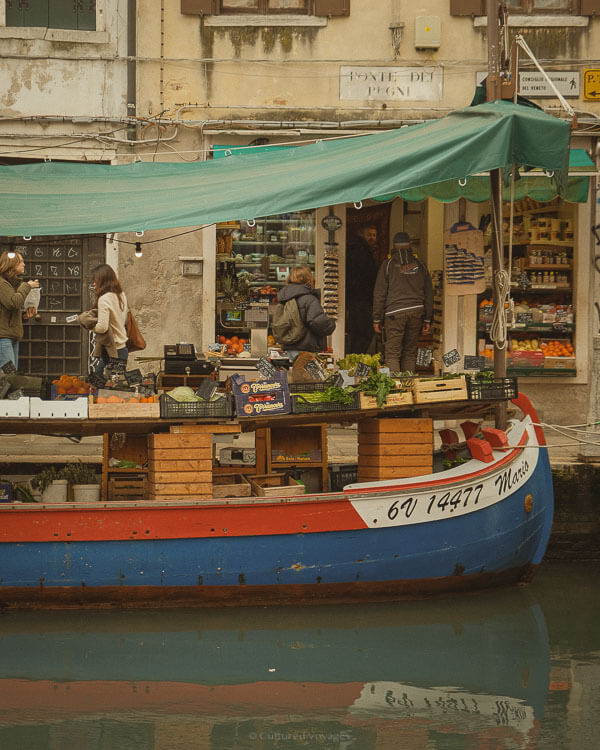
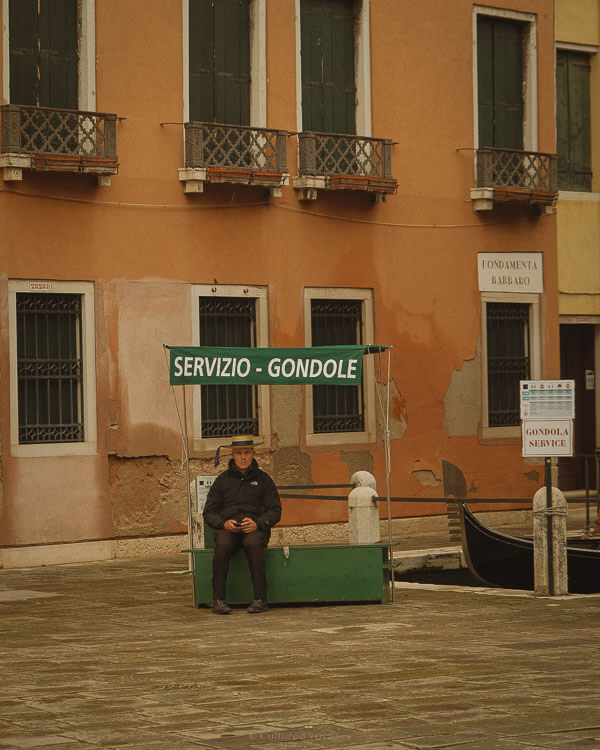
Venice’s beauty comes with a challenge—it regularly floods.
Acqua alta (high water) happens mostly in autumn and winter, when tides rise and parts of the city—especially St. Mark’s Square—become submerged under water. It’s not always dramatic, but it can make getting around tricky.
What does it mean for visitors? You might find yourself walking on raised platforms, avoiding waterlogged streets, or wearing waterproof boots to navigate certain areas.
Should you avoid Venice in flood season?
Not necessarily. Acqua alta rarely lasts all day—it comes and goes with the tides. Plus, some people love the eerie, mirror-like reflection it creates on the streets.
pro Tip
If visiting in October–January, bring waterproof shoes and check the tide forecasts (apps like Hi!Tide Venice help you track flooding in real time).
3 It’s More Expensive Than Other Italian Cities
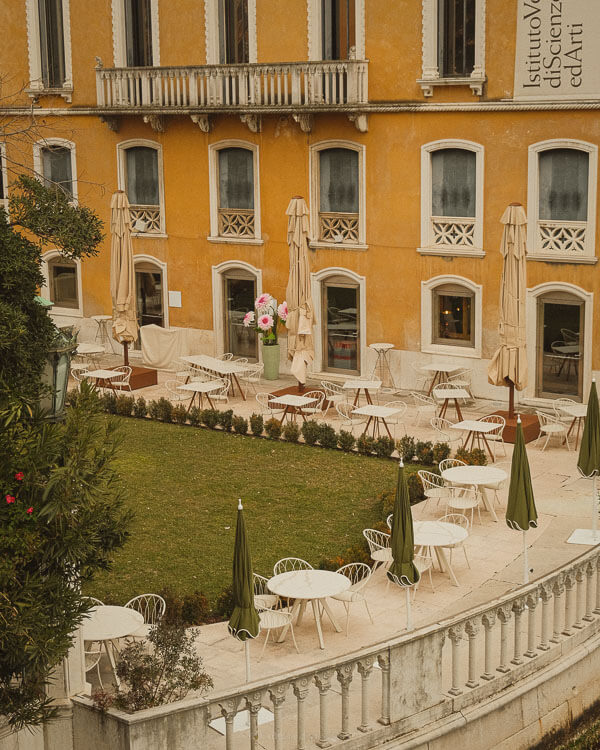
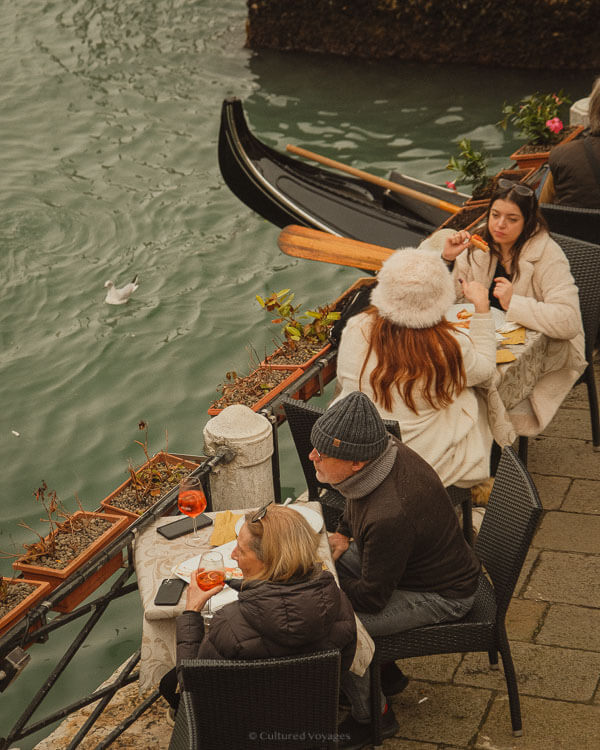
Venice is beautiful, but it isn’t cheap. Hotels, restaurants, gondola rides—almost everything is more expensive here than in Rome, Florence, or Naples.
A few examples:
- Hotels in central Venice often cost 30-50% more than similar ones in mainland Italy.
- A coffee in St. Mark’s Square? €10 (and that’s if you’re sitting).
- A 30-minute gondola ride? €80-100.
- Public transport? A single vaporetto ticket costs €9.50—more than a day pass for the metro in most European cities.
That said, budget-friendly Venice does exist:
- Stay outside the tourist core (Cannaregio, Giudecca, or even Mestre on the mainland).
- Eat at bàcari instead of restaurants (cicchetti is much cheaper than a sit-down meal).
- Buy a transport pass instead of single vaporetto tickets.
pro Tip
Don’t eat anywhere with a waiter standing outside trying to pull people in. That’s a guaranteed tourist trap.
4 Mass Tourism is Damaging the City

Venice’s beauty is also its curse. The very thing that makes it famous—its fragile, floating existence—is being eroded by tourism.
The problems?
- Overtourism is pushing locals out – With so many short-term rentals, it’s nearly impossible for residents to afford to live here.
- The city is physically sinking – Venice was built on wooden stilts, and the weight of modern infrastructure (along with rising sea levels) threatens its future.
- Cruise ships (though restricted) still bring unsustainable crowds – While large ships have been banned from the historic centre, they still dock nearby, unloading thousands of passengers at once.
This isn’t an abstract problem. Every year, you can see Venice struggling under the weight of its own popularity. And while responsible tourism helps, many visitors treat it like an amusement park rather than a real place where people live.
pro Tip
Stay overnight, shop locally, and don’t contribute to the “hit-and-run” tourism model. Please reconsider if you’re considering a visit as part of a cruise. Venice needs visitors who respect it—not just those looking for a quick Instagram photo.
RELATED READING:
👉 Venice Travel Tips – 30+ Things to Know Before You Go
5 If You Don’t Plan Well, You’ll End Up in Tourist Traps
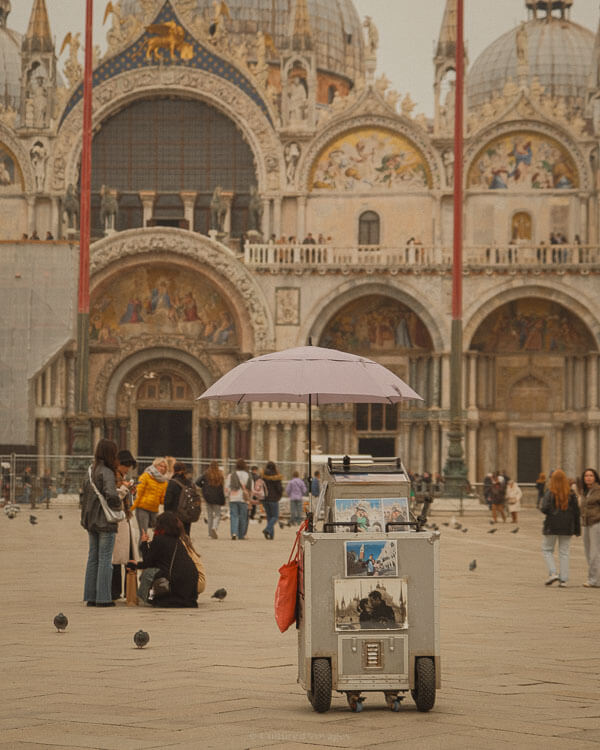
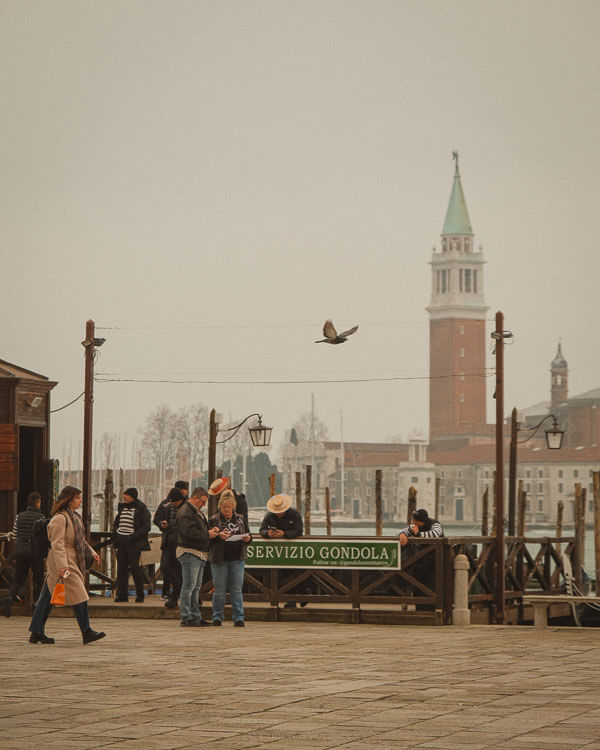
Venice has some of the best food in Italy—but also some of the worst. It’s a tale of two cities:
- Incredible family-run bàcari and seafood osterie, serving dishes that Venetians have eaten for centuries.
- Overpriced tourist restaurants with microwaved pasta, frozen seafood, and €15 Aperol Spritz.
The bad news? Most people only experience the second one.
Common tourist trap signs:
❌ A restaurant with a menu in 10 languages.
❌ A waiter calling you in from the street.
❌ A place advertising a “tourist menu.”
The solution? Eat where the locals eat. Stick to bàcari for cicchetti, ask for local recommendations, and avoid anywhere with photos of the food on the menu.
pro Tip
If you see locals standing at a crowded counter with small plates of food and glasses of wine, you’re in the right place.
6 There’s a LOT of Walking (And Many Bridges to Climb)

Venice may be compact, but it’s also one of the least accessible cities in Europe. With no cars or bicycles, your feet are your only form of transport.
That means:
- You’ll walk a LOT—5-10+km per day isn’t unusual.
- There are over 400 bridges, most with steps. If you have heavy luggage or mobility issues, getting around can be a challenge.
- Getting lost is part of the experience—Venice’s street layout is famously confusing, and Google Maps isn’t always accurate.
- Location A may not be far from Location B as the crow flies, but if you have to cross the Grand Canal, you may have to do quite a bit of additional walking (or waiting for a vaporetto or traghetto) to find a crossing.
For some, this is part of the charm. For others, it can be frustrating—especially if you’re carrying luggage or have trouble with stairs.
RELATED READING:
👉 How to Get from Venice Airport to the City Centre – All 5 Options Compared
pro Tip
Pack light and choose a hotel near a vaporetto stop to avoid dragging suitcases over countless bridges.
7 Venice is Not Very Accessible
For all its beauty, Venice is one of the least accessible cities in Europe. If you have impaired mobility, use a wheelchair, or are travelling with a stroller, you’ll need to plan carefully.
- Most bridges have stairs – While a handful have ramps, the vast majority do not, making it difficult for wheelchair users and those with mobility issues to get around.
- Vaporettos (water buses) can be tricky – Some are wheelchair accessible, but stops often have steep ramps that vary depending on the tide. Boarding can be difficult, especially at low tide.
- Limited accessible routes – There are some step-free paths, but they require a lot of pre-planning. The city does offer accessibility maps, but realistically, navigating Venice with a wheelchair or stroller will be a challenge.
If you do have mobility concerns, staying near a vaporetto stop and planning accessible routes in advance is essential. I would also discuss this with your accommodation, who will know that particular area of Venice well.
How to Make the Most of Your Trip to Venice
Venice has its downsides, but if you travel smart, you can avoid most of them. Here’s how to have the best experience possible.

1. Visit in the Off-Season (November-Mid February)
- No cruise ships, fewer crowds, cheaper hotels, and a more authentic experience.
- Yes, it might be foggy or rainy—but Venice in winter is hauntingly beautiful.
- Don’t visit during Carnival (mid-February to early March) if you want to avoid crowds.
2. Stay in a Less Touristy Neighbourhood
- Cannaregio – Local, quiet, great for hidden bàcari.
- Dorsoduro – Artsy, student vibe, close to attractions but not chaotic.
- Giudecca – Peaceful island across the lagoon with amazing views.
3. Learn How to Navigate the City
- Buy a Vaporetto Pass – Single rides are expensive; passes save money.
- Don’t rely too much on Google Maps – Venice’s streets are tricky, and sometimes you just have to embrace getting lost.
4. Eat Where Venetians Eat
- Stick to cicchetti and bàcari for affordable, authentic food.
- Ask locals for recommendations—not hotel concierges, who often get kickbacks from touristy spots.
Conclusion: Is Venice Worth Visiting for You?

Venice is one of the most extraordinary cities in the world—but it isn’t for everyone. Whether you’ll love it or find it overrated depends on how you travel and what you’re looking for in a destination.
You’ll love Venice if you:
- Want to experience one of the world’s most unique and beautiful cities—Venice is unlike anywhere else, with its floating palaces, endless canals, and dreamlike streets.
- Love history and culture—Venice is packed with museums, Renaissance art, and iconic sites, from St. Mark’s Basilica to the Doge’s Palace. If you enjoy wandering through historic buildings, ornate churches, and world-famous galleries, Venice will captivate you.
- Appreciate atmosphere as much as attractions—Beyond the landmarks, Venice has an intangible magic—the glow of street lamps on water at night, the hum of local chatter in a quiet campo, the way the city feels like it belongs to another era.
- Enjoy walking and exploring—With no cars or public transport within the city, the best way to experience Venice is on foot or by boat, winding through its labyrinth of bridges and alleys.
- Are excited to experience Venice beyond the tourist traps—The real Venice isn’t just St. Mark’s Square and gondola rides. If you’re willing to step off the main paths, you’ll find quieter canals, authentic eateries and hidden gems.
You might not enjoy Venice if you:
- Hate crowds—Venice in high season is overwhelmingly busy.
- Need cars or public transport to get around—Venice is 100% walking and boats.
- Want a “cheap” Italian trip—Venice is one of Italy’s most expensive cities.
- Prefer a nightlife-heavy destination—Venice is more about quiet evenings and scenic strolls than wild parties.

How to Enjoy Venice Without Contributing to Overtourism
Venice is sinking, struggling, and at risk of becoming a theme park—but it doesn’t have to be. You can visit responsibly and support the city in a way that helps locals rather than hurting them.
- Visit in the off-season (November-March) to reduce the strain on the city.
- Stay overnight—day-trippers overwhelm Venice without giving much back to the economy.
- Avoid short-term rentals (Airbnb in the historic centre), which push locals out of their own city.
- Eat at family-run bàcari, not tourist trap restaurants.
- Be respectful—this is a real city, not just an Instagram backdrop.
Venice doesn’t need more tourists—it needs better tourists. And if you go with the right mindset, you’ll find a city that is still utterly enchanting, despite its challenges.
Continue Planning Your Trip to Venice
If you’ve made it this far, chances are you’re seriously considering a trip to Venice—or you’ve already decided to go. And if so, you’re in for something special!
Now that you know what to expect, it’s time to start planning the details. Whether you’re looking for the best things to do, trying to figure out where to stay, or just want to know where to find the best cicchetti and spritz, I’ve got you covered elsewhere on the blog.
Here’s where to go next:
Thinking of taking a day trip? Venice is well-connected by train—here are The Best Day Trips from Venice if you want to explore beyond the lagoon.
Not sure how to spend your time in Venice? Check out my Top Things to Do in Venice or follow one of my detailed itineraries: 3 Days in Venice or 2 Days in Venice.
Looking for great food? Skip the overpriced tourist traps and read my guides to Where to Eat in Venice and The Best Places for Cicchetti, Wine & Spritz.
Want to see Venice’s best museums? From Renaissance masterpieces to modern art, here’s my guide to The Best Museums & Galleries in Venice.
Deciding where to stay? Each neighbourhood has its own charm—find out which area is best for you in Where to Stay in Venice.
Curious about Venice’s famous gondolas? They’re iconic but expensive—learn how to make the most of the experience in How to Get a Gondola in Venice.
Arriving by plane? Here’s a breakdown of Venice Airport Transport: Bus vs. Vaporetto vs. Water Taxi to help you find the best way into the city.
Related reading for venice


Like this post? Pin for later!


