Disclosure: Some of the links on this site are affiliate links. If you make a purchase through one of them, I may earn a small commission at no extra cost to you. Read my full disclaimer here. Thank you for your support!
Florence’s Duomo is one of the most recognisable buildings in the world – and a somewhat challenging one to visit well, if you don’t plan in advance.
The queues are long, the ticketing system is confusing, and most first-time visitors don’t realise that “the Duomo” isn’t just one site, but a six-part complex.
I’ve visited Florence multiple times across the years, and I was recently based in the city for several weeks.
I’ve climbed Giotto’s Bell Tower in a heatwave, explored the underground ruins of Santa Reparata, and seen the Museum on quiet mornings when it felt like I had it to myself. I’ve also missed my allotted Dome climb, and learned the hard way how to approach it better.
The interior of the Cathedral itself is surprisingly bare, and I wouldn’t queue for hours to see it. But the rest of the complex is genuinely brilliant.
From the shimmering mosaics of the Baptistery to the buried ruins of Santa Reparata, the quiet power of the Museum to the city-spanning views from Giotto’s Bell Tower – it’s rich, varied, and far more rewarding than you might expect.
You don’t need to do it all at once, either. With a three-day ticket, the pace feels manageable, even in high season. Some parts will surprise you, and it’s not just about the Dome – it’s about how everything fits together once you’ve seen it properly.
Dome Tickets Sold Out or Want to Book a Tour?
If Dome tickets are sold out – or you want a special experience – here are the options I recommend most:
- After-Hours Duomo Tour with Walks: Includes Dome climb, Cathedral terrace access, and exclusive after-hours entry to the Cathedral.
- VIP David & Duomo Tour: Early Accademia entry (before it opens), plus a guided Dome climb and terrace access. Great if you’re short on time.
- Brunelleschi Pass via GetYourGuide: Includes all six sites, including the Dome climb. Slightly more expensive than booking direct, but ideal if the official site is sold out.
For a full breakdown of all tours and passes – including private and museum-focused options – scroll down to the Tours section below.

Table of Contents Show
TL;DR: Visiting Florence’s Duomo Complex – What to Know
- Yes, it’s worth visiting – but not necessarily the parts you’d expect.
- The Cathedral interior is free, but unless you’ve got a ticket that includes entry via Santa Reparata, I wouldn’t queue for hours to go in. It’s underwhelming.
- The Brunelleschi Pass is the only ticket that includes the Dome climb. Book it well in advance – or try the third-party link below if it’s sold out.
- The Bell Tower climb gives a better view of the Dome (and a less stressful stairwell, if you’re claustrophobic or afraid of heights).
- Don’t rush it. The three-day ticket gives you time to spread the visit out – much better than doing it all in one go.
- Santa Reparata and the Opera del Duomo Museum are two of the most underrated parts of the complex. Don’t skip them.
Quick Clarification: What Does “Duomo” Actually Mean?
In Italian, Duomo doesn’t mean “dome” – it’s just the word for a city’s main cathedral. So when people say “Florence’s Duomo,” they’re referring to the Cathedral of Santa Maria del Fiore, not the Dome itself.
In Italian, Duomo doesn’t mean “dome” – it’s just the word for a city’s main cathedral. So when people say “Florence’s Duomo,” they’re referring to the Cathedral of Santa Maria del Fiore, not the Dome itself.
What Is Included in the Florence Duomo Complex?
The Cathedral of Santa Maria del Fiore

- Included with: Brunelleschi Pass, Giotto Pass, Ghiberti Pass
- Timed entry: No
- Opening hours: 10:15 – 15:45 (closed Sundays and religious holidays)
- Time required: 15-30 minutes
- Access point:
- Free entry: via the main front entrance (expect long queues)
- With a ticket: through Santa Reparata on the south side – discreet, near the Bell Tower
Note: Your ticket might not list “Cathedral” as an entry point, which is confusing. But if it includes Santa Reparata, you’ll be able to access the Cathedral via that side entrance – no separate queue required.
What the Cathedral Is and Why It Matters
Florence’s Cathedral – formally the Cathedral of Santa Maria del Fiore – is one of the most iconic buildings in the world. And for me, it’s the most beautiful I’ve ever seen.
Construction began in 1296 and took nearly 150 years to complete. At one point, the builders simply left a vast hole in the roof where the dome was supposed to go – because no one yet knew how to build something of that scale.
They waited decades for someone with the imagination (and nerve) to solve it. That someone, eventually, was Filippo Brunelleschi, whose revolutionary engineering gave the city not just a dome, but a symbol of its ambition.
The Cathedral was designed as a civic statement – to rival Milan and Rome, to reflect Florence’s wealth, independence, and belief in itself. It’s enormous: 153 metres long, able to hold over 30,000 people. The pink-and-green marble façade you see today wasn’t completed until the 19th century, but its impact is timeless.
When I was living in Florence for several weeks, I saw the Duomo every single day – and I never got tired of it.
But the moment that stuck with me most was on a train from Venice to Rome, and as we passed through Santa Maria Novella station without stopping, I happened to glance up.
Through a gap in the buildings, there it was – the Dome, perfectly framed down a narrow street. It’s one of the most visually impactful constructions I’ve ever had the luck of laying my eyes upon.
Inside, however, is a somewhat different story.
The Cathedral interior is vast and echoey, with very little ornamentation. A lot of the artworks that once filled it were removed after the 1966 flood and relocated to the nearby museum. What’s left is a mostly empty space that doesn’t come close to matching the grandeur of the exterior.
The one thing that is worth stopping for is Vasari’s fresco on the underside of the Dome – a huge, swirling Last Judgement scene that pulls your eye upward. Even if the rest of the space doesn’t do much for you, this part will hold your attention for more than a minute or two. Stand in the centre, spin slowly, and take it in from a few angles.
Just don’t expect the Baroque richness and detail you’ll find in other Italian churches. It’s a vast space, and it feels it.


Tips for Visiting the Cathedral
- Don’t queue for the free entry – it’s just not worth it. I’ve watched visitors queue in blistering July heat, snaking halfway across the piazza. And all for a space that feels, frankly, underwhelming. There are better ways to spend your time in Florence.
- Use the Santa Reparata side entrance if you have a ticket. This gets you in without the wait. It’s discreet and easy to miss – just down the right-hand side of the Cathedral near the Bell Tower – but if Santa Reparata is on your ticket, you’re covered.
- Visit as part of the complex, not on its own. The Cathedral makes more sense when seen in the context of everything beneath and around it – especially the ruins of Santa Reparata.
- If you’re short on time, skip it. I’d go to San Lorenzo instead. The Medici Chapels are close by, full of atmosphere, and home to some of Michelangelo’s most powerful sculptures.
- If you do go in, make it about the dome. Stand in the centre and really look up. It’s chaotic and slightly absurd – but there’s a scale and vision to it that still holds something. Even if the rest of the space doesn’t.
The Baptistery of San Giovanni

- Included with: Brunelleschi Pass, Giotto Pass, Ghiberti Pass
- Timed entry: No
- Opening hours: 08:30 – 19:30 (closes early on first Sundays of the month)
- Time required: 15-20 minutes
- Access point: From the North Door (Via de’ Martelli side)
- Accessibility notes: Restoration works are ongoing – much of the interior mosaic ceiling is currently covered
What the Baptistery Is and Why It Matters
The Baptistery is one of the oldest buildings in Florence – and to me, one of the most charming.
It sits directly opposite the Cathedral, slightly overshadowed by it in scale, but not in beauty. Built between 1059 and 1128, it’s Romanesque in style and octagonal in shape, and for centuries, this was the place where all Florentine Catholics – including Dante – were baptised.
You might already recognise the exterior: the Baptistery’s three sets of bronze doors are famous, especially the gilded “Gates of Paradise” by Lorenzo Ghiberti.
What you might not expect is how lovely the interior is. It reminds me of a miniature San Marco in Venice – that soft, golden glow, the Byzantine mosaics. Even though large sections were covered due to restoration when I visited, I still found it beautiful.
It only takes about fifteen minutes to walk around, but it left an impression. It’s not showy, but it has presence.


Tips for Visiting the Baptistery
- Don’t skip it. It’s quick and quietly atmospheric, and far more beautiful than you might expect for something that gets overshadowed by the Dome.
- Go in the morning if you want the best light. The golden mosaics catch the morning sun beautifully – though they may still be partially covered during restoration.
- Note the dress code. This is still an active religious site. Shoulders and knees need to be covered, and hats off.
- It’s included in every pass – use it. Even if you’re short on time, this is one of the easiest and most worthwhile stops in the complex.
Brunelleschi’s Dome

- Included with: Brunelleschi Pass only
- Timed entry: Yes – must be booked for a specific time slot when purchasing
- Opening hours: 08:15 – 18:45
- Time required: 45 minutes
- Access point: Porta della Mandorla (north side of the Cathedral)
- Accessibility notes: 463 steep steps, no lift. The climb isn’t suitable for visitors with mobility issues, claustrophobia, vertigo, or heart conditions
What the Dome Is and Why It Matters
The dome of Florence’s Cathedral – the Cupola – isn’t just a local icon. It’s one of the most significant architectural achievements in history.
When the Cathedral was first designed in the late 13th century, no one knew how to build a dome big enough to cover its central crossing. For over a century, that space remained open, waiting for a solution.
That solution came from Filippo Brunelleschi – not a trained architect, but a goldsmith with a radical idea. He proposed a self-supporting dome with no internal scaffolding, built from interlocking bricks laid in a herringbone pattern. It had never been done before, and yet he convinced the city (and Cosimo de’ Medici) to let him try.
Construction began in 1420. Sixteen years later, the Dome stood complete – still the largest masonry dome in the world. It changed how people thought about space and structure, and it helped shape the Renaissance itself.
Michelangelo studied it before designing the dome at St Peter’s Basilica in Rome. Engineers still reference it. But more than that, it became a symbol of Florence: ambitious, innovative, and self-assured.
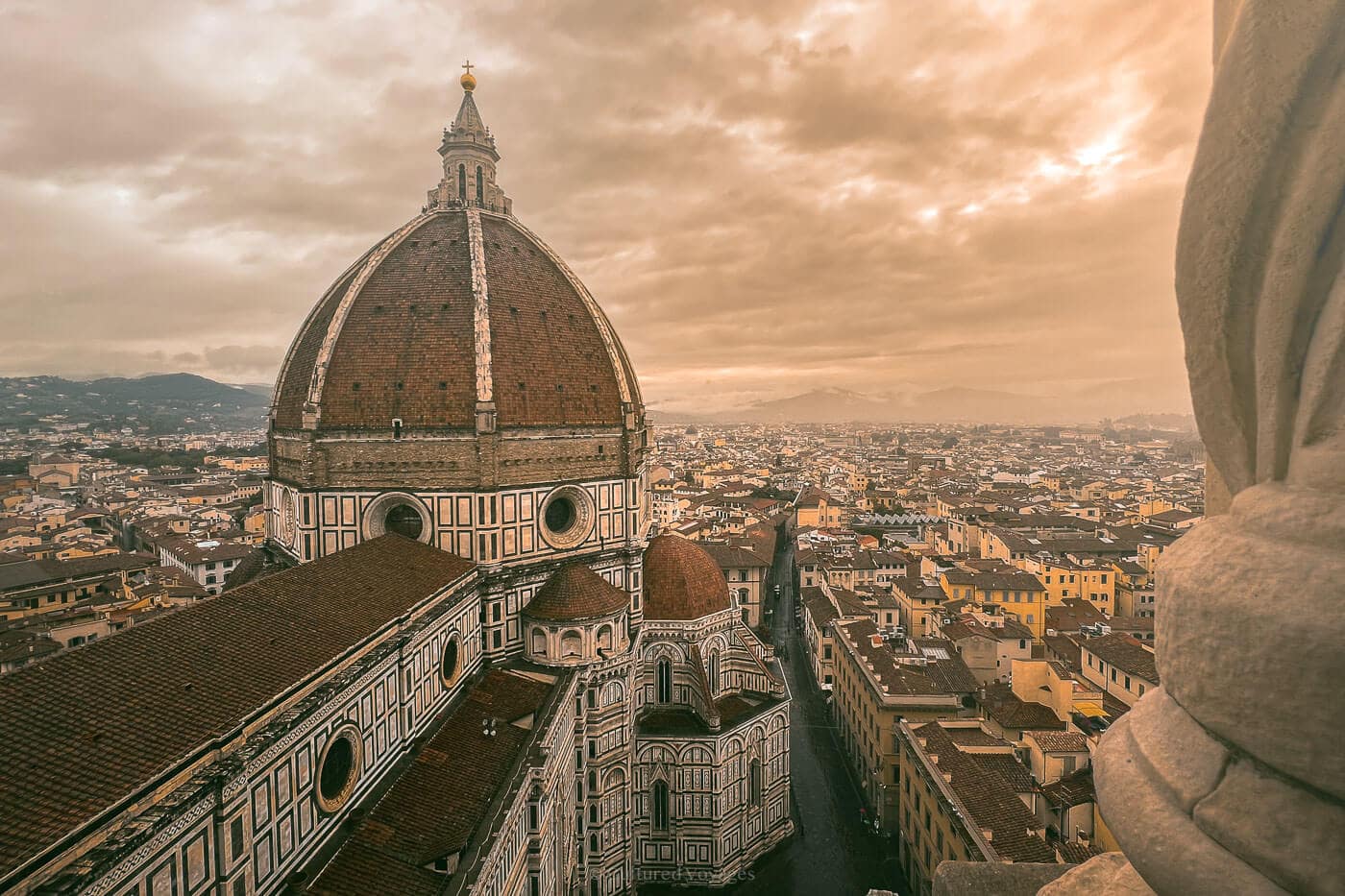
Even if you don’t climb it, you’ll see it from all over Florence. It dominates the skyline – visible from alleyways, bridges, rooftops, and terraces. And no matter how often you see it, it always hits.


Tips for Climbing Brunelleschi’s Dome
- I haven’t yet done the climb myself – I had an injury at the time and missed my slot – but I’ve researched it extensively and will update this once I’ve done it. Honestly, I didn’t feel too hard done by, especially after climbing the Bell Tower.
- If you’re after city views, both climbs offer something different. The Dome takes you higher and gives you completely unobstructed views – no fencing, just open air. The Bell Tower, on the other hand, gives you the Dome in your shot, which is great for orientation and more photogenic if you’re behind the camera.
- If you’re curious about the Dome’s construction, climbing it gives you a rare perspective. You’ll see the two layers of the Cupola and the engineering features Brunelleschi used to make it all work – herringbone brickwork, structural ribs, and all. It’s an incredible way to step inside the history.
- If you’re afraid of heights or tight spaces, be aware. I’ve heard from several people that there are a few sketchy moments during the climb. You walk narrow ledges around the interior fresco (Vasari’s Last Judgement), and there are sections where you’re passing other climbers on tight staircases. It’s not unbearable, but it’s something to be aware of.
- Book your ticket as early as possible. It’s the only timed-entry monument in the complex, and the time slots sell out well in advance. If you’ve left it too late, you can try a third-party ticket like this one on GetYourGuide, which includes the Brunelleschi Pass but costs a little more.
- If you want the best tour of the Duomo itself, this is the one I recommend. You get a guided climb up the Dome, exclusive access to the Cathedral terraces, and after-hours entry to the Cathedral once it’s closed to the public – all without the crowds.
- Plan around it. Whether you’re doing it solo or as part of a tour, it will anchor your whole day. Don’t try to do the Bell Tower climb on the same day unless you’re absolutely sure your legs and lungs are up for it.
Giotto’s Bell Tower

- Included with: Brunelleschi Pass, Giotto Pass, Ghiberti Pass
- Timed entry: Yes – selected at time of booking
- Opening hours: 08:15 – 18:45
- Time required: 45 minutes
- Access point: At the base of the tower, just behind the Cathedral on the south side
- Accessibility notes: 414 steps, no lift. The climb isn’t suitable for those with limited mobility, vertigo, claustrophobia, or heart conditions
What the Bell Tower Is and Why It Matters
The Campanile, or bell tower, stands right beside the Cathedral and offers one of the best 360-degree views over the city.
It’s often mistaken as part of the Cathedral itself, but Giotto designed it as a freestanding tower in 1334 – a vertical complement to the vast horizontality of the church.
Visually, it’s one of the most beautiful towers in Italy. It has the tricolour marble and beautiful sculptural detail like the Duomo.
But what I love most about it is how solid it feels when climbing it – especially compared to other towers in Italy, many of which have those terrifying open staircases with metal grids you can see through (which I personally hate, and usually have to reverse down halfway through!).
This one feels enclosed and safe. You climb in stages, with little platforms at each level, and you get better and better views as you go.
The top view is incredible. It’s one of the only places where you get to see the Dome in the skyline – not just be inside it or beneath it and that makes a huge difference.


Tips for Climbing Giotto’s Bell Tower
- Do this if you’re scared of heights but want a view. I find most towers in Italy terrifying – all see-through stairs and open drops – but this one is absolutely manageable. You’re enclosed the whole way, the steps feel solid, and there are several rest points.
- You’ll get a better view of the Dome from here than from the Dome itself. That’s part of why I don’t feel like I missed out on the Dome climb.
- Do note however: the top platform is surrounded by a mesh-like grid, which can make it tricky to get clean shots (or selfies, unless you’re okay with the fence in the background). If you’re after unobstructed views, the Dome climb has the edge.
- Book your slot when buying your pass. Bell Tower entry is timed – not quite as competitive as the Dome, but you still need to secure a time when you purchase.
- Bring water and pace yourself. There’s no lift, and while it’s doable, it’s still a proper climb – especially in heat. However, if it’s not too hot, towards the end of day at sunset would be an incredible time photography wise.
- Don’t rush the ascent. Each platform gives you a new perspective over the city. Take your time at each one – the climb is the experience, not just the view from the top.

Dome vs Bell Tower: Which Should You Climb?
View:
The Dome gives you sweeping city views from the top – but the Bell Tower lets you look at the Dome, which is arguably more iconic.
Climb experience:
The Dome staircase is steep, narrow, and can feel intense if you’re claustrophobic or afraid of heights. The Bell Tower is much more manageable – solid, enclosed steps and space to pause.
Crowds:
Dome slots sell out fast, and the climb is busy. The Tower feels quieter and more spacious.
Photos:
The Bell Tower gives you the best view of the Dome, but it’s surrounded by a metal grid that makes it difficult to photograph clearly. The Dome climb offers higher, unobstructed views – better for skyline shots, but you won’t be in them.
Time and booking:
Both climbs take around 45 minutes, but Dome access is much more competitive and must be booked well in advance.
💡 My take:
If you want that picture-perfect shot of the Dome, go for the Bell Tower – just be aware of the fencing. If you want to climb through the structure itself and see Florence from the highest, clearest point, the Dome wins.
The Opera del Duomo Museum

- Included with: Brunelleschi Pass, Giotto Pass, Ghiberti Pass
- Timed entry: No
- Opening hours: 08:30 – 19:00 (closed the first Tuesday of the month)
- Time required: 60-90 minutes
- Access point: Piazza del Duomo no. 9
- Accessibility notes: Fully accessible via lifts and stairways across three levels
What the Museum Is and Why It Matters
Most people treat the Opera del Duomo Museum like an optional extra – something to tack on if there’s time. But for me, it was one of the most unexpectedly powerful parts of the whole complex. It’s genuinely excellent.
The museum holds many of the original artworks that used to be in the Cathedral and Baptistery (over 750 of them), removed over the centuries either for preservation or post-flood restoration.
If you’ve just come from the main Duomo interior and thought, “Why is it so empty?”, the answer is: everything’s here.
The space itself is well laid out – big, airy galleries that walk you through the story of the Cathedral’s construction, its design competitions, its artists, and its politics. One section is devoted to Brunelleschi and the making of the Dome – with engineering models and interactive displays that make it feel very tangible.
But you’ll also see Donatello’s haunting wooden Mary Magdalene, Ghiberti’s original Baptistery doors, and Michelangelo’s unfinished Pietà, which he carved for his own tomb.
There’s also a brilliant recreation of the old Cathedral façade, dismantled in 1587 – scaled to size, indoors – which gives you a sense of what it would have felt like to walk past in its original state.
And right at the top, there’s a small terrace that gives you a totally different angle on the Dome. Quiet, slightly hidden, and well worth finding.


Tips for Visiting the Museum
- Don’t skip this if you love art. I know you’re probably more excited about climbing something – but this museum ties everything together. It gives real depth to what you’ve seen above ground.
- Go early or late in the day. It’s surprisingly peaceful compared to other sites – no pushing, no rushing – and it’s a lovely place to slow down.
- Give it at least an hour. You could rush it in 30-45 minutes, but it deserves more. If you’re even slightly interested in art, architecture, or how things are made, this will hold your attention.
- Michelangelo’s unfinished Pietà is worth lingering over. Michelangelo gave up on this piece (apparently the piece of marble is flawed). I think it’s unfinished state, in which you can see the chisel marks, actually lend to the gravity of the subject matter and the juxtaposition of smooth vs rough and unfinished makes it all the more interesting. Of all his works that I’ve seen, it’s definitely one of my favourites.
- Don’t miss the upper terrace. It’s easy to overlook, but it gives you a beautiful, quiet view across to the Dome from a more intimate perspective.
The Ancient Basilica of Santa Reparata

- Included with: Brunelleschi Pass, Giotto Pass, Ghiberti Pass
- Timed entry: No
- Opening hours: 10:15 – 16:00
- Time required: 20-30 minutes
- Access point: Via the Santa Reparata entrance on the south side of the Cathedral (same access point used for Cathedral entry with a ticket)
- Accessibility notes: Entry via a short staircase down to the excavated level below the Cathedral
What Santa Reparata Is and Why It Matters
This was the part of the Duomo complex that completely caught me off guard, in the best way.
Santa Reparata is the remains of a 4th-5th century early Christian basilica that once stood on this site, long before the Cathedral was even imagined. What’s left of it lies beneath the current floor of the Duomo, and visiting it feels like slipping through a trapdoor into another time.
It’s quiet, cool, and genuinely fascinating.
You walk down a small staircase and find yourself in a dimly lit archaeological site, with layers of mosaic flooring, remnants of old chapels, and early Christian tombs – including the burial places of Brunelleschi and Giovanni di Bicci de’ Medici, the patriarch of the Medici dynasty.
There’s a real sense of depth here – not just physical, but historical. You’re standing in the footprint of the church that came before everything else.
There’s also beautiful tile work still visible, and little fragments of fresco and stone that hint at the scale and importance Santa Reparata once held. It might not be on every traveller’s radar, but if you care about Florence’s deeper story, and all the layers of it, then this is essential.


Tips for Visiting Santa Reparata
- Don’t breeze past it on your way into the Cathedral. It’s very easy to overlook – but absolutely worth 20-30 minutes of your time.
- Slow down and really look. There’s a lot of texture here – worn mosaics, faded paintings, half-buried gravestones. Take it in slowly, and let your eyes adjust to the low light.
- Look for Brunelleschi’s tomb. It’s understated, but knowing he’s buried here adds an unexpected emotional charge – especially after visiting his Dome above.
- It’s included in all passes – and it gives you Cathedral access. Even though your ticket might not list “Cathedral,” the inclusion of Santa Reparata is what gets you in. Don’t let that confuse you.
Do You Need a Tour for the Florence Duomo Complex?

You absolutely don’t need a guided tour to visit the Duomo complex. I’ve done it all on my own and found the whole thing quite manageable, with prior planning.
That said, I also know that not everyone wants to spend time figuring all that out – especially if you’re on a short trip, visiting in high season, or want deeper insight into what you’re actually seeing.
There’s a lot of history here, and a good guide can make it much more vivid.
⭐ My Top Pick: After-Hours Duomo Tour with Dome Climb and Terrace Access
If you’re looking for a special way to experience the Duomo complex – without the daytime crowds – this is the tour I’d book. It includes a guided Dome climb, exclusive Cathedral terrace access, and after-hours entry to the Cathedral once it has closed to the public. It’s a small group, beautifully paced, and feels worlds away from the daytime queues and chaos.
It’s ideal if you’re looking for something atmospheric, immersive, and memorable – a real highlight of your time in Florence.
Book the After-Hours Duomo Tour with Walks
Dome climb, Cathedral terraces, and after-hours entry to the Cathedral
🎯 Want to Combine Two Icons? Do the David & Duomo Tour
This is the best combo tour if you want to fit two Florence icons into a single, well-paced half-day. It includes early access to the Accademia before opening, so you can see Michelangelo’s David without the crowds, followed by a guided Dome climb and exclusive Cathedral terrace access – a part most visitors never get to see.
It’s ideal for first-time visitors or those with limited time.
Book the VIP David & Duomo Tour
Before-hours Accademia entry, Dome climb, and exclusive terrace access
🧠 Craving More Context? Go Private with Context Travel
If you’re the kind of traveller who wants to understand not just what you’re seeing, but why it matters – this is the tour to book. It’s private, led by an art expert, and connects the Duomo to the wider story of Renaissance Florence, from civic power to theological symbolism.
It’s not cheap, but it’s deeply rewarding – especially if you’re someone who finds meaning in deep cultural experiences.
Book the VIP David & Duomo Tour
Before-hours Accademia entry, Dome climb, and exclusive terrace access


🎟️ Want Expert Insight Without the Frills? Try This Museum + Dome Climb Tour
If you’re especially interested in the Opera del Duomo Museum and the Dome itself, this is a great middle-ground option. It doesn’t include the terraces, but you’ll be guided through the museum’s key pieces – including the original Baptistery doors, Donatello’s Mary Magdalene, and Michelangelo’s unfinished Pietà – before climbing the Dome with expert commentary.
A solid choice if you’re short on time but still want a meaningful interpretation of the most important elements.
Book the Dome + Museum Tour via Viator
Includes Museum, Dome climb, and skip-the-line access
When a Tour Might Be Worth It
- You want more context. Florence’s Cathedral and Dome aren’t just architectural marvels – they represent a pivotal moment in Western history. A good guide brings that to life.
- You’ve missed out on booking official tickets. Some third-party tours have reserved time slots for the Dome climb, even when direct tickets are sold out.
- You just want it all taken care of. If logistics stress you out, or you’d rather just be shown around, then it’s money well spent.
- You’re someone who prefers premium, small-group or private travel. That’s where tours like Walks and Context shine. These aren’t megaphone-in-the-air tourist groups – they’re quality-led, intentionally designed, and actually worth your time.
How to Buy Tickets for the Duomo Complex in Florence

Do You Need to Book Duomo Tickets in Advance?
Yes – especially if you want to climb the Dome or Bell Tower.
The Dome climb requires a timed-entry reservation, and slots often sell out well in advance, especially from spring through autumn. The Bell Tower also needs a timed slot, though there’s usually a bit more flexibility.
For everything else – the Baptistery, Museum, Santa Reparata – you can turn up without a booking. But I wouldn’t recommend it in high season. Queues can be long, ticket windows limited, and it’s just not worth the hassle when you could have booked ahead online in two minutes.
Can You Buy Duomo Tickets at the Door?
You can – but options are limited and lines are long.
There is a staffed ticket office in Piazza San Giovanni, no. 7, just beside the Baptistery. But you’ll often face queues just to speak to someone, and by the time you get to the front, any of the Dome and Bell Tower time slots will already be gone.
There’s also an on-site Ghiberti Pass (available only if the regular online version has sold out), but it’s not a great backup plan – it doesn’t include the Dome or Tower, and it’s not available every day.
If you know your dates, book your tickets as soon as possible.
Where to Buy Official Duomo Tickets
The best place to start your search and book your tickets is the official site.
Tickets are sold as passes, not individually per monument – and you’ll select your Dome and Bell Tower time slots when you buy.
Note: if your ticket includes Santa Reparata, that also gets you entry into the Cathedral via a quieter side door. The ticket itself might not say “Cathedral,” which confuses people – but if you see Santa Reparata on it, you’re good.


Trusted Third-Party Ticket Options
If the Dome is sold out on the official site – or you want someone else to handle the logistics – try a third-party ticket like this one on GetYourGuide:
👉 Florence Duomo Complex 3-Day Pass with Dome Climb – GYG
It costs a bit more, but gives you access when the official route isn’t available.
You’ll also find combo tickets or guided tours on:
My Tips for Booking Duomo Tickets
- Lock in your Dome climb time slot first. Everything else can be flexible, but the Dome is the bottleneck.
- Book direct if you can, third-party if you must. Especially in summer – if the calendar looks greyed out on the official site, availability is gone.
- If you’re short on time, a tour might be easier. Skip the ticket queues and climb with a guide – I’ve listed my favourite ones above.
Which Duomo Ticket or Pass Should You Choose?

What Are the Different Duomo Passes?
Florence’s Duomo Complex doesn’t sell individual tickets to each monument – instead, you’ll choose from three passes that bundle access to different parts of the complex.
Here’s how they compare:
| Pass Name | Includes Access To | Timed Entry Required? | Price | Best For… |
| Brunelleschi Pass | Dome climb, Bell Tower, Cathedral (via Santa Reparata), Baptistery, Museum, Santa Reparata | Yes – Dome + Bell Tower | €30 (Adult) | First-time visitors who want the full experience |
| Giotto Pass | Bell Tower, Cathedral (via Santa Reparata), Baptistery, Museum, Santa Reparata | Yes – Bell Tower only | €20 (Adult) | View seekers who prefer not to climb the Dome |
| Ghiberti Pass | Cathedral (via Santa Reparata), Baptistery, Museum, Santa Reparata | No | €15 (Adult) | Art/history lovers short on time (no climbs) |
💡 Note: The Bell Tower and Dome climbs both require timed entry. All other sites are flexible within your 3-day window.
What About the Ghiberti Pass Sold On-Site?
There’s a limited version of the Ghiberti Pass that’s only available at the ticket office, but:
- It doesn’t include the Dome or Bell Tower
- It’s only released after standard availability has sold out online
- You can’t rely on it as a backup – and it doesn’t save you much money
It’s fine in a pinch, but I wouldn’t plan your visit around it.
So – Which Duomo Ticket Is Best?
Here’s how I’d break it down:
- If it’s your first time visiting Florence → Get the Brunelleschi Pass. You’ll want to climb at least one tower, see the Dome from inside, and have the freedom to explore everything at your own pace.
- If you’re afraid of heights, claustrophobic, or just not up for 463 steps → The Giotto Pass still gets you views (from the Bell Tower) and full access to the Museum, Baptistery, and Cathedral.
- If you’re short on time or already towered out → The Ghiberti Pass is a low-stress way to dip into the art and history side of things.
- If you’ve missed out on Dome availability → Try this third-party option on GetYourGuide – it includes the Brunelleschi Pass (with Dome access) for a little extra.
When Is the Best Time to Visit Florence’s Duomo?

Time of Day: Go Early if You’re Climbing
If you’re planning to climb the Dome or Bell Tower – especially in summer – go first thing in the morning. Even before 9am, the heat starts to build, and those stairwells turn into stone ovens. I was based in Florence during a heatwave and genuinely felt sorry for the people still queueing at midday.
The buildings in Florence retain heat well into the evening, so even late afternoon won’t save you from the sweat if you’re doing a climb. Aim for the earliest available slot, grab a coffee after, and then visit the more shaded parts of the complex like the Museum or Santa Reparata later on.
Day of the Week: Avoid Weekends if You Can
Weekends are always busier – especially in high season – and queues for the Cathedral or ticket office can stretch right across the piazza, wrapping their way back around the Cathedral. If you’re flexible, visit Tuesday to Thursday for a little more breathing room.
Also note:
- The Opera del Duomo Museum is closed on the first Tuesday of the month
- The Baptistery closes early (1:30pm) on the first Sunday of the month
So avoid those specific times if those sites are high on your list.
Best Time of Year to Visit the Duomo Complex
The complex is open year-round, but shoulder season is by far the most pleasant:
- Late March to early May
- Mid-September to early November
The weather is milder, the crowds are less overwhelming, and you’ll have a better chance of getting your preferred Dome time slot without booking months ahead.
I visited in peak July heat, and honestly – I wouldn’t recommend it. You can still enjoy the experience, but it takes planning, patience, and a lot of water. If that’s your only window, just book everything early, avoid midday climbs, and give yourself breaks.
Bonus Tip: Spread Your Visit Over Two or Three Days
Your pass is valid for three calendar days, and that’s honestly ideal. There’s no need to cram everything into one exhausting go. You can climb one morning, visit the Museum the next afternoon, and space out your energy and time.
FAQs About Visiting the Duomo in Florence

How much does it cost to visit the Duomo in Florence?
The Cathedral itself is free to enter – no ticket required – but it’s honestly not worth queueing hours for on its own. To visit the rest of the complex, you’ll need one of the official passes:
- Brunelleschi Pass (all 6 sites, incl. Dome climb): €30
- Giotto Pass (all sites except Dome): €20
- Ghiberti Pass (Museum, Baptistery, Santa Reparata): €15
Children under 7 go free. Reduced tickets are available for kids aged 7-14.
What are the opening hours of the Duomo complex?
Opening hours vary slightly by monument:
- Dome: 08:15 – 18:45
- Bell Tower: 08:15 – 18:45
- Baptistery: 08:30 – 19:30 (closes early on first Sundays)
- Opera del Duomo Museum: 08:30 – 19:00 (closed first Tuesdays)
- Cathedral: 10:15 – 15:45 (free entry; closed Sundays)
- Santa Reparata: 10:15 – 16:00
Always check the official site for closures on religious holidays or restoration updates.


Can you buy Duomo tickets on the day?
Yes – but it’s not ideal. Same-day tickets are available at the official ticket office in Piazza San Giovanni, but by the time you queue and reach the counter, most of the Dome and Bell Tower slots will be gone. If you know your dates, book ahead online to save yourself the stress.
Which Duomo ticket is best for first-time visitors?
The Brunelleschi Pass is the best choice if it’s your first time – it covers every part of the complex, including the Dome climb, Bell Tower, Museum, Baptistery, Santa Reparata, and Cathedral access (via the Santa Reparata entrance). It’s the only ticket that gives you the full experience.
Is there a dress code to enter the Duomo?
Yes, and it’s enforced – especially at the Cathedral and Baptistery. This is an active place of worship, and visitors are expected to dress modestly.
Here’s what that actually means:
- Shoulders must be covered – no strappy tops or sleeveless dresses
- Shorts and skirts must fall well below mid-thigh (officially to the knee, but I’ve observed across many church visits to Italy that it depends on the overall ‘modesty’ of the rest of your outfit, and the person in charge of the line)
- No hats or caps
- No sandals or flip-flops
If you’re visiting in summer and don’t want to overheat, I’d recommend keeping a light scarf or wrap in your bag to throw over your shoulders. You’ll also see plenty of market stalls nearby selling cheap cover-ups if you’re caught short – they’re basic, but they’ll do the job.


Can you skip the line at the Duomo in Florence?
You can’t skip the Cathedral queue unless you have a ticket that includes Santa Reparata – that gives you access via a quieter side door. For the Dome and Bell Tower, booking a timed entry ticket in advance is essential. If slots are sold out, a third-party ticket or guided tour (like this one with exclusive terrace access) is your best bet.
Which is better: climbing the Dome or the Bell Tower?
Both climbs offer something different. The Dome is higher, fully open-air, and gives you an unobstructed view of the city. You also get to see the interior engineering up close – including the two layers of the dome and Brunelleschi’s herringbone brickwork.
The Bell Tower gives you the best view of the Dome, but it’s surrounded by a grid fence that makes photos tricky. If you’re after views and photos, the Dome might be the better bet – but if you’re claustrophobic, the Bell Tower is less intense.
Continue Planning Your Visit to Florence
Visiting Florence’s Duomo complex can be one of the most rewarding parts of your time in the city – if you plan it well. Hopefully, this guide has helped you understand how it all fits together: the tickets, the climbs, the quiet corners, and the parts that are genuinely worth your time.
If you’re building out the rest of your Florence itinerary, here are a few of my other posts that might help – depending on what you’re most interested in:
Culture, History & Must-Sees
Things to Do in Florence – my essential cultural highlights
How to Visit Michelangelo’s David – another icon that needs advance planning
Planning Your Itinerary
Florence in 2 Days – ideal if you’re short on time
Florence in 3 Days – includes all the key highlights at a manageable pace
Where to Eat & Drink
Where to Eat in Florence – my favourite restaurants, wine bars, and bakeries
Best Food Tours in Florence – great if you want to taste your way through the city
Best Wine Tours from Florence – if you’re tempted by a day trip into Tuscany
Where to Stay
Where to Stay in Florence – includes neighbourhood breakdowns and my top hotel picks
Hotels in Florence with Pools – perfect for summer stays
Cool Places to Stay in Florence (coming soon) – unique, design-led accommodation you’ll actually want to hang out in
If you found this guide helpful, feel free to share it or bookmark it for later. And if you’ve still got questions about planning your Florence trip, leave a comment below – I’m always happy to help.

You’ll find all my Florence travel guides below – or browse my full collection of Florence posts for more local insight, tips, and itineraries.
Planning a broader trip? My Italy destination page groups all our regional guides in one place to help you explore further.
Related reading for Florence


Like this post? Pin for later!


