Disclosure: Some of the links on this site are affiliate links. If you make a purchase through one of them, I may earn a small commission at no extra cost to you. Read my full disclaimer here. Thank you for your support!
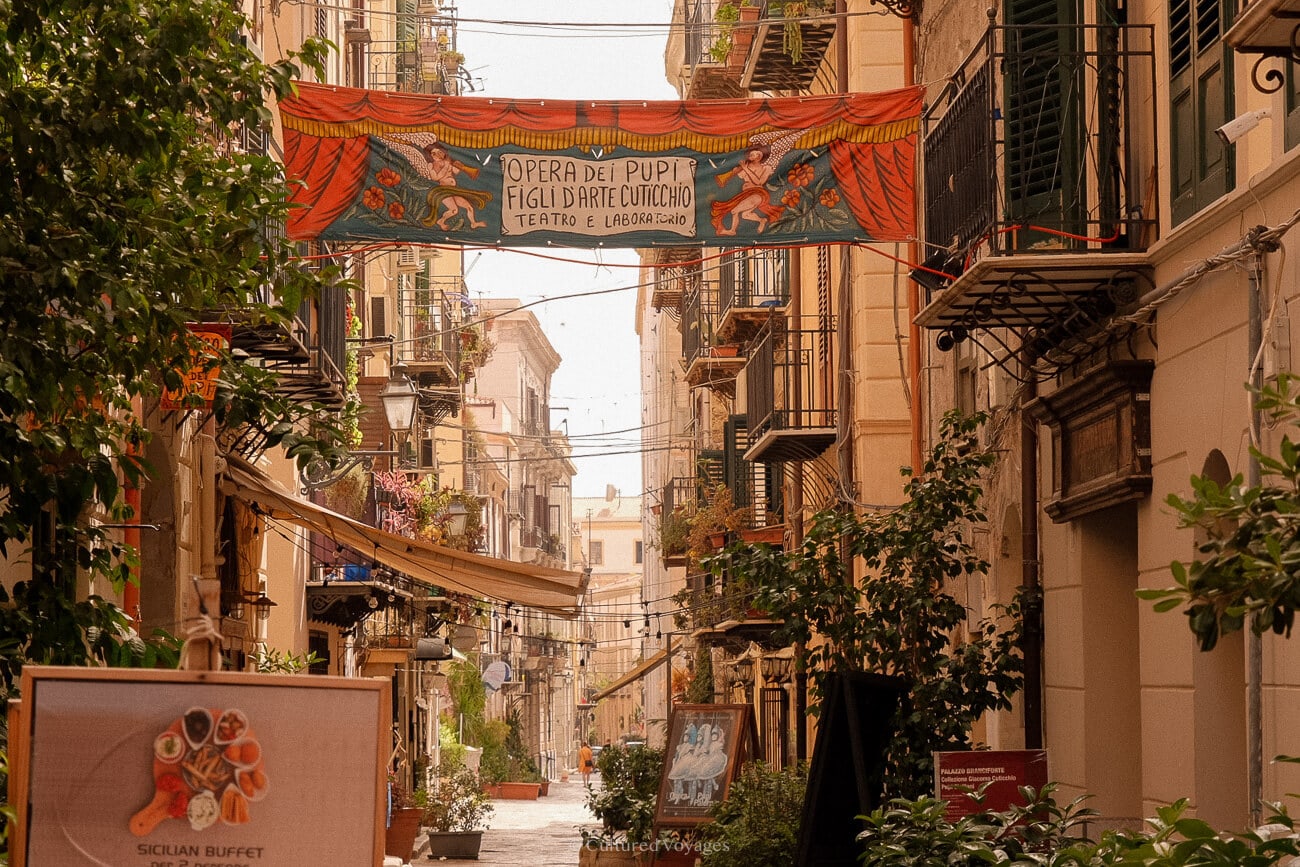
These Palermo travel tips come from a month of living in Il Capo, one of the city’s old market quarters.
They cover what tends to catch out a first visit – which streets to stay off after dark, when the city shuts for the afternoon, how to eat your way through the markets – along with the history that explains why so much of Palermo looks the way it does.
I didn’t quite know what to expect upon arrival in Palermo, having booked an apartment for a month somewhat on a whim.
I knew that it would be a bit like its southern cousin, Naples, but while certain parallels can be drawn – histories shaped by various civilisations, friendly and expressive locals, bustling street markets and delectable local cuisine – that’s probably the point around which you would draw the line.
Palermo is utterly unique.
It is a city that takes a while to open up to you, and much of its story has to be sought out on your own initiative.
It’s hidden in the crumbling facades of buildings bombed in the Second World War, behind high walls that conceal opulent palaces, and in the agonising photographs of the exhibition at the No Mafia Memorial.
As I roamed the streets as the weeks went on, I found myself pulled in by the contradictions – the maze-like markets, the mix of Norman, Arab and Baroque architecture on every street, the sense that there was always another layer underneath the one I’d just figured out.
I had arrived with unusually little preparation, so the city posed its questions long before it offered any answers – churches crowned with red, unmistakably Arab domes a few streets from Baroque ones, grand facades missing whole floors, and a heat that seemed to settle on the city rather than pass through it.
Those answers, and the practical things I’d want a friend to know before their first morning there, are what follow, starting with the short version.

Things to Know Before You Visit Palermo
The post runs to 22 tips across several themes. Here’s the headline from each, linked to the full section.
- Staying safe | Palermo is about as safe as any large Italian city, as long as you keep to busier streets after dark
- Practicalities | Restaurants close between lunch and 7pm, the city is best explored on foot, and the nearest beach is 13km away at Mondello
- Eating | Go to the markets with someone who knows them, and order pasta alla Norma at least once
- Understanding the city | Learn who ruled Palermo, and the grit, the ruins and the Arab domes all start to make sense
- Making the most of your time | Give it at least 2 days, and leave room to sit and watch the street
- Quick questions | Siesta hours, the best months to go, what things cost and whether you need cash
What to sort before Palermo
Most of Palermo you work out on arrival, and that is the pleasure of it. These are the few things that are easier decided at home.
Worth booking before you go
A street food walk through the markets
The markets are the whole point of eating in Palermo and they are not self-explanatory, so going in with someone who knows them is the difference between a good lunch and a great one.
The night version takes in the Vucciria at its liveliest, which is a far easier way to enjoy it than learning its edges on your own.
Run by Addiopizzo Travel, it walks you through the neighbourhoods where the city turned on the Mafia, and puts your money behind the businesses that did.
Where to stay
Boutique palazzo stays cost about what a chain hotel does
That is the single most useful thing to know about staying here, and I’ve put the ones worth booking in my guide to where to stay in Palermo.
Is Palermo safe for tourists?

Yes – Palermo is about as safe as any large Italian city, and the risk worth planning for is opportunistic theft. After dark, I’d know your route and keep to busier streets such as Via Maqueda and Corso Vittorio Emanuele, and the areas to take more care in are Ballarò, the Vucciria and the station.
Nothing happened to me in a month of living in Palermo, and nothing happened to anyone I knew or met there. Its reputation was largely earned by the Mafia in decades past rather than by anyone likely to cross your path today.
A Cultured Voyages Guide
Seven shifts that take you from sightseeing to actually understanding a place – the same ones I use on every trip I plan.
The national figures bear that out, too: Il Sole 24 Ore’s 2026 crime index, built on Interior Ministry data, ranks the province of Milan first in Italy for reported crime per head and Rome third, with the province of Palermo down in 33rd place.
What Palermo does have is a historic centre laid out as a warren, in which a street narrows into a laneway, the laneway into an alleyway, and the alleyway into somewhere you hadn’t meant to be.
An opportunistic thief is far more interested in the person who looks as though they’ve arrived there by accident than in one walking with somewhere to be, so the caution I’d apply is the same as anywhere, with a little more attention to where I’m going. I also found the area around Teatro Massimo to be frequently patrolled by police.
Is it safe to walk around Palermo at night?
It is, on the main streets. Via Maqueda, Corso Vittorio Emanuele and the streets around Teatro Massimo stay busy well into the evening, and I was comfortable walking them after dark.
The quieter lanes are another matter, chiefly because there is nobody else about if something were to happen.
I’d suggest using them at night only when your accommodation is on one, and otherwise knowing your route between places before you set out, so that you’re walking with purpose rather than wandering.
Is Albergheria a safe area in Palermo?
By day, it is. Albergheria is the old quarter around Ballarò market, and while the market is trading its streets are crowded, loud and fine to walk – I’d keep your bag closed and worn across your body, with nothing in an open pocket, as you would at any busy market.
After dark, it changes. The stalls pack up, the area feels more run-down than its neighbours, and I’d heard anecdotally that petty crime there picks up at night (which, having spent time in it, I could easily believe).
I’d keep to Via Maqueda and Corso Vittorio Emanuele on its edges rather than cutting through the interior streets around the market, and if you’re weighing up accommodation there, it’s worth knowing before you book.
Continue reading Choosing where to base yourself is the one safety decision you make before you arrive, and my guide to where to stay in Palermo breaks down the best neighbourhoods for first-timers, couples and families.
Watch your belongings at the Vucciria after dark
The Vucciria is a smaller, more enclosed affair than Ballarò, almost an amphitheatre of a square, hemmed in by bars and restaurants in the buildings around it. By night it fills with tourists eating, drinking and dancing to whatever music has started up, which makes it great fun and exactly the sort of crowd an opportunist is drawn to.
As in most busy nightlife squares in Europe, there are usually a few figures lingering at its edges, some of them selling weed (and, I suspect, not only weed), and rather more watchful eyes than you’ll notice. The risk I’d plan for is the phone or wallet that goes missing before you realise it’s gone.
Enjoy it by all means, but if you’re drinking, I’d keep your bag zipped and in front of you, and head home while you’re still sharp enough to notice who is standing close.
Pass through Palermo Centrale rather than lingering
The streets around Palermo Centrale have the same edge as those around most big train stations: transient, busy and a little removed from the more trodden parts of the centre. They’re fine to pass through at any hour, but I wouldn’t hang around them at night.
I’d know which way you’re heading before you step out of the station, and walk on without lingering.

Beware of the kamikaze moped and scooter-drivers
Mopeds are ridden by just about everyone in Palermo, frequently without helmets and occasionally by boys who look no older than ten, doubled up on electric models silent enough to arrive at your elbow unannounced. Shared scooters and locals on their own add to the traffic, cutting corners at angles that suggest the highway code is open to interpretation.
Zebra crossings help, though less than you’d hope. Cars will usually stop once you’re on the stripes, but the mopeds tend to treat that as an invitation to swerve around you instead.
I’d step out with purpose, keep looking both ways until you reach the other side, and listen out for the electric ones in the narrower streets, where there’s often no pavement to step back onto.
Practical Palermo tips: opening hours, getting around and the heat


Be aware of opening times
Palermo keeps hours of its own, and a day planned without them can leave you facing a shuttered restaurant at 4pm or a locked museum on a Monday.
Many restaurants close after lunch and don’t reopen until around 7 or 7.30pm for dinner. Via Maqueda is the exception, as somewhere along it will be serving food at almost any hour.
Beyond the best-known landmarks such as Palermo Cathedral and the Norman Palace, many sites and museums, including the Archaeological Museum, close on Mondays and shut at 1.30pm on Sundays. If your trip spans either day, I’d check the hours of anything you’ve set your heart on before you plan around it.
Continue reading If you’d rather have the timings worked out for you, my 2-day Palermo itinerary puts the main sights into a workable order.

The best way to get around is on foot
Palermo’s compact layout means you can walk almost everywhere, and I’d recommend doing so: the Norman Palace, the Cathedral, Teatro Massimo and both of the big markets sit within easy reach of one another, and the Cathedral and Teatro Massimo are only around ten minutes apart.
You’ll pass a church, a market stall and something that smells incredible roughly every five minutes.
Continue reading Short on time? My one day in Palermo itinerary fits the essentials into a single day.

It’s on an island, so plan logistics in advance
This may be stating the obvious, but Palermo sits on the north-west corner of Sicily, and reaching it takes a little more planning than most Italian cities.
Getting to Palermo from elsewhere in Sicily
By train | Trains connect Palermo with most of Sicily’s larger towns, though the journeys can take longer than the map suggests. Typical times from the main cities are:
- Catania Centrale to Palermo: about 3 hours direct
- Messina Centrale to Palermo: around 3 to 3.5 hours
- Syracuse to Palermo: about 4 hours at best, with a change at Catania
By bus | Palermo is well connected by coach, and on some routes the bus is as quick as the train – the SAIS coach from Catania takes about 2 hours 45 minutes. Intercity coaches use the bus terminal on Via Fazello, beside Palermo Centrale.
By car | Driving to Palermo is an option if you prefer the freedom of a road trip, but be aware of the city centre’s ZTL (limited traffic zone) and plan your parking in advance.
If Palermo marks the start of your trip around Sicily, I’d pick up a hire car as you leave rather than pay to park one you won’t use in the city.
PLAN YOUR TRANSPORT | Search train and bus timetables using this website. For car rentals, I always use RentalCars, as I find it has the best search and filter function, the widest choice of providers and usually the best prices, with free cancellation too.
Getting to Palermo from mainland Italy
By flight | Flights from Italy’s major cities are the quickest way in, with several direct flights a day from Rome, Milan and other hubs. Falcone-Borsellino Airport sits about 35 kilometres outside the city, and when we flew from Palermo to Venice, it took a little over 1.5 hours.
By train | Long-distance trains do run from the mainland, but they’re a commitment: from Milan, the direct overnight Intercity Notte takes about 21 hours, and the fastest daytime route is around 13 hours with changes. For anyone travelling from mainland Italy without time to spare, flying makes far more sense.
By ferry | Overnight ferries run from several southern Italian ports, and if you find yourself in Naples, GNV and Grimaldi both sail to Palermo in roughly 8.5 to 11 hours.
SEARCH FERRY TIMETABLES | Take a look at prices and schedules for the ferry to Palermo here.
Reaching Palermo from abroad
By flight | Flying is the simplest way to reach Palermo from abroad. Falcone-Borsellino Airport is the main international gateway, with flights from across Europe, including hubs such as Munich, London and Paris.
Getting to Palermo city centre from the airport
Once you land at Falcone-Borsellino Airport, there are three ways into the city centre.
Bus | The Prestia e Comandè bus is the economical choice at €6 one way or €10 return (€6.50 if you buy on board), and you can buy your ticket in advance here. It runs every half hour and takes about 40 to 50 minutes, depending on which of its city stops you need.
Train | Trains run roughly every 30 minutes between the airport and Palermo Centrale, take 45 minutes to an hour and cost about €7.
Taxi | Taxis wait outside the Arrivals hall. Ours cost more like €60 to €80 at the time, but fixed fares now apply – €39 to Viale Michelangelo and Viale Lazio, €44 to Corso Calatafimi and Corso Vittorio Emanuele, and €50 to Palermo Centrale.
If there are four of you, the taxi-sharing service drops that to €10 each, or you can book a transfer in advance here.

While situated by the sea, there is no city beach in Palermo
One of the intriguing paradoxes of Palermo is its seafront location without a sandy beach in sight.
It comes down to geography. Palermo sits in a natural harbour, its shoreline is rock rather than sand, and the lungomare, or waterfront, is less a promenade than a reminder of the city’s turbulent past, much of it built on rubble dumped there during post-war construction.
Mondello, 13km away, has the crescent of pale sand, Art Nouveau villas and seafood restaurants the city lacks, and it’s where much of Palermo goes to swim, so expect company in high summer. Further along the coastline, Cefalù and San Vito Lo Capo are both worth the journey for clearer water.
Cefalù is around 50 minutes by train; San Vito and the smaller coves are far easier with a car, as the buses that serve them are often overcrowded in summer.

It can often feel hotter than the mercury suggests
Sheltered by mountains on one side and lapped by the sea on the other, the city wears a thick blanket of heat – muggy, heavy and sweaty, and far more oppressive than the thermometer suggests. Of all the cities I’ve visited in Europe, Palermo’s is the heat that stands out.
The city’s street hawkers are no strangers to this fact. Ever enterprising, many of their stalls stock an array of fans, and during my visit in the peak summer months, these became an indispensable accessory, offering fleeting moments of cool amidst the relentless heat.
Part of it is the city itself. The dense blocks of seven and eight storeys thrown up in the post-war building boom hold the heat through the summer, and a 2025 Legambiente study of Palermo’s heat islands found parts of the city running up to 4°C hotter than its surroundings.
The heat is manageable if you plan around it, and I’d sightsee early, retreat indoors through the hottest part of the afternoon (which the city’s opening hours more or less impose on you anyway), and buy one of those fans on your first day.
Eating in Palermo: street food, markets and restaurants


Palermo’s street food draws few parallels
Palermo’s street food tells you more about the city’s history than most of its museums do – every dish carries a trace of whoever ruled here when it was invented.
If you book one thing before you arrive, I’d make it a street food tour, because the markets are where Palermo eats and they’re not self-explanatory.
Start with ‘pane e panelle’, hot chickpea fritters stuffed into a sesame-seeded bun and best with a squeeze of lemon. Then come the ‘arancine’, fried rice balls with a range of fillings (feminine in Palermo, and a point of civic pride, since Catania insists on ‘arancini’).
The adventurous can try ‘pani ca meusa’, boiled spleen and lung in a soft bun. It’s a genuine local favourite, though I must confess it didn’t quite suit my tastes.
‘Sfincione’ is Palermo’s own pizza, thick and spongy, traditionally topped with tomato, onion, anchovies, oregano and breadcrumbs, though you’ll find it dressed in all sorts now. Vucciria and Ballarò are where you’ll find most of it – noisy, colourful, and the best places to eat your way through all of the above.
Continue reading I’ve compared the Palermo food tours worth booking in a separate guide, by format and by who each one suits.

Elsewhere, expect seafood, pistachio and aubergine to feature regularly
Palermo’s restaurants widen the picture beyond the markets, with the sea, local pistachios and the humble aubergine doing much of the work.
One dish you’ll encounter constantly is Pasta alla Norma, named after Bellini’s opera – aubergine, tomato sauce, salted ricotta and basil. I ordered it again and again, and it was rarely anything less than excellent.
The city’s coastal location also means a wealth of seafood: grilled swordfish, a local favourite, prawns seasoned with lemon, and mussels in tomato sauce. You’ll even find the Roman pasta dish of cacio e pepe served with a good dollop of mussels in certain restaurants, and before you knock it, it’s positively delicious.
Lastly, don’t overlook Palermo’s love affair with pistachios. These nutty green kernels feature in everything from savoury pastas to creamy gelato, providing an unexpected but delicious twist.
Continue reading For where I actually ate well, see my Palermo restaurant guide, drawn from a full month in the city.
Understanding Palermo: the history behind what you’ll see

Learn who ruled Palermo, and the buildings start to make sense
Few cities have changed hands as often as Palermo, and almost everything you’ll look at was built, converted or embellished by one of its rulers.
Fixing the sequence in your head before you go turns a jumble of domes, mosaics and Baroque facades into a city you can read (the Arab-Norman buildings are UNESCO-listed as a group, which is a useful shortlist in itself).
- 8th century BC | Phoenicians, then Carthage. Very little survives above ground; the finds are in the Salinas Archaeological Museum.
- 254 BC | Rome, later the Vandals, Goths and Byzantium. Very little of it remains in the centre.
- 831 | The Arabs. Look for them in the Kalsa, whose name comes from the Arabic al-Khalisa, in the market streets of Ballarò, and in Sicilian dialect and street food.
- 1072 | The Normans. The Palatine Chapel, La Martorana, the red domes of San Cataldo, the Cathedral and Monreale are theirs.
- 1194 onwards | Swabians, Angevins, Aragonese, Spanish and Bourbons. The Quattro Canti and the city’s Baroque churches and oratories date from these centuries.
In 1072 the Normans seized Palermo, yet they did not erase its Arab character. Mosques became churches, and Byzantine, Arab and Norman styles mingled into an architecture found nowhere but Sicily, which is why a twelfth-century Christian chapel can carry Arabic inscriptions beneath a ceiling carved like a mosque’s.


Leave room to wander, because the history lives in the streets
Palermo is a genuine playground if you’re a history buff – I say that as one myself – and what I valued most was the freedom it gave me to follow my curiosity at my own pace.
Its history lives as much in the street plan, the palazzi, the markets and even the food as it does behind museum walls, so a day with fewer tickets and more wandering is rarely a day wasted.
For the set pieces, go to the Palatine Chapel at opening time, which is 8.30am. I headed straight there when the doors opened, and the rare stillness in front of its gold mosaics had gone entirely by the time the palace filled up.
Palermo Cathedral, Teatro Massimo (the largest opera house in Italy) and, for those drawn to the macabre, the Capuchin Catacombs, where the mummified dead of the city still hang in their finest clothes, round out the list.

It’s not the most pristine place you’ll ever visit
I’ll say it plainly – Palermo is by no means the cleanest city you’ll visit.
Stroll down the city’s narrow, meandering alleys and one of the first sights that might catch your attention is the bins. It isn’t hard to notice these heaving, overflowing monstrosities, particularly away from the main tourist trails where skip-style bins are brimming.
Graffiti, indiscriminate and bold, also adorns even freshly renovated buildings, while litter sprinkles the streets in a city where, it could be said, many of its buildings could use a good power-wash.
However, to make those comments without digging deeper into why this is the case would demonstrate a certain level of ignorance, and a rejection of the reason why many of us travel, which is to understand.
The explanation lies in Palermo’s recent history – a war that flattened much of the centre, and a peace in which it was left to crumble – but to reduce the city to its bins would be to miss the point.
Palermo is a city that is lived in rather than put on show. Its messy corners and graffiti-laden walls are reminiscent of a lived-in home, carrying the imprint of the people who dwell there. Humans, by nature, aren’t the neatest of creatures, and Palermo reflects this unfiltered reality.
I have a theory that most of the people who come away disliking Palermo were only there for a day or two, and saw little beyond the grubby facades, the graffiti and the rubbish. The longer I stayed, the more I loved it.

Read the gaps and ruins as war damage rather than neglect
The empty lots, roofless palazzi and facades missing whole floors that you’ll pass in the Kalsa and Albergheria are, for the most part, what the Second World War left behind, and what the decades of neglect that followed it failed to repair.
The city suffered extensive damage from Allied bombing raids in 1943, in the months before the Allied invasion of Sicily. The raids targeted the port and strategic infrastructure but caused destruction across large parts of the historic centre, which bore the brunt of the devastation.
The impact on Palermo’s people was just as severe. The bombing left nearly 150,000 of them to live in cramped slums, makeshift shantytowns and even caves on the outskirts of the city, a period of hardship and displacement that profoundly affected its social fabric.
After the war, instead of the centre being restored and its residents returning home, the Mafia capitalised on the crisis. It manipulated the reconstruction, facilitating the ‘Sack of Palermo‘, in which characterless, hastily built apartment blocks replaced the city’s traditional fabric.
The historic centre emptied as people moved out to them, its population falling from 125,000 to 39,000 between 1950 and 1980.


Know the Mafia backstory, and spend with Addiopizzo businesses
You’ll understand modern Palermo far better if you know how recently the Mafia ran it. For decades, Cosa Nostra dominated the city through the ‘pizzo’, the protection money extorted from businesses, alongside drug trafficking, contract killings and political corruption.
The Mafia’s ironclad grip started loosening in the early 1990s, sparked by the assassinations of anti-mafia judges Giovanni Falcone and Paolo Borsellino. Public outrage triggered rigorous law enforcement, broad societal changes and a resolve to reclaim the city.
Under Mayor Leoluca Orlando, a resolute anti-Mafia advocate, Palermo began to wrestle its independence back. Orlando endorsed a city-wide rebellion against the pizzo, backing businesses that resisted Mafia extortion.
Its most visible legacy for a visitor is Addiopizzo, or ‘goodbye pizzo’, a movement of businesses that publicly refuse to pay.
It’s worth looking for the orange ‘Pago chi non paga’ (I pay those who don’t pay) sticker in shop and restaurant windows, or searching Addiopizzo’s directory before you go, as spending with them is a small, direct way of backing the city’s side of the story.
The No Mafia Memorial on Corso Vittorio Emanuele (free, and closed on Tuesdays) is the place to start, and the No Mafia walking tour goes further, through the neighbourhoods and landmarks where this history played out. One courtesy worth observing is not to raise the subject with locals unless they do.
Continue reading The sights in this chapter, and plenty more, are gathered in my guide to things to do in Palermo.

Stay in a restored palazzo, and you’ll see the regeneration up close
Skip the standard hotel chains if you can. Palermo has an unusually high number of beautifully restored palazzos and townhouses converted into boutique stays, and they’re often no more expensive than a chain hotel would be.
Those conversions are part of a much wider restoration of the historic centre, and you’ll see it happening around you.
On Via del Celso, the street in Il Capo where we lived for the month, we watched builders give the derelict building opposite a new roof (with a friendly ‘buongiorno’ every morning), while two doors down another had already been reborn as guest accommodation.
Our gym was on the same street, in Palazzo Santamarina, once home to the noble Crispi family and brought back from dereliction as apartments, guest suites, a spa, a gym and several places to eat.
The old centre, whose population halved in the 1960s, has been filling up again since 2001, and the restoration you’ll see on almost every street is the visible end of that slow return.


A room with original stone walls, or a breakfast courtyard with three hundred years of history under it, isn’t a novelty here – it’s fairly standard, if you choose the right place. I’ve gathered the ones worth booking in my guide to where to stay in Palermo.
Making the most of your time in Palermo

Give it at least 2 days, and treat it as a city break in its own right
One day won’t do Palermo justice, and I’d give it 2 at the very least. It rewards the time it takes to peel back its layers, and a stopover on the way to the rest of Sicily rarely allows for that.
Given 3 or 4 days, it makes an excellent city break in its own right, and an unpredictable one by Italian standards: chaotic, layered and unlike anywhere else in the country, with Mondello or Cefalù on hand when you want a day by the sea.


If one day is all you have, a guided tour will give you the outline of the city’s story far faster than you’d piece it together alone, and at the very least, drop into the No Mafia Memorial for the political context Palermo is still emerging from.
My one day in Palermo itinerary makes the most of a short visit; with longer, my 2-day Palermo itinerary covers the city properly.


Build in time to watch the street, and to talk to it
Just when you think you’ve seen it all, Palermo, once again, overdelivers.
At first, I thought the quirkiest thing was the friendly homeless man who is never without his pet dog and tabby cat, which rides everywhere on his shoulder.
Then, it moved on to a rather strange pairing of jivers, who take to the street each night and throw a variety of odd shapes, none of which would get either of them into a troupe of dancers.
They were soon replaced by a rather enthusiastic gentleman, who, with beaming smile and music blaring from speakers hidden somewhere on his person, rode up and down Palermo’s busiest pedestrian street on a unicycle, balancing – I kid you not – a glass of Aperol Spritz on his head.
The winning prize, however, was snatched by the young man, who amidst the residential (but kamikaze-scooter-ridden) back streets close to our apartment, apparated out of a narrow alleyway mere metres in front of me, accompanied by the smart clip-clop of a dappled grey, 11-hand pony.
I had to quickly pull my jaw off the cobblestones before I could scurry off on my way for pasta.
Palermo, much like its Southern Italian neighbour Naples, is more than a bit bonkers, but in a way entirely its own. Without setting foot in a single attraction there is more than enough to see, so I’d pull up a seat at a café on Via Maqueda as the evening passeggiata gets going, and let the show come to you.

Younger Palermitans, especially those working in hospitality or retail, tend to speak English well and are quick to chat. Beyond them, conversation often becomes a mix of pidgin Italian and hand gestures, and it’s well worth making the effort (who doesn’t enjoy a game of charades in the middle of a busy market?).
One scene that stands out in my mind is of a local man on a scooter, who made his daily rounds to feed the stray cats on our street. It’s these small acts of kindness, these snippets of everyday life, that bring out the true spirit of Palermo.


Know where Palermo goes out at night
Palermo stays up late, helped along by a large university population, and its evenings spill onto the streets once the sun goes down. Via Maqueda fills with bars and the people in them, while those along Via Libertà draw a more polished crowd for cocktails.
The Vucciria is where the night gets loudest: a daytime market that turns into an open-air party after dark, slightly bonkers but great fun (with a few precautions worth knowing).

Use Palermo as a base for day trips
Palermo makes a good base when you want to break up city time, and the day trips sort themselves fairly naturally by what you’re after.
To complete the Arab-Norman story
- Monreale | the hilltop cathedral above the city, famed for its gold Norman mosaics, 30 to 40 minutes on the AMAT 389 bus from Piazza Indipendenza
- Cefalù | a Norman cathedral town on the sea, around 50 minutes by train, with a beach for the afternoon
Monreale and Cefalù sit in different directions from the city, which makes them awkward to combine on public transport; a half-day tour takes in both.
For a day by the sea
- Mondello | Palermo’s own beach, 13km away and reachable by AMAT city bus (the 806 runs from the Politeama in summer)
Further afield, and far easier with a car
- Segesta | a remarkably intact Greek Doric temple standing alone in open country
- Erice | a medieval hilltop town above Trapani, known for its pastries and its views, reached from Trapani by cable car
- Zingaro Nature Reserve | protected coastline with cliff paths and coves

Palermo tips: some common questions answered
Is there a siesta in Palermo?
Yes, in effect. Most shops and many restaurants close in the early-to-mid afternoon and don’t reopen until around 4 or 5pm, with restaurants often not serving dinner again until 7 or 7:30pm.
Via Maqueda is the exception – you’ll usually find somewhere open there throughout the day.
What is the best month to visit Palermo?
April to May and September to October are the months I’d choose, with temperatures of around 20-25°C (68-77°F) that make long days on foot a pleasure. I visited at the height of summer, and with the humidity, 30-35°C (86-95°F) and more was a test of endurance.
If you do go then, I’d plan your days around the heat, with early starts and a long lunch indoors.
Is Palermo expensive to visit?
I found Palermo good value, particularly for food.
An arancina at lunchtime, for example, could cost you as little as €3 and have you rather satisfied – two of them, and you’ll be completely stuffed. Pasta dishes range from anywhere between €8 – 20, depending on how much seafood (or not) is in them.
Aperol Spritz typically run somewhere in the region of €3-6, with an average glass of wine costing around €5.
Do you need to carry cash in Palermo?
While many restaurants and shops in Palermo accept cards, I’d carry some cash, especially for street vendors and smaller places, as some vendors prefer it and small notes make things smoother. It’s also customary to tip in cash, and most places could give change for larger notes, so there’s no need to carry a pocketful of coins.

Before you go
Everything I check before a trip now lives on one page.
Seven shifts I run on every trip I plan, each one paired with the story that taught it to me and the steps for using it yourself — built to be printed, kept, and pulled back out before the next one.
It arrives when you join The Cultured Voyages Edit, a fortnightly letter on European cultural travel.
Continue Planning Your Trip To Palermo
With the practicalities covered, the next decision is where to base yourself. My guide to where to stay in Palermo breaks down the best neighbourhoods for first-timers, couples and families.
From there, it’s worth shaping your days. If you’ve got a tighter schedule, start with my one day in Palermo itinerary; with more time, my 2-day Palermo itinerary covers the city in proper depth.
For the food side of things, my Palermo restaurant guide covers where I ate well over a full month in the city.
Like this post? Please share or save for later…

